


Taking a scalpel to hospital ticket scalpers
High demand for medical services has provided golden opportunities for unscrupulous gangs to fleece unsuspecting patients at some of the nation's major hospitals. Despite an official crackdown, the law-breakers continue to operate, as Zhang Yi and Wang Xiaodong report.
Wu Yutian arrived at Peking University First Hospital, a renowned establishment in downtown Beijing, at 2 am after a 60-minute bike ride in a bone-chilling November wind. When he entered the registration hall, Wu was annoyed to see a number of plastic bottles lined up in front of the registration windows, because in China, it's a common practice to place bottles in the line to reserve a space.
Wu seethed as he looked at the bottles in the empty hall, convinced that they had been placed there by ticket scalpers.
|
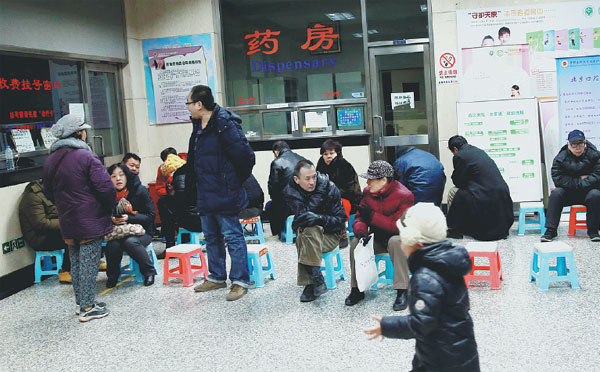
Patients wait in line for the registration windows to open at the Beijing Stomatological Hospital on Wednesday. The windows open at 7 am to sell tickets for treatment, and it is a common practice for people to use stools or other objects to reserve a place in the line. Photos by Zou Hong / China Daily |
"They had been left there to reserve places in the line for appointment tickets, which are sold when the registration desk opens at 7 am. But until 5:30 am, there was not a single person guarding the bottles.
I was outraged, thinking about how disappointed my wife, who was pregnant, would be when she arrived at the hospital at 8 am and I told her I had been unable to get a ticket," the 35-year-old said.
"A ticket to see a senior doctor in the obstetrics department at Peking University hospital costs around 14 yuan ($2) but the scalpers sell them for 300 yuan," he said.
Most hospitals require patients to reserve tickets for routine treatment. Larger hospitals usually operate a platform that allows patients to book online or by telephone, but those tickets usually have to be booked months or at least weeks in advance.
Patients who want to see a senior doctor or require an immediate medical check usually have to buy tickets in person, which encourages scalpers to put chairs or plastic bottles in front of the registration window to reserve places in the line.
Viral video
A video clip that recently attracted widespread public attention on social media showed an unidentified woman at Guang'anmen Hospital, one of China's best-known centers for traditional Chinese medicine, in downtown Beijing.
In the clip, shot by a member of the public on Jan 19, the woman denounced the apparent collusion between hospital security staff and scalpers, saying she had waited in line all day only to be told that the tickets had sold out. She complained that scalpers in the line, who arrived after her, had obtained tickets, and had offered to sell her one for 4,500 yuan, far more than that the original price of 300 yuan.
"This is Beijing. I might be killed on the way home, so I want to say this: this society is hopeless," she yelled, suggesting she might be threatened or worse. She received threatening calls from scalpers when she returned to her home, although she had no idea how they obtained her phone number, and was so shaken that she declined to be interviewed.
A hospital official told the Beijing News that members of staff had colluded with them in the past, and that several security guards had been fired for working with scalpers. However, he claimed that there was no evidence of collusion on the occasion featured in the video clip.
On Jan 26, a reporter for the Beijing Youth Daily made contact with two scalpers at Guang'anmen Hospital and was offered tickets for appointments with senior doctors for 1,500 yuan and 6,000 yuan, depending on the time and date.
When the video clip was uploaded to the Internet and caused uproar, the Beijing Municipal Commission of Health and Family Planning released a statement pledging to maintain the crackdown against scalpers.
"Scalpers seriously disrupt hospital security and are bad influences. We have always adopted a zero-tolerance attitude to scalpers, in particular illegal collusion between scalpers and hospital staff," it said, adding that the commission would overhaul hospital management and improve the online- and telephone-registration platforms, and also cooperate with the police to fight the scalpers.
The video triggered a widespread public outcry, and the police arrested more than 50 scalpers across Beijing - 11 were detained on Jan 30 at three hospitals, including the Air Force General Hospital of the People's Liberation Army, where 32 scalpers were also apprehended on Jan 21. Seven scalpers were also arrested at the Guang'anmen Hospital, where the video clip was shot.
Organized ring
"The scalpers are an organized ring. They place the plastic bottles at midnight, after the hospital security guards have cleared the registration hall, and usually return between 5:30 and 6:00 am. Some of them solicit patients at the main gate of the hospital or the entrance of the registration hall, while other gang members occupy the places they had reserved with plastic bottles and wait for 'clients' to replace them," Wu said.
"They also use websites and apps to attract patients from all over the country. After I spent that cold night at the hospital, I called a number on one of the websites and asked about a hospital ticket for my wife. The man on the other end of the line promised me a ticket for 300 yuan," he said.
According to Wu, the sale of black market tickets is a highly profitable operation.
When contacted by China Daily, a man from a scalping website, who refused to give his name, said he could obtain registration tickets for popular hospitals. He claimed to be able to provide tickets for appointments with a senior surgeon at the Peking Union Medical College Hospital, a top public hospital, for 400 yuan, even though the official price is just 14 yuan. Tickets for consultations with senior specialists cost 900 yuan apiece, he said.
The trade in hospital tickets is not a new phenomenon. As a 2010 report published by mcclatchydc.com, the website of the McClatchy Newspaper Group, explained: "At Peking University First Hospital, a patient can stand in line for hours to buy a 14 yuan ticket, about $2, to see a doctor. Or a patient can pay 200 yuan, almost $30, and see the same doctor without waiting."
In 2013, a report on Central China Television showed that ticket scalping was rampant in Beijing's major hospitals. The report prompted the Ministry of Public Security and the National Health and Family Planning Commission, the country's top medical authority, to pledge a joint clampdown on scalpers.
The problem has also been noted in large hospitals in first-tier cities, such as Shanghai and Hangzhou, the capital of Zhejiang province, according to media reports.
Resources shortfall
Huang Yuguang, a professor of anesthesiology at the Peking Union Medical College Hospital, said the scalping trade is the result of a severe shortage of high-quality medical resources that leaves hospitals unable to cope with the high demand for treatment.
"The distribution of quality medical resources varies greatly in different regions, and between urban and rural areas," he said. "The hospitals that people are really dissatisfied with fall far short of requirements."
The Beijing Municipal Commission of Health and Family Planning, the city's top health authority, said that "Grade A" hospitals, ranked at the top of the three-tier public hospital system, treated 110 million patients in 2014, more than twice the number in 2010, and many of the patients came from other parts of China.
Ni Xin, president of the Beijing Children's Hospital, said patients from outside Beijing outnumber those from the city at some of the capital's larger hospitals. More than 70 percent of patients at the hospital - which has provided clinical services to an average 10,000 people every day in recent years - come from outside Beijing.
According to Huang, the professor, the high demand for services is driving the problem: "The excessive demand has provided business opportunities for scalpers." He added that patients from outside Beijing often find it difficult to obtain registration tickets for popular hospitals, so they buy them from scalpers.
"Police raids only deter scalpers in the short term, but they cannot eliminate them altogether," he said.
In most large hospitals in Beijing and other areas of the country, patients are required to use their ID card to register in person. Many large hospitals also provide online- and telephone-registration services, but an ID number is still required.
A recent report in the Beijing Times said that although "real name" registration is required by many big hospitals, loopholes still exist. For example, the online- and phone-registration platforms are not linked to the Public Security Bureau's ID database, so scalpers simply input a false name and number to obtain a reservation. When the scalper finds a patient willing to buy the ticket, he cancels the original reservation and immediately reserves a new ticket using the buyer's ID.
"Fighting the scalpers requires coordinated efforts by different government departments," Huang said, adding that one solution would be to improve training for doctors at grassroots hospitals to narrow the gap with large hospitals and attract more patients.
In addition, the registration fees at big hospitals should be raised to encourage patients with minor ailments to seek treatment at smaller hospitals, he said.
"Most common illnesses, such as flu, can be treated effectively at smaller hospitals," he said. "But patients with minor ailments still swarm to the big hospitals because there is little difference between the registration fees in big hospitals and smaller ones."
Contact the writers through zhang_yi@chinadaily.com.cn
















