


Innovation shakes up financial industry
Chinese private enterprises have nudged the nation's Internet companies into underserved areas of the economy
Yirendai, a microfinancing company owned by Beijing-based Credit-Ease, completed an initial public offering on Dec 18 on the Nasdaq in New York, raising $75 million in new capital. In its IPO prospectus, the company stated that it had executed 8.8 billion yuan ($1.34 billion; 1.21 billion euros) worth of microfinance lending and borrowing between March 2012 and the end of September 2015.
Yirendai is an example of a new kind of financial company in China, one that focuses on competing with China's state-owned banks to provide savers with better investment returns than they would receive on a bank deposit. These higher returns are possible because Yirendai (and its competitors in China) match savers with individuals and smaller companies who need capital, or simply want to borrow to improve their lifestyle, and whose incomes enable them to pay higher interest rates.
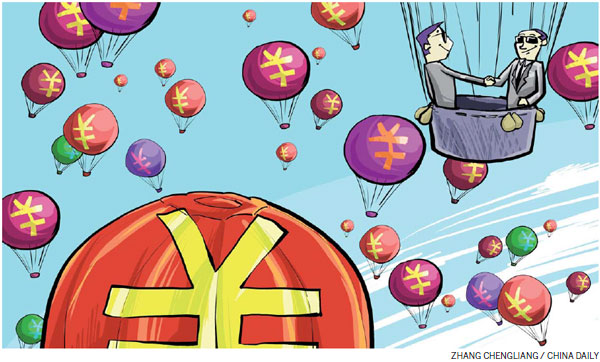
The online matching of a private lender with a private borrower is known as P2P. Private entrepreneurs have led this Chinese P2P revolution, which has found a huge market both with savers seeking better returns and borrowers, who even without banking service are now able to convert their monthly cashflows into credit.
Since 2010, more than 2,000 online P2P platforms have emerged in China to offer a range of wealth-management products. China's banking sector - led by the large, state-owned banks: Industrial and Commercial Bank of China, China Construction Bank, Bank of China and Agricultural Bank of China - have complained that private online lenders should be closed down because the high rates they offer to savers are based on risky lending. They say private lenders can make large profits because they don't have to maintain expensive bank branches.
Are these criticisms justified? Are the new financial companies dangerous for Chinese investors? Does this financial innovation have any significance for the health of the Chinese economy?
In the 1990s, China's banks acted as cash machines for China's state-owned economy. The process to overhaul Chinese banks, which began in the late 1990s, significantly improved their structure and management, but they continued to operate much as they had before: taking deposits from, and making loans to, the state-owned sector.
Because many of their state-owned customers continued to lose money, the big Chinese banks continued to incur losses on their loan books even after restructuring. Effectively, Chinese households are still subsidizing the state-owned sector via the low savings rates offered by the state-owned banking system.
It was left to China's private entrepreneurs to come up with a solution that could satisfy China's army of savers while providing much-needed finance to undercapitalized small companies. The first to do this, in about 2005, were from Wenzhou, a city in East China famous for its entrepreneurs. But when their badly designed savings products ran into trouble, the central government clamped down.
The Wenzhou experience with shadow banking, although not successful, did show there was a huge unmet demand among Chinese households for financial savings products that offered higher rates of return. Local governments - short of funds since a reorganization in 1994 transferred much of their tax revenues to Beijing - saw an opportunity here to balance their books.
They set up trust companies, separate from their ordinary activities, and through them offered wealth management products backed by the local government and administered by a leading Chinese bank, giving the high-yield products the same appearance of security as a bank deposit.
The funds that flowed in from savers who were attracted by the high returns and apparent security on offer were used to meet local government funding gaps, and to invest in projects sponsored by local governments that provided local employment and economic activity, but often little or no economic return. After 2011, the economy slowed. Many of these projects turned sour and many of the trust companies became insolvent.
Since 2013, the Chinese government has intervened to resolve these problems by prohibiting new local government trust companies and encouraging large banks to buy bonds issued by local governments to plug their losses.
The first steps in these financial innovations appeared to bring more bad than good. But P2P platforms like Yirendai, which link small borrowers with small lenders online, provide an important channel for the diversion of China's huge savings pool into economically sound and productive uses. If the borrowers are carefully analyzed, then the P2P services can provide genuine opportunities to savers and can benefit the national economy.
These platforms address the huge Chinese small and medium-sized enterprises market, which generates almost all of China's new jobs and most of its economic growth, but which has remained outside China's financial system because of the focus of banks on large and medium-sized state-owned companies.
The new focus of the Chinese government under President Xi Jinping on market-driven solutions has meant that online P2P platforms are now being encouraged as an important private-led development in China's capital markets.
After the Ministry of Finance sent a team of researchers to investigate how P2P platforms worked and were regulated in London, China's banking regulator published its own set of guidelines for P2P in December. These state that the platforms are not banks and cannot lend their own capital to borrowers.
Instead, they should act only as intermediaries, by providing a convenient online service to match investors with suitable projects. The P2P platforms must not borrow money, and must disclose their aggregate loan information and performance to the public, as well as register with the local financial authorities.
Here, the Chinese government is acting as a referee, not as a business owner, and is leaving the borrowing and lending decisions to the individual customer, as it should. Getting the government out of ownership and into governing is an essential part of the reform, which the Chinese government is pursuing.
E-commerce group Alibaba's leadership of the Chinese online payment market originated from its successful online retail site, Taobao, which accounted for 83 percent of Alibaba's total revenue in 2015.
Although Taobao was set up in 2003 as a competitor to US auction site eBay, it did not start to become a success until six or seven years later, when online payment through Alibaba's Alipay became secure and convenient enough to attract Chinese retail buyers in large numbers.
Starting in 2012, Alipay users were encouraged to deposit funds by the high interest rates on offer. Today, the payment service generates significant profits through its money operations, although these are not available to the public because Alipay became a company privately owned by Chinese nationals in 2011 in order to obtain a business license.
Since 2000, private enterprise has driven the emergence of China's Internet companies into areas of the economy underserved by China's big state companies. These private Chinese companies have produced market-driven financial innovations, like P2P microfinance, which have already disrupted and developed China's financial services market.
Last year, transactions via Chinese P2P platforms totaled $150 billion, while household saving via P2P rose by four times.
In 2013, the Chinese leadership declared that the market would play a decisive role in the economy. It has started to do that. Its impact should spread much wider in order to release Chinese dynamism and growth.
The author is a visiting professor at Guanghua School of Management, Peking University. The views do not necessarily reflect those of China Daily.
















