Kenya looks to China for tea expertise
African nations hope they can use the example of how Chinese tea sector grew strong from organic growth of cottage industries
Collaborating with Chinese investors may be a useful approach to stabilize tea prices and raise earnings for Kenyans who cultivate the crop, say Kenyan officials and experts.
There is a need to strategically expand Kenya's market base and explore various price stabilization models to cushion farmers from low prices, says Elizabeth Kaimenyi, interim director at the Tea Directorate, a department of Kenya's Agriculture, Fisheries and Food Authority.
|
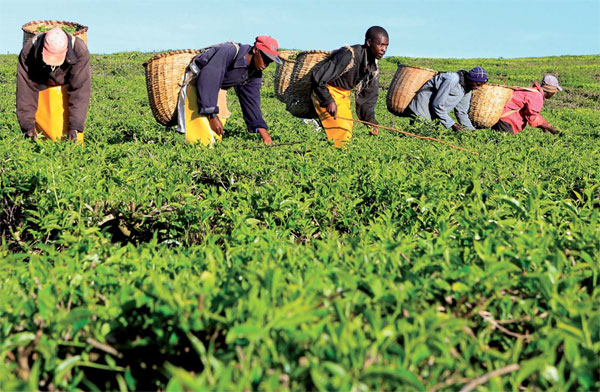
Workers pick tea leaves at a plantation in Nandi Hills, in Kenya's highlands region west of capital Nairobi. Reuters |
"We have been closely collaborating with China on capacity building," she says, adding that the training focuses on specialty manufacturing. "We want to move away from solely selling semiprocessed black CTC tea. China is an advanced market and that is why we are proactive in diversifying," she says. CTC, the crush, tear and curl method, is mainly destined for use in tea bags.
The collaboration, she says, offers a glimpse of expansion opportunities. In particular she mentions the cottage industry that has contributed to the organic growth of the Chinese sector.
"Farmers would be empowered to do their own manufacturing process. When sold in the international market, the end product would be differentiated depending on packaging and unique attributes of the tea," she says.
For a cottage industry in tea to thrive in Kenya, farmers need hand-processing skills that involve wilting, rolling, steaming, pressing and drying to produce hand-crafted, artisan teas for high-priced shops, experts say. That's why Pu'er tea is expensive and highly prized in China.
"Tea value addition will see farmers earn six times more revenue than unpacked tea," says Henry Njeru, the managing director of Njeru Industries, a tea producer.
But Kenya's ambitions to manufacture tea locally is handicapped. "We cannot compete with the likes of Lipton," says Lucy Nyakiore, the marketing and branding manager at the Kenyan Tea Development Agency, a public limited liability company charged with promoting and fostering the development of tea for the small-scale tea growers.
She was referring to Unilever products, a UK-based company that buys 12 percent of global tea, according to a report, Analysis of incentives and disincentives for tea in Kenya, released in July 2013 by the United Nations Food and Agriculture Organization.
Nyakiore says that once exported, a lot of Kenyan tea, known for its excellence, is added to other teas to boost their quality. The quality of Kenyan tea is attributed to its cultivation along the equator and favorable soil, combined with new varieties developed from extensive research, experts say.
"Production costs of Kenyan tea make the product uncompetitive. To even these costs, international buyers blend Kenyan tea with others," Nyakiore says. High energy, labor and transport costs help make Kenyan tea expensive.
She says China has been identified as an emerging export market but challenges exist. First, the market is highly attuned to consuming its own local green tea.
"Most of them complain that Kenyan tea is bitter and highly concentrated," she says. The feedback, from trade fairs attended by the agency, also unearthed a small but growing thirst for Kenyan tea in cosmopolitan cities such as Shanghai, Beijing and Guangzhou.
Taxes levied on Kenyan teas are also high at 15 percent. "We also do not have storage facilities in China, thus limiting our supply to the market," she says. The competitive and advanced nature of China's market, as seen in sophisticated packaging and multiple brands that differentiate tea products, also is challenging.
The local industry was further affected by recent complaints raised by Chinese authorities and private firms of high concentrations of fluoride and rare earths in imported teas. Researchers have found that excessively heavy drinkers of tea can develop skeletal fluorosis, which can be misdiagnosed as arthritis.
Kenya's exports to China had risen over the years to 1.3 million kilograms in 2012. In 2014, it plunged to 935,600 kg following new regulations touching on the fluoride content found in Kenyan leaves, media reports said.
"I think a bilateral agreement can address this situation, together with high import prices," says Njeru. Higher levels of fluoride are found in lower quality, older leaves. He adds that a harmonized standard method would ensure the situation is resolved since such complaints have not been expressed by other governments.
He says Kenyan tea for export meets the food standards set by agencies such as the Kenya Bureau of Standards and has undergone testing by the Kenya Tea Research Institute.
Despite the challenges, Njeru is persisting. Together with Fujian Flamingo, it plans to develop a Chinese-style factory on more than 280 square meters of land in Kenya. "We want to increase our capacity. The growth of our sector hinges on Chinese technologies and market," he says.
This would mean more job opportunities for the residents of Meru. He thinks other local factories could easily replicate his success by acquiring Chinese machines.
"Their machines are competitively priced. Depending on the size, farmers in cooperatives can invest about $300,000 to $600,000 for a machine that can handle about 10,000 kg of green leaves daily. Current factories do 100,000 kg to 300,000 kg of black CTC daily," he says, noting that new technology offers a chance to diversify. In Kenya, most small-scale farmers work in cooperatives that comprise the bulk of the KTDA. Farmers receive low-interest loans that can be used for expansion.
He acknowledges that high electricity costs can be prohibitive to Chinese investors but hopes recent government initiatives to commission coal and geothermal power plants will reduce the costs.
"I believe Chinese investors are willing to enter our market. I also believe Kenyans want to partner with them," he says.
China's influence is expected to add a new dimension to Africa's tea value chain. "It is especially important now since we are keen on agro processing," says Patrick Mathenge, the dean school of agriculture and biotechnology at Karatina University in eastern Kenya.
He believes that replicating the Chinese cottage industry concept will unlock Africa's tea sector. "The reforms won't be easy but worthwhile. Chinese technology will liberate our farmers and put more money in their pockets as they are empowered to manage their businesses in a profitable manner," says the scholar. He proposes the development of special economic zones in tea growing areas to make the sector more attractive.
lucymorangi@chinadaily.com.cn