


Teaching Mandarin to the world
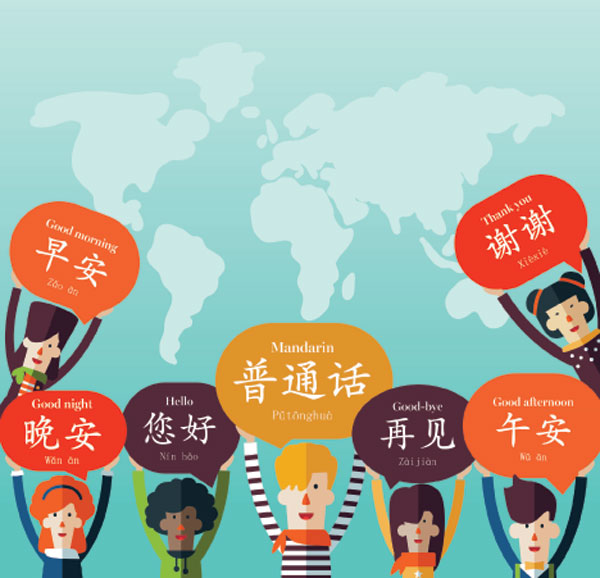
Confucius Institutes take Chinese language and culture to a global audience eager to learn more about the country
The opening lines of The Analects, one of China's most famous historic texts, read: "Is it not a pleasure to study and practice what you learn? Is it not good when friends visit from far-off places?"
More than 2,000 years after they were written, the aphorisms of its author - the Chinese sage Confucius - might well refer to China's rising language centers.
In a mere 12 years, Confucius Institutes have opened on 500 campuses and are now teaching Chinese language and culture to almost 2 million people.
The first institute opened its doors in Seoul in 2004. By the following year there were 33 in operation. Today there are more than 500, spread across more than 134 countries and on every continent apart from Antarctica.
One of the reasons for the institutes' current popularity, says Chu Hung-lam, director of Hong Kong's own Confucius Institute, is that China is genuinely interested in getting people to learn firsthand about its unique - often misunderstood - culture.
"China wants to tell and show herself and be understood," explains Chu, who is also head of the Chinese culture department at Hong Kong Polytechnic University.
China is not alone when it comes to expanding cultural soft power. For years, countries have used their cultural cachet as a way to push their national tongue as a second language.
Among such respected cultural institutions are the likes of the British Council, the Japan Foundation, Germany's Goethe-Institut and France's Alliance Francaise.
The success of the Confucius Institutes did not happen overnight. Julia Gong, senior associate director of the Confucius Institute at The University of Melbourne, recalls that she only had four students when she started her first class in 2007. Today the institute is running at least three classes every weekday and has enrolled 976 students this year.
Gong says: "Our institute runs a fee-paying program, about the same price or slightly higher than commercial schools."
Unlike commercial schools, however, the institute's students can apply for scholarships and study at a Chinese university of their choice thanks to the center's ties with colleges in China.
As well as offering Chinese courses to the general public, the institute provides tailored language classes to a range of would-be Mandarin speakers, including undergraduates and university staff, businesspeople and government officials.
"With the increase in communication between Australia and China, in particular with the signing of the Free Trade Agreement between the two countries (in 2015), there has been more interest in learning Mandarin," Gong says.
With more Chinese travelers going to Australia, demand for language lessons in the tourism industry has grown too.
The Chinese economy is driving global interest in Mandarin, placing the Confucius Institute network in an enviable position. Thanks to China's economic clout and expanding diplomatic links with the 60-plus countries included in the Belt and Road Initiative, there is little work needed to promote the language.
Xu Tao, director of international cooperation and exchanges at the Ministry of Education, says: "We help people in countries along the Belt and Road learn Chinese, and these countries help us learn their languages."
Institutes in countries including Cambodia, Pakistan and Bangladesh have shown particular interest in blending language skills with future Belt and Road projects
However, the reality is that the majority of Confucius Institutes are currently located in only a handful of countries. More than 100, for instance, are in the United States, and more than two dozen in the United Kingdom.
It is unlikely that China's economic power, on its own, can maintain a deep, widespread interest in learning a second language, says Molly Huang, who teaches Mandarin in South China's Guangdong province and Hong Kong. Instead, she says that first and foremost, language is entwined with culture.
Gong, of Melbourne's Confucius Institute agrees, stressing that the teaching of language and culture cannot be separated.
In Hong Kong, where Mandarin is already taught in schools, the emphasis is more on cultural elements than language.
"Rather than offering language courses like most other Confucius Institutes," says Chu of Hong Kong's Confucius Institute, "we leverage our unique environment and the strength of the Polytechnic University to provide high-level cultural events."
The Confucius Institutes' growing influence at foreign universities has not been without controversy, however. They have been accused of being opaque, too political, or sometimes even not political enough.
"Since they bring funding, trained teachers, organized programs, and textbooks, (Confucius Institutes) have been welcomed with open arms by some university administrators," says Robert Bauer, an honorary professor of Chinese linguistics at the University of Hong Kong.
"At the same time, however, I am aware that awkward situations have arisen over political issues at some schools, and their Confucius Institutes were asked to close and leave."
Institutes have suffered such a fate in countries including Canada, Sweden and the US.
In other cases, the institutes simply have not got off the ground. In Japan, none of the elite public universities have agreed to allow a Confucius Institute on campus - though almost a dozen private colleges have done so.
Despite hiccups, Hanban has a clear plan for its institutes. By 2020, it aims to have more than 1,000 worldwide.
"I believe more Confucius Institutes will be established all over the world in the years to come - if China can keep its economic strength and economic impact overseas," says Chu.
"What I would love to see is some of the traditional Chinese values that have enabled China to survive for so long being appreciated by more people in the world, in and outside China."
















