


A dish full of history
Editor's note: To understand China, sit down to eat. Food is the indestructible bond that holds the whole social fabric together and it is also one of the last strong bonds of community and culture.
It is a dish full of history, and there are about as many myths and legends attached to it as there are ingredients in the recipe. Unlike many Chinese classics for the dinner table, this one has no fancy title.
It is simply known as pencai, or "dish in a basin". The name reflects the presentation. Layers of food are stacked on top of one another in a large serving pot or basin.
To find out why, we need to hark back to its origins.
|
The layerings of meat and vegetables provide a delicate harmony of taste and texture. Photos by Chuai Meitu / For China Daily |
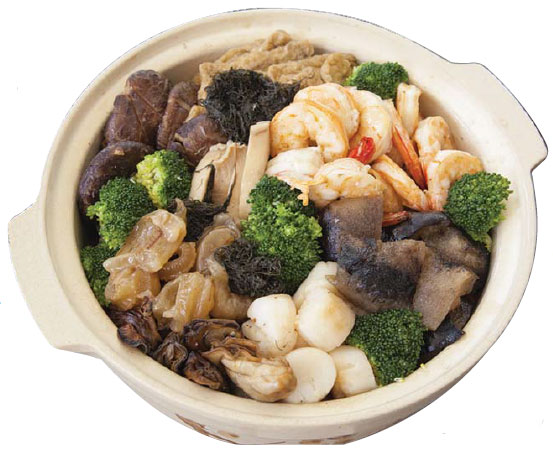
Many versions of how this dish came about are floating around the wild blue yonder of the internet, but the elements are largely the same as the story my mother told me when I first tasted pencai in Hong Kong decades ago.
The story involved a fugitive king or general washed up on the shores of either Shenzhen or Hong Kong - cold, hungry and in need of the kindness of strangers. The strangers were variously fishermen or village folk, depending on which version of the story one prefers.
Out of sympathy and respect, the common folk brought out the best ingredients they had in their homes and cooked for their down-and-out visitor. They were so poor they didn't have enough spare crockery for guests, so the food was served from a wooden basin.
One thing everyone agreed on was the Hakka element. The Hakka are the "guest people" - emigrants from the Central Plains who settled in the coastal provinces of the south, notably Fujian and Guangdong.
In Hong Kong they built villages surrounded by low enclosures called weicun, or walled villages. In neighboring Shenzhen, they formed fishing communities and also settled in the hills of nearby Meizhou. There is historical evidence that the royal refugee would most likely have been hosted by a Hakka community.
The Hakka are famous to this day for their pencai, which is eaten on festive occasions such as birthdays, weddings and on the eve of the lunar new year, during the reunion dinner.
It is a masterpiece of cooking skill and frugality, with expert layering of ingredients that sound contradictory but actually provide a delicate harmony of taste and texture.
At the very bottom of the large basin is a layer of braised radish, a root vegetable that withstands long cooking and readily absorbs the juices of meat and seafood.
On top of the radish is usually braised pork belly, its rich fat leaching down to nourish the radishes. The pork may be topped with fried tofu or gluten balls, which again soak up the fatty meat juices and act as a soft barrier for the next layer.
Roast duck or steamed chicken on top of the tofu or gluten adds distinctive flavor and texture - especially duck, whose fat lends a special fragrance to the dish.
The next layer, again vegetables, is likely to be thick slices of yam or taro, chosen for the ability to complement meat.
The layering will go on, alternating meat, seafood and vegetables until the chef runs out of imagination and ingredients. Generally, the best ingredients are displayed on the very top, and some pencai may even see the luxurious addition of dried scallops, whole abalones or sea cucumber.
Other ingredients used may include dried oysters, prawns, fish maw, crab, fish cakes or meatballs. In fact, the pencai may be assembled from very economical items, not just expensive, exclusive treats.
Pencai is popular in Huaiyang cuisine as well, a cooking style that is quickly gaining popularity in China for its lighter, natural flavors. It has traveled far from its Yangzhou-Huai'an roots and is now often served at state banquets, including dinners served at the Great Hall of the People.
A senior colleague from Yangzhou says the Huaiyang version of pencai also has the characteristic layerings of meat and vegetables. What makes it different is that it will have two very Huaiyang ingredients - danjiao and fish meatballs.
Danjiao are dumplings made with an egg skin. Beaten egg is poured into a heated ladle and swirled until slightly set. A spoonful of filling is added and the dumpling is quickly folded over. The dumplings are laid out in rows in the pencai to fully cook.
Fish meatballs are equally laborious to make. The filleted meat of the freshest fish is scraped and minced and beaten together until it forms a light, white cloud.
With a dexterous squeeze and twist, a meatball is formed and dropped into boiling water. The finished meatballs are then added to the pencai. Huaiyang cuisine only uses sea cucumber to top the dish, and skips the abalone.
The dish has also been duplicated in the north, where it's known as quanjiafu, or "family reunion". However, the ingredients may be more rough-and-ready, and it may lose some of its southern finesse. The romance of the dish seems to fade as it travels.
paulined@chinadaily.com.cn
A popular dish for Spring Festival reunions
A new culinary phenomenon that has surfaced in recent years is the hotel hamper for Spring Festival. In many ways, it is like the traditional Christmas hamper, minus the turkey or ham.
It also reflects the changing lifestyle of many urban Chinese.
A series of family meals is a traditional part of the festivities, starting with the reunion dinner on New Year's Eve. The first day of the Chinese New Year sees another gathering of family and friends, and the feasting may go on for a week.
While in the past a battalion of mothers, aunts and sisters would be churning out dishes from the kitchen, it is getting increasingly likely that food may be ordered in.
This is where the hotel hampers come in, with their gifts of cakes, buns and a large ready-to-heat pot of pencai, an ideal dish for such occasions,
All you need to do is to reheat the pot on a low fire and wait until the ingredients are again warm and bubbling. Cooking time is minimal because the dish has been prepared in advance.
And its ready mix of seafood, meat and vegetables is a luxurious and impressive treat for all.
















