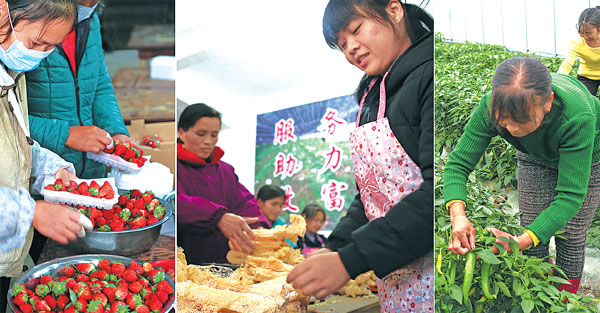
What villagers' rise from poverty looks like
In communities of Jinggangshan, residents learn to create sustainable path to prosperity
Jinggangshan, with its remote, hilly location near the border of Jiangxi and Hunan provinces, was an ideal home in the 1920s for the Communist Party of China and the Red Army - both young at the time.
Now, the area has officially said goodbye to poverty, a major milestone it reached on Sunday, along the country's path toward eradicating poverty by 2020.
The cultural heritage left by the revolutionary era has catalyzed a booming travel industry and led some to a well-off life. The GDP of the city in 2015 was 5.7 billion yuan ($830 million).
Still, the demanding natural conditions dampened some other mountain dwellers' hopes of catching up with China's pace of modernization.
One example illustrates the situation: Although the city has built a road network and a 6-kilometer-long tunnel through a mountain, a drive of more than an hour is still required to reach Shenshan village, one of the most remote communities from downtown.
"When I first visited the village, the road here was a headache. It was all dirt," said Hu Yanxia, 34, who met her husband, Zuo Xiangyun, a villager from Shenshan, in 2002.
They married in 2003. On their wedding day, Zuo carried Hu on his back during the walk home because the pavement ended at the entrance to the village. The car carrying them could go no farther.
To survive in these mountains, full of bamboo and threaded with unpaved back roads, Zuo, grandchild of a Red Army soldier from the revolutionary era, took over the small bamboo business of his father.
The raw materials didn't produce much profit, so Zuo turned to processing the bamboo into various craft pieces - small items like pen holders and slingshots - for greater benefits.
He even purchased a set of laser inscribers and a computer to help customize the pen holders, adding Chinese characters and portraits, as requested by customers.
In February last year, President Xi Jinping paid a visit to Shenshan and visited Zuo's house. Zuo presented Xi items he had made out of bamboo.
Later, Zuo started a restaurant serving local dishes to visitors. His income began to grow.
"Now, my family has around 70,000 yuan a year," he said.
Zuo told China Daily he plans to build a bigger bamboo pavilion to host more customers, and he's thinking about more promotion of local wine packaged in bamboo tubes that he can make himself.
Taking a long view
Zuo is one of the 55.6 million people in China who have risen out of poverty since 2013.
In the 31 years from 1981 to 2012, the country cut 72 percent of the world's poor population, according to the China Poverty Alleviation and Development Report for 2016.
Looking back on China's efforts over the decades, Pakistan's Ambassador to China, Masood Khalid, told China Daily: "It is a miracle to lift almost 700 million people out of poverty."
On his visit to Zuo's village last year, Xi told the residents that "no one should be missed" as the country breaks away from poverty, and he underlined the need to "remove poverty with targeted measures".
At a group study session of the CPC Central Committee's Political Bureau earlier this month, Xi urged reinforced awareness and preparedness for eradicating poverty.
As the regions and residents still in poverty are mostly undeveloped and financially weak, Xi warned that "difficulties of poverty relief will increase in the next few years."
For places like Jinggangshan, whose financial burden is smaller than other areas with little development, the top mission is to build a sustainable poverty-alleviation process and to avoid a return to the grim old days, local officials said.
At a news conference of the Jiangxi provincial government on Sunday, Jinggangshan was officially taken off the list of impoverished areas. The poverty rate has dropped from 13.8 percent at the start of 2014 to 1.6 percent today, meeting the national standard for removal.
Liu Hong, Party chief of Jinggangshan, said the ultimate goal is not removing the city from the list, but leading the local people to a better life. The city will focus on achieving sustained income, spiritual support and taking steps "to make the effects stable and long lasting", Liu said.
To ensure fair, efficient identification of households in need, Jinggangshan sorts out those who have no capability of making a living, according to Huang Changhui, deputy chief of the city's office in charge of poverty relief and migration.
The city has them registered on a regular basis and publishes a list of those receiving governmental assistance for public supervision.
Also, the city offers a fund of 10,000 yuan to each of its more than 1,000 households, and it created a nonprofit investment company with the money after obtaining consent from households.
The company invests in local leading companies and earns an annual interest yield of no less than 15 percent for the households, Huang said.
"The four companies we have invested in return an interest of 12 percent, and even more, and the municipal treasury will make up for any shortfall," Huang said.
Targeting bureaucracy
Transparency is a high priority. Visitors to poor households that receive assistance from local governments in Jinggangshan may find a placard, hanging high on a wall, stating the name, title and cellphone number of the local official providing assistance.
According to Liu, the Party chief, it's part of the city's effort to ensure full coverage of all the households in need, as well as public supervision of the officials.
"At least one official is assigned to help a poor family, and all of the 3,000-plus officials or Party members in Jinggangshan take part in poverty-relief activities," Liu said.
"They visit the households one by one, thinking and deliberating alongside the villagers on the deep-seated root causes of poverty there in order to find the viable solutions."
Also, Liu said that the city selects those talents who are experts at finding business opportunities, farming and gardening, and introduces them to the poverty relief teams.
Training during winter and spring is offered to batches of Party members to brief them on the latest policies and production techniques.
Xie Ganghua, a local farmer, stopped working as a migrant worker away from his hometown and returned to Jinggangshan's Xincheng township.
He started planting vegetables - such as peppers - in greenhouses in July. He credits his techniques to technicians introduced by the local government.
"The seeds are also provided by the local government," Xie said. "Although I work longer hours now every day, I can also take care of my family."
He is now running seven greenhouses, with a tight schedule and heavy workload every day. "I get up at 5:30 am and arrive at the greenhouses at 6:30," he said.
Then he sends freshly harvested vegetables to market in the nearby township and sells them before he returns and finishes his greenhouse work at 5:30 pm.
"The greenhouses need to be attended on daily basis. If the temperature runs high, I open them. If it is too cold, I keep them closed," Xie said.
And making money is not easy. Each of the greenhouses makes a profit of 2,000 yuan every six months, he said.
Looking ahead
Two major factors that throw families back into poverty are medical fees resulting from major illnesses and the cost of higher education, according local officials and residents.
The family of Xiao Fumin, 63, a local farmer, suffered a huge financial blow when it shouldered the daunting cost of treatment for his daughter's toxemia.
"She needs dialysis twice a week, and the medical insurance covers 10,000 yuan each year," Xiao said.
Now the burden is being eased as his family runs a restaurant that is supported by his village.
Bashang village, which once hosted the Red Army, now hosts tourists and groups of officials from all parts of the country for training and studies. The visitors are sometimes introduced to households like Xiao's.
Huang Chengzhong, Party chief of Shenshan village, said that a lasting financial capability in tackling poverty partly stems from the increasing strength of the village's collective economy, which means businesses run by cooperatives of residents, Huang said.
The village-run businesses include tourism, as well as the planting and processing of tea, bamboo and yellow peaches.
"As long as the village-run collective economy is strong enough, those financially challenged households will be helped by the village," Huang said.
Another problem is the widespread ignorance of the disparity between rural and urban areas, particularly the gap in the access to skills and technologies.
When tourists flock into inns and restaurants located in Zuo Xiangyun's village, many express amazement at the great changes happening there.
Some say they believe that the local villagers' rise to well-off status is easy to see because visitors come to honor the revolution's hometown, which brings a steady flow of cash.
However, recalling his experience of learning the technique of getting the laser machine and software to run for inscribing bamboo penholders, Zuo said achieving success has its frustrations.
Some of those from whom he sought help didn't want to share their techniques, while some others were not quite proficient enough to get the equipment running as expected.
"So I needed five or six teachers before I fully mastered the technique," Zuo said.
Another awkward fact is that although Zuo got broadband internet service installed in his house several years ago, he has not yet enjoyed Wi-Fi.
It was simply because no one informed him that he could replace the cable router with an updated one with wireless functions.
As a result, he uses GPRS, or 4G, signals to surf the Web and receive payments via WeChat, resulting in a monthly telecommunication cost of around 100 yuan.
zhangyunbi@chinadaily.com.cn
|
Left: Workers package strawberries at a local production base in Nashan township in Jinggangshan, Jiangxi province. Center: Villagers in Jinggangshan package bamboo fungus for online orders. The packages will be shipped by China Post. Right: Farmers harvest peppers at a greenhouse in Xincheng township. Photos By Huang Zeyuan / China Daily |