


China on brink of quantum computing
As a 'baby' device is born, experts point to its historic significance; meanwhile, researchers are following multiple development path
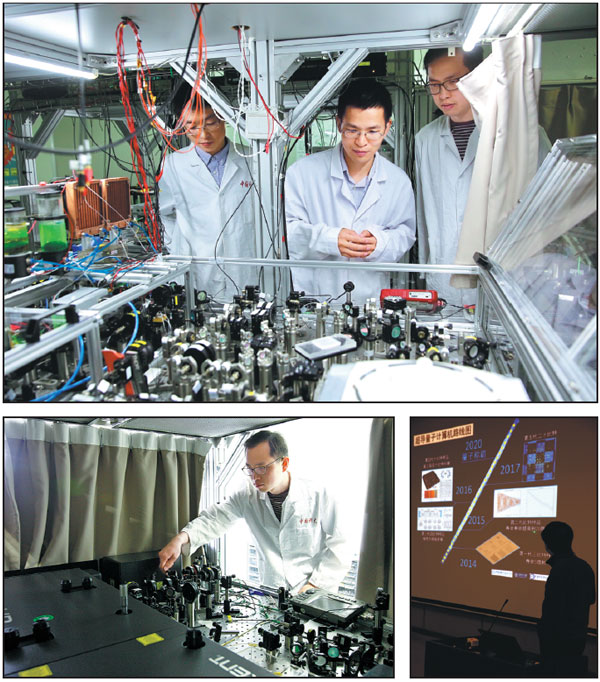
On a table of 3 square meters are dozens of lenses and odd devices, with wires suspended above and a machine chirping ceaselessly.
It is a prototype quantum computer developed by about 20 Chinese scientists at the Shanghai-based Institute for Quantum Information and Quantum Technology Innovation of the Chinese Academy of Sciences.
The "baby" quantum computer, unveiled in early May, is the first quantum computing machine based on single photons that could go beyond the early classic, or conventional, computer.
|
The 'baby' quantum computer, unveiled in early May, is the first quantum computing machine based on single photons that could go beyond early classical, or conventional, computers. Xinhua / China Daily |
The principle of quantum computing is based on one of the strangest phenomena in quantum physics: quantum entanglement. It occurs when particles in pairs or groups interact and are influenced by each other, even when they are a great distance apart.
Scientists say quantum computing enables ultrafast parallel calculation and simulation capabilities. In normal silicon computer chips, data is rendered in one of two states: 0 or 1. In quantum computers, data can exist in both states simultaneously, holding vastly more information.
The computing power of a quantum computer grows exponentially with the number of quantum bits that can be manipulated. This could effectively solve large-scale computation problems that are beyond the ability of current classical computers, scientists say.
Lu Chaoyang, a 34-year-old professor at the University of Science and Technology of China and one of the developers of the prototype quantum computer, is nicknamed "the photon wizard".
"You can't find two identical leaves in the world, but we can make two identical photons," says Lu. "With identical photons, we can produce quantum interference and entanglement."
The identical photons are produced by a device called a single photon source. The chirping machine is a refrigerator that keeps the single photon source at a temperature of -269 C.
"As a result of technological breakthroughs in 2013, our single photon source is the world's best, as 99.5 percent of the photons it produces are identical. It is 10 times more efficient than its counterparts abroad," Lu says.
"Using the former technology, the photons were like twins playing in mud - you could distinguish them by the droplets of mud on their bodies. But our technological innovation makes photons into clean, indistinguishable twins."
Since the "baby" quantum computer was born, it has done just one thing: play a "game" called Boson sampling, which was designed to enable a quantum computer to compete with a classical computer.
"We can manipulate five entangled photons so the machine defeats the early classical computer," says Lu. In fact, he and his colleagues set a world record at the end of last year by manipulating 10 entangled photons.
They aim to realize manipulation of 20 entangled photons by the end of this year.
"Although the 'baby' quantum computer can not even beat the mobile phone in your hand, it's a milestone. The first electronic computer in human history, which is so big that it filled several rooms, is worthless today, but it is of great scientific significance. We have to develop step by step from science to technology and then to application," Lu says.
"When the car was first invented, it was unreliable and uncomfortable compared with the carriage. But cars eventually surpassed carriages as a result of technological progress."
Lu's tutor, Pan Jianwei, a CAS academician and a leading quantum physicist, has spent more than two decades researching the manipulation of microscopic particles.
"At first, our road was very hard, but now our progress is faster and accelerating. It heralds the coming of a key period in the development of quantum computing. This is like bamboo shoots popping up after the rain," Pan says.
Because of the enormous potential of quantum computing, Europe and the United States are actively collaborating in their research. High-tech companies such as Google, Microsoft and IBM also have massive interest in quantum computing research.
The photon-based system is just one of the means by which scientists are trying to achieve quantum computing.
Zhu Xiaobo, a professor at the University of Science and Technology of China who is researching superconducting quantum computing, says there are at least seven or eight different technical routes. Several Chinese research teams are on different roads.
"Nobody knows which route could eventually lead to a quantum computer of practical value. Maybe all roads lead to Rome. Maybe there will be different kinds of quantum computers to solve different problems. There is another possibility that a dark horse from an unknown road reaches the goal first," Zhu says.
The research team led by Pan is exploring three technical routes: systems based on single photons, ultracold atoms and superconducting circuits.
Although his team has an advantage in a photon-based system, Pan says a system based on ultracold atoms might be the first of practical value.
In addition, the superconducting system, with its integration and coherence, cannot be ignored, says Pan. High-tech companies such as Google and IBM have made large investments in this field.
He estimates that Chinese scientists could realize manipulation of around 50 quantum bits to construct a superconducting quantum computer that could exceed the most powerful supercomputer by 2020.
In another lab of the Institute for Quantum Information and Quantum Technology Innovation, a superconducting quantum computer is under incubation.
Unlike the photon quantum computer displaying all its "organs" on the table, the superconducting quantum computer "baby" hides its key parts in a big cylinder more than a meter tall. The cylinder keeps the superconducting quantum chip at a temperature of -273.13 C.
Zhu Xiaobo, one of its main developers, and his colleagues have broken a record set by the research team from Google, NASA and the University of California at Santa Barbara, who achieved high-precision manipulation of nine superconducting quantum bits in 2015. The Chinese team independently developed a superconducting quantum circuit containing 10 superconducting quantum bits.
Zhu says the most difficult thing is to increase the control accuracy of the chip.
Although the team developed the chip, Zhu says the system cannot be called a superconducting quantum computer. "A quantum computer is totally new. Many top scientists are uncertain how a quantum computer will work."
He says he hopes to build a prototype superconducting quantum computer with 10 quantum bits by the end of this year.
Pan believes Chinese scientists can realize manipulation of 100 quantum bits within 10 years, which means the capacity of one quantum computer would be a million times the total capacity of all the computers currently in use.
He predicts there will be tens of thousands or millions of quantum computers in the world.
" I don't need one at home, as it's very difficult to make my mobile phone or laptop extremely cold. But I can use cloud technology to send tasks to the quantum cloud platform," he says.
"We don't need a quantum computer to do what traditional computers can do well. We need it to solve problems that are difficult for traditional computers, such as code cracking, weather forecasting and pharmaceutical design. Quantum computing will also push the development of artificial intelligence," Pan says.
"We still don't know if quantum computers will enter common use. Maybe future quantum computers will be totally different from what we imagine today."
Xinhua
















