<tt id="6hsgl"><pre id="6hsgl"><pre id="6hsgl"></pre></pre></tt>
          <nav id="6hsgl"><th id="6hsgl"></th></nav>
          国产免费网站看v片元遮挡,一亚洲一区二区中文字幕,波多野结衣一区二区免费视频,天天色综网,久久综合给合久久狠狠狠,男人的天堂av一二三区,午夜福利看片在线观看,亚洲中文字幕在线无码一区二区
          您現在的位置: > Language Tips > Easy English > Today in History  


          March 1
          [ 2007-03-01 08:47 ]

          The first hydrogen bomb was detonated in the Pacific in 1952
          1954: US tests massive hydrogen bomb in Bikini

          England have

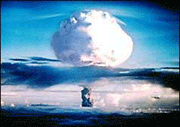
          The US has produced the biggest ever man-made explosion so far in the Pacific archipelago of Bikini, part of the Marshall Islands.

          It is believed the hydrogen bomb was up to 1,000 times more powerful than the atomic bomb that destroyed Hiroshima.

          It was so violent that it overwhelmed the measuring instruments, indicating that the bomb was much more powerful than scientists had anticipated.

          The bomb was the equivalent of 20m tons of TNT.

          One of the atolls has been totally vaporised, disappearing into a gigantic mushroom cloud that spread at least 100 miles wide and dropping back to the sea in the form of radioactive fall-out.

          The Atomic Energy Commission announced this was the first in a series of tests to be carried out in the area.

          Tests first began in Bikini in 1946 after the natives were moved to the island of Rongerik, then to Ujelan a year later and to Kili on 1949.

          This is the second H-bomb test in the area.

          A 10.4 megaton bomb was exploded on 1 November 1952 at Enewatak, west of Bikini.

          It destroyed one island and left a crater 175 feet deep.

          It was hundreds of times more powerful than that used over Hiroshima.

          Unlike that device which tapped energy by splitting atomic nuclei, the Enewetak weapon forced together nuclei of hydrogen to unleash an even greater destructive force.

          Klaus Fuchs was a devoted Communist

          1950: Communist spy jailed for 14 years

          Artificially 1969:
          The A top nuclear scientist has been jailed for fourteen years at the Old Bailey for spying for the Soviet Union.

          Klaus Emil Julius Fuchs, 38, a civil servant from Harwell in Berkshire, pleaded guilty to four offences under the Official Secrets Act.

          German-born Fuchs, who fled his home country to escape Nazi persecution in 1933, had come to be regarded as one of Britain's top atomic scientists.

          But beneath the facade was a committed Communist who had been passing secrets to the Russians for most of the past decade.

          He was convicted on four counts of disclosing atom secrets "calculated to be directly or indirectly useful to an enemy" - in England in 1943 and 1947 and in the United States in 1944 and 1945.

          The Attorney General, Sir Hartley Shawcross KC, who opened the case for the prosecution, said Fuchs had undoubtedly passed information to the Soviets on many more than four occasions even though he was on trial for four specific offences.

          His motivation, said Mr Shawcross, was his "unswerving devotion to Communism".

          Fuchs, who until his arrest last month was employed as senior principal scientific officer at the Harwell Atomic Research Establishment, arrived in Britain from Germany, via France, in 1933.

          When France was invaded by the Germans in 1940, Fuchs was interned and deported to Canada.

          He was released in 1942 and was head-hunted by Birmingham University to carry out atomic research.

          It was at this stage he made contact with the Soviets and began regularly passing information relating to atomic energy, the court was told.


          Between 1944 and 1946 he worked in the American Atomic Research department in Los Alamos, New Mexico, where he was involved in the construction of the first atomic bomb.

          The court was told that it was information from the Americans which first led British detectives to suspect Fuchs of espionage .

          Defending, Mr Derek Curtis-Bennett, KC, said it was at about this time that his client had started "having doubts about the Russian policy" and began to "see the light".

          He added the first three offences had in fact been committed when Russia was an ally of Britain and therefore information passed could not have been regarded as prejudicial to the interests of the state.

          Passing sentence, Lord Chief Justice Lord Goddard said: "You have betrayed the hospitality and protection given to you by this country with the grossest treachery."

          Vocabulary:
           

          archipelago: a group of many islands in a large body of water(群島)

          espionage : the systematic use of spies to get military or political secrets(間諜;偵探)


          相關文章 Related Stories


          48小時內最熱門


          本頻道最新推薦

               
            Have you seen my big banana?
            文胸的起源
            我們的身體價值多少?
            新年春節英文短信
            為健康飲酒?(通訊員稿)

          論壇熱貼

               
            糾錯語料庫:品牌意識
            請大家幫助找錯 - 幫專家糾錯
            What does 'the French Connection' mean?
            don’t hesitate to be a stranger
            (歡迎大家積極參與)每日一句
            HIP-HOP AND SPOKEN WORD POETRY


          主站蜘蛛池模板: 精品成人免费自拍视频| 色欲国产精品一区成人精品| av在线播放日韩亚洲欧我不卡| 国产免费人成网站在线播放 | 久久婷婷大香萑太香蕉av人| 国产区成人精品视频| 欧美日韩一区二区三区视频播放| 亚洲综合无码中文字幕第2页| 久久一区二区中文字幕| 最近2019年日本中文字幕免费| 亚洲精品一区二区三区蜜臀| 精品亚洲AⅤ无码午夜在线| 人妻另类 专区 欧美 制服| 亚洲综合久久一区二区三区| 最新国产精品精品视频| 免费国产一区二区不卡| 少妇做爰免费视频网站| 色偷偷中文在线天堂中文| 国产成人亚洲综合无码精品| 人妻一本久道久久综合鬼色| 免费特黄夫妻生活片| 国产视频一区二区在线看| 亚洲日韩在线中文字幕第一页| 免费无码又爽又刺激网站直播| 亚洲成av人片乱码色午夜| 亚洲综合av永久无码精品一区二区| 国产精品久久福利新婚之夜| 在线观看无码av免费不卡网站| 国产资源精品中文字幕| 99爱视频精品免视看| 日本高清视频网站www| 国产精品人成在线观看免费| 在线观看精品日本一区二| 人妻无码手机在线中文| 国产日韩av一区二区在线| 精品人妻少妇一区二区三区在线 | 久久精品无码一区二区小草 | 好爽毛片一区二区三区四| 亚洲不卡av中文在线| 亚洲人妻中文字幕一区| 精品国产成人国产在线视|