June 1
[ 2007-06-07 08:00 ]
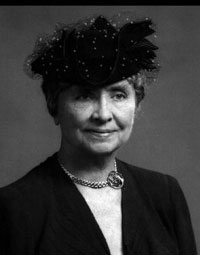
June 1, 1968: Helen
Keller dies
 On June 1, 1968, Helen Keller dies in Westport, Connecticut, at the age
of 87. Blind and deaf from infancy, Keller circumvented her disabilities to
become a world-renowned writer and lecturer. On June 1, 1968, Helen Keller dies in Westport, Connecticut, at the age
of 87. Blind and deaf from infancy, Keller circumvented her disabilities to
become a world-renowned writer and lecturer.
Helen Adams Keller was born on June 27, 1880, on a farm near Tuscumbia,
Alabama. A normal infant, she was stricken with an illness at 19 months,
probably scarlet fever, which left her blind and deaf. For the next four years,
she lived at home, a mute and unruly child. Special education for the blind and
deaf was just beginning at the time, and it was not until after Helen's sixth
birthday that her parents had her examined by an eye physician interested in the
blind. He referred the Kellers to Alexander Graham Bell, the inventor of the
telephone and a pioneer in teaching speech to the deaf. Bell examined Helen and
arranged to have a teacher sent for her from the Perkins Institution for the
Blind in Boston.
The teacher, 20-year-old Anne Sullivan, was partially blind. At Perkins, she
had been instructed how to teach a blind and deaf student to communicate using a
hand alphabet signaled by touch into the student's palm. Sullivan arrived in
Tuscumbia in March 1887 and immediately set about teaching this form of sign
language to Helen. Although she had no knowledge of written language and only
the haziest recollection of spoken language, Helen learned her first word within
days: "water." Keller later described the experience: "I knew then that
'w-a-t-e-r' meant the wonderful cool something that was flowing over my hand.
That living word awakened my soul, gave it light, hope, joy, set it free."
 Under Sullivan's dedicated guidance, Keller learned at a staggering
rate. By April, her vocabulary was growing by more than a dozen words a day, and
in May she began to read and arrange sentences using raised words on cardboard.
By the end of the month, she was reading complete stories. One year later, the
seven-year-old Keller made her first visit to the Perkins Institution, where she
learned to read Braille. She spent several winters there and in 1890 was taught
to speak by Sarah Fuller of the Horace Mann School for the Deaf. Keller learned
to imitate the position of Fuller's lips and tongue in speech, and how to
lip-read by placing her fingers on the lips and throat of the speaker. In
speaking, she usually required an interpreter, such as Sullivan, who was
familiar with her sounds and could translate. Under Sullivan's dedicated guidance, Keller learned at a staggering
rate. By April, her vocabulary was growing by more than a dozen words a day, and
in May she began to read and arrange sentences using raised words on cardboard.
By the end of the month, she was reading complete stories. One year later, the
seven-year-old Keller made her first visit to the Perkins Institution, where she
learned to read Braille. She spent several winters there and in 1890 was taught
to speak by Sarah Fuller of the Horace Mann School for the Deaf. Keller learned
to imitate the position of Fuller's lips and tongue in speech, and how to
lip-read by placing her fingers on the lips and throat of the speaker. In
speaking, she usually required an interpreter, such as Sullivan, who was
familiar with her sounds and could translate.
When she was 14, Keller entered the Wright-Humason School for the Deaf in New
York City. Two years later, with Sullivan at her side and spelling into her
hand, she enrolled at the Cambridge School for Young Ladies in Massachusetts. In
1900, she was accepted into Radcliffe, a prestigious women's college in
Cambridge with classes taught by Harvard University faculty. She was a
determined and brilliant student, and while still at Radcliffe her first
autobiography, The Story of My Life, was published serially in The Ladies Home
Journal and then as a book. In 1904, she graduated cum laude from Radcliffe.
Keller became an accomplished writer, publishing, among other books, The
World I Live In (1908), Out of the Dark (1913), My Religion (1927), Helen
Keller's Journal (1938), and Teacher (1955). In 1913, she began lecturing, with
the aid of an interpreter, primarily on behalf of the American Foundation for
the Blind. Her lecture tours took her several times around the world, and she
did much to remove the stigmas and ignorance surrounding sight and hearing
disorders, which historically had often resulted in the committal of the blind
and deaf to asylums. Helen Keller was also outspoken in other areas and
supported socialism all her life. For her work on behalf of the blind and the
deaf, she was widely honored and in 1964 was awarded the Presidential Medal of
Freedom, the nation's highest civilian honor, by President Lyndon B. Johnson.
"My life has been happy because I have had wonderful friends and plenty of
interesting work to do," Helen Keller once wrote, adding, "I seldom think about
my limitations, and they never make me sad. Perhaps there is just a touch of
yearning at times, but it is vague, like a breeze among flowers. The wind
passes, and the flowers are content." |