June 6
[ 2007-06-07 08:00 ]
June 6, 1984: Indian army
storms Sikh's golden temple
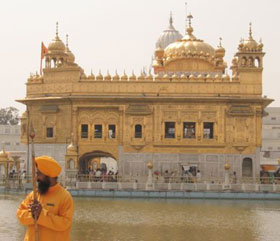 |
| The Golden Temple or Darbar Sahib, situated in
Amritsar, Punjab, is the most sacred temple for
Sikhs. | In a bloody climax to two years of
fighting between the Indian government and Sikh separatists, Indian army troops
fight their way into the besieged Golden Temple compound in Amritsar--the
holiest shrine of Sikhism--and kill at least 500 Sikh rebels. More than 100
Indian soldiers and scores of nonbelligerent Sikhs also perished in the
ferocious gun and artillery battle, which was launched in the early morning
hours of June 6. The army also attacked Sikh guerrillas besieged in three dozen
other temples and religious shrines throughout the state of Punjab. Indian
officials hailed the operation as a success and said it "broke the back" of the
Sikh terrorist movement.
The Sikh religion, which was founded in the late 15th century by Guru Nanak,
combines elements of Hinduism and Islam, the two major religions of India. The
religion is centered on the Indian state of Punjab in northern India, where
Sikhs comprise a majority and speak Punjabi. In the 1970s, agricultural advances
made Punjab one of India's most prosperous states, and Sikh leaders began
calling for greater autonomy from the central government. This movement was
largely peaceful until 1982, when the Sikh fundamentalist Jarnail Singh
Bhindranwale and his followers launched a separatist campaign in Punjab.
Employing terrorism and assassination, Bhindranwale and his guerrillas killed
scores of political opponents and Hindu civilians in the name of establishing an
autonomous Sikh Khalistan, or "Land of the Pure." Most Sikhs did not support
Bhindranwale's violent campaign, in which the extremists also assassinated
several Sikhs who spoke out against the creation of Khalistan.
 |
| The Golden Temple | To
appease the Sikhs, Indian Prime Minister Indira Gandhi nominated Zail Singh to
be the first Sikh president of India in 1982, a significant choice because the
Sikhs comprise a small percentage of India's overall population. Most Sikhs
distrusted Singh, however, because as Indian head of state he generally
supported Gandhi's policies. Meanwhile, the separatists occupied the Golden
Temple and other Sikh holy sites and turned them into armed bases.
The Golden Temple, known as the Harimandir in India, was built in 1604 by
Guru Arjun. It was destroyed several times by Afghan invaders and rebuilt in the
early 19th century in marble and copper overlaid with gold foil. The temple
occupies a small island in the center of a pool. There are a number of other
important buildings in the 72-acre temple compound, including the Akal Takht,
which is the repository for Sikhism's Holy Book of scriptures and the
headquarters of the religion.
To suppress the separatist revolt, which had claimed more than 400 Hindu and
Sikh lives and virtually shut down Punjab, Prime Minister Gandhi ordered Indian
troops to seize control of the Sikh bases by force in June 1984. On June 1, army
troops surrounded the Golden Temple and exchanged gunfire with the rebels, who
were heavily armed and commanded by a high-ranking army defector. The Sikhs
refused to surrender, and in the early morning of June 6 army forces launched an
assault on the temple compound. By daylight, the Sikhs were defeated.
Jarnail Singh Bhindranwale, the rebel leader, perished in the attack,
allegedly by his own hand. The Indian government announced that 492 Sikh
militants were killed, but the Sikhs put the number at more than 1,000. More
than 100 army troops were killed and several hundred wounded. More than 1,500
Sikhs were arrested in the operation. The Golden Temple itself suffered only
minor damage, but the Akal Takht, a scene of heavy fighting, was heavily
damaged.
In the aftermath of the bloody confrontation, Sikhs rioted across India, and
more people were killed. Some 1,000 Sikh soldiers in the Indian army mutinied,
but these defectors were suppressed, and rebel leaders still at large were
captured or killed. On October 31, in a dramatic act of retaliation, Indira
Gandhi was shot to death in her garden by two Sikh members of her own bodyguard.
This act only led to further violence, and thousands of Sikhs were massacred by
angry Hindus in Delhi before Gandhi's son and successor, Rajiv Gandhi, called
out the army to end the orgy of violence. Punjab's political status remained a
divisive issue in India, and disorder and violence persisted in the state until
the early 1990s.
|