 |
 |

當(dāng)前位置: Language Tips> VOA聽力> Special Speed News VOA慢速
This is AS IT IS.
Welcome back. I’m Caty Weaver. Today on the show the subject is HIV/AIDS.
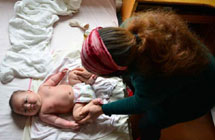
In recent years, developing countries have increased the availability of medical treatment for adults infected with HIV, the virus that causes AIDS. But the United Nations AIDS organization UNAIDS says it is still difficult to get treatment for children in such countries. It warns that most children who are not treated will die by their fifth birthday.
Christopher Cruise reports on one group that is working to end pediatric AIDS.
The Elizabeth Glaser Pediatric AIDS Foundation says progress is being made in preventing new HIV infections in children. It says there has been a 24 percent reduction in new cases since 2009. Much of that drop has resulted from providing antiretroviral drugs to more pregnant women infected with the virus.
But officials say much more needs to be done. Mary Pat Kiefer is the foundation’s director for technical leadership.
“We still have way too many children being infected and just in sub-Saharan Africa last year there were 300,000 kids with new infections. That’s way too many.”
Estimates show that in 2009, only 28 percent of children who needed HIV treatment received it. Mary Pat Kiefer says part of the problem is tied to health care systems in Africa. She says some are not able to link children of HIV positive women to the right services.
“I would say overall that we’re able to identify maybe 50 percent of those HIV exposed kids and test them. And we still have problems making sure we have everything in a place and can provide the services to kids.”
Treating a child with the human immunodeficiency virus is complex. Children are not just given a smaller amount of the medicines adults take. The drugs must be specially prepared for a child’s body.
Ms. Kiefer says treating a baby can be especially difficult. She says as the number of infected infants goes down, drug companies have less cause to develop new medicines for children. The development of new drugs is costly. The return on the investment may be small.
But Mary Pat Kiefer says drugs alone will not solve the problem. She says more attention must go to mother and child health care and improving healthcare systems. She says money for healthcare workers, equipment and supplies.
I’m Christopher Cruise.
A big health crisis in Uganda is the rising rate of HIV infections among married people. The main reason for the increase is cheating, when a married man or woman has sex with someone other than their wife or husband. As Mario Ritter reports, the subject is often too politically or culturally sensitive to discuss.
The face of Uganda’s battle against AIDS is changing. In the 1990s the country brought down its infection rate sharply through the ABC campaign. ABC stood for abstinence -- voluntarily doing without sex --- being faithful and condom use. The government urged people against sexual relationships with more than one person. It suggested the safest place for sex was within a secure, committed relationship.
But now HIV infection rates are climbing among Ugandans who are married. Results of a study last year showed that more than 40 percent of new HIV infections are among husbands and wives.
Sandra Kyagaba works with the National Community of Women Living with HIV/AIDS. She says more than half of the women who seek help from her group are married.
“Most of them when they come, they will share with you and say, ‘I contracted HIV from my husband, I was really faithful.’ That means the husband was not faithful. It’s really very common here.”
Recently, the issue of cheating was publicized in the capital, Kampala. An American-based group, AIDS Healthcare Foundation, put up a big sign. It read “Cheating? Use a condom. Cheated on? Get tested.”
Omonigho Ufomata is with the AIDS Healthcare Foundation. She says her group is willing to speak directly if it will help people protect themselves and their partners.
“We’re taking a pragmatic and practical approach saying that people stray outside of relationships. It’s not about judgment, it’s not about trying to change that behavior or criticize it but simple that people protect themselves and protect their partners.”
But the sign angered many Ugandans who saw it as condoning, or pardoning, infidelity. The government ordered the AIDS Healthcare Foundation to take it down. Uganda’s official AIDS Commission told the media that the AFH was spreading the wrong message.
The billboard has been removed. But a number of activists say the message was simply realistic. They argue infidelity is a part of Ugandan culture and must be considered in efforts to slow infection rates.
HIV infection rates are rising in the country for the first time in 20 years. Most Ugandans agree a change is necessary. But, what change to make and how? Activists and the government, so far, fail to agree.
I’m Mario Ritter.
About forty-million people around the world are infected with HIV, the virus that causes AIDS. Most of them live in African countries south of the Sahara Desert.
In South Africa, 17 percent of adults are infected. Last year, the country began broadcasting a television show about people with HIV and AIDS.
The drama “Intersexions” was created by John Hopkins Health and Education in South Africa. Every week the series follows as HIV is passed from sexual partner to sexual partner.
Harriet Gavshon is a producer of the hit show.
“The original concept of ‘Intersexions’ was to try and explain to young people the idea of a sexual network. The idea that once you sleep with somebody, you’re entering into a huge network of millions of people you don’t know, so you should protect yourself.”
“Intersexions” is like many television dramas. It tells stories of love, sex, secrets and lies. But, there is a difference.
“Each week, we jump into a new milieu, from the city to the rural areas, to the prisons, to a club…Somewhere along the twenty-six episodes you will come across someone just like yourself.”
One third of South African women between 20 and 25 years old are infected with the virus. Research shows risky sexual behavior is the main reason for the spread.
Lusanda Mahlasela from Johns Hopkins says say “Intersexions” shows the dangers of such behavior without disrespecting its audience.
“It becomes a fine line between trying to convey the message and making sure you’re not being judgmental and moralizing.”
The show has a strong presence on social media, where people like to discuss each episode.
Last year, “Intersexions” received a Peabody Award, one of the highest media honors in the world.
And that’s AS IT IS for today. I’m Caty Weaver.
相關(guān)閱讀
Thanks to volunteers, elderly can age in place
Automakers capitalizing on Chinese appetite for larger, luxury cars
(來源:VOA 編輯:Julie)

添加Chinadaily_Mobile
你想看的我們這兒都有!

中國首份雙語手機(jī)報(bào)
學(xué)英語看資訊一個(gè)都不能少!
關(guān)注和訂閱


關(guān)于我們 | 聯(lián)系方式 | 招聘信息

電話:8610-84883645
傳真:8610-84883500
Email: languagetips@chinadaily.com.cn