Also: A project to make electronic maps of soil in Africa. And, one kind of insect shows its skill at tricking another.
VOICE ONE:
This is SCIENCE IN THE NEWS in VOA Special English. I'm Bob Doughty.
VOICE TWO:
And I'm Faith Lapidus. This week, we will tell about one explanation for many trees dying in the western United States. We will tell about a project to make electronic maps of soil in Africa. And, we tell how one kind of caterpillar can trick another insect.
(MUSIC)
VOICE ONE:
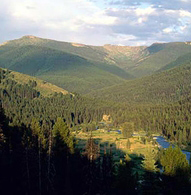
Scientists have found that trees are dying at an increasing rate in the western United States. The scientists say they believe the tree deaths were partly a result of warmer and drier weather conditions linked to climate change.
A team of 11 researchers reported their findings last month in Science magazine. The researchers work for the United States Geological Survey, the Forest Service and several universities.
They studied trees in 76 long-term forests in 6 American states and the Canadian province of British Columbia. The 30-year study is said to be the largest ever investigation of North America's old growth forests.
VOICE TWO:
The researchers say they were concerned by the findings. The trees they observed were dying two times as fast as trees were 30 years ago. Additionally, the increased death rate was higher than the rate of new tree growth.
The findings are similar to those of other recent observations and studies, including one involving bark beetles. That study blamed the insect for the destruction of more than one million hectares of pine forest.
VOICE ONE:
The new study found increasing death rates of several kinds of forests, like pine, fir and hemlock. The higher rates were observed among trees of different ages and sizes.
The elevation of the forests was not considered important. Trees high in the mountains were dying at about the same rate as those closer to sea level.
The researchers investigated other possible causes of the tree deaths like insects, fires and air pollution. They also look at issues like operations to clear forests, and increasing competition among trees. Yet the researchers say none of these are as likely to blame for the tree deaths as climate change.
VOICE TWO:
Nathan Stephenson was a lead writer of the report. He says temperatures have increased in the areas where forests are found. Since the 1970s, temperatures have increased almost half a degree Celsius in each 10-year period.
Mister Stephenson says summers are becoming longer and hotter in the western United States. This makes trees weaker and decreases their ability to survive insect attacks and forest fires.
The researchers say the long-term effects of the increased death rates are hard to predict. However, they say, there could be fewer forests in the future.
VOICE ONE:
Forests are important to the environment because they take in carbon dioxide and release another gas -- oxygen. This process removes carbon from the atmosphere. However, carbon is released when trees die or burn. If trees take in less carbon dioxide, scientists say, it could increase the effects of climate change.
Some researchers say new measures may be needed to keep the forests alive. Mister Stephenson says one of the best answers is to reduce the amount of pollution that people produce.
(MUSIC)
VOICE TWO:
Poor soil keeps many farmers in Africa from growing good crops. Low soil fertility has slowed agricultural production in parts of the continent for years. The United Nations says that 1/3 of the people south of the Sahara Desert suffer from hunger.
But a newly announced project promises help for the situation. A not-for-profit agency is working toward developing soil maps and making them available on the Internet. The agency is called the International Center for Tropical Agriculture. It plans to describe the soil in 42 nations insub-Saharan Africa.
VOICE ONE:
When the project is completed, farmers will be able to get information that will help them decide what to plant and how to care for their land. In the past, it often has been hard to get complete information about soil conditions. Maps for the purpose exist. But they are in paper form and often not widely available.
The Tropical Soil Biology and Fertility Institute in Kenya will supervise the project. Institute director Nteranya Sanginga says supervision, or management, of soil in sub-Saharan Africa must improve. He said the improvements are needed if the area is to reduce poverty and feed growing populations. He said the improvements also are needed to fight the effects of climate change.
VOICE TWO:
Researchers from the African Soil Information Service will study earth samples and rate them. The researchers will also use satellite technology to create images showing the nutrients and wetness of the samples. The images also will show the amount of organic material in the soil.
The researchers also will study chemical and physical qualities of the soil with a method called infrared spectroscopy. The method can quickly judge the soil's ability to hold water and take-in nutrients. Project information manager Peter Okoth says a majority of farmers may have the information on-line in three years.
The Bill and Melinda Gates Foundation and the Alliance for a Green Revolution in Africa have given eighteen million dollars to collect the information. The money will be provided over four years. Project partners include the Earth Institute at Columbia University in the United States.
(MUSIC)
VOICE ONE:
Have you ever wondered what it would be like to be treated like an important leader? A European butterfly species has found a way to make that wish come true.
Insect experts say ants communicate mainly through touch and chemical signaling. But scientists now believe that the leader of an ant community, the queen ant, makes sounds that set her apart from other ants. Because of the sounds, worker ants feed and protect the queen ant.
VOICE TWO:
The scientists say they found that one kind of caterpillar has ways to reproduce a sound that the worker ants think is their queen. The caterpillars grow to become Maculinea rebeli, also known as the Rebel's Large Blue butterfly.
The caterpillars also release chemicals that trick the ants into bringing them to their communities, or colonies. Once inside, the caterpillars make the sounds of the queen ant. The ants feed and care for them during a period when they are inactive. After 11 to 12 months, the caterpillars form pupae and become butterflies.
VOICE ONE:
New electronic technology made it possible for the scientists to record the queen and worker ant sounds. The sound the caterpillar makes was also recorded. When played back to the worker ants, they reacted the same way to the caterpillar sounds as they did to the queen ant sounds. They gathered around a device making the sounds and did not move for hours.
The queen ant and the caterpillar sound very different to the human ear. However, scientists say similarities in what they called resonant frequency were found through sound tests.
VOICE TWO:
An international team of researchers carried out the study. The researchers come from Britain's Centre for Ecology and Hydrology, the University of Oxford and Italy's University of Turin. The findings were reported last month in Science magazine.
Jeremy Thomas is a professor at the University of Oxford. He found that ants will rescue a caterpillar they believe to be the queen when their ant colony is threatened.
His research showed the worker ants would do this before protecting their young. The ants have even been observed using ant larvae to feed a caterpillar when food supplies are low.
VOICE ONE:
Francesca Barbero from the University of Turin was the lead writer of the report. She says the findings show that sounds are more important in the communication between ants than scientists had thought.
The Rebel's Large Blue butterfly has become endangered because of changes to its environment. Currently, it is only found in grassy areas within the mountains of Europe.
The scientists believe their findings will help in designing new methods to protect the endangered insects. Scientists are also interested in discovering whether other species have developed ways to use a similar kind of trickery to survive.
(MUSIC)
VOICE TWO:
This SCIENCE IN THE NEWS program was written by Jerilyn Watson and Brianna Blake, who was also our producer. I'm Faith Lapidus.
VOICE ONE:
And I'm Bob Doughty. Read and listen to our programs at voaspecialenglish.com. Join us again next week for more news about science in Special English on the Voice of America.