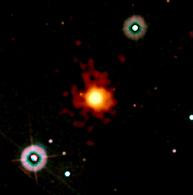
Astronomers have discovered evidence of the oldest and most distant cosmic event ever detected, a burst from a dying star that occurred 13 billion years ago, very soon after the birth of the universe. Scientists hope the discovery of the ancient explosion will bring new insights into the evolution of the cosmos.
Astronomers say the high-energy gamma-ray burst from the dying star occurred 630 million years after the so-called Big Bang that is believed to have created the universe nearly 14 billion years ago.
The discovery suggests the so-called Dark Age of the universe, the period after the Big Bang before first-generation stars could fill the cosmos with light, ended much earlier than previously thought. Prior to the discovery, the earliest stellar explosion on record occurred 200 million years later and involved a star much closer to Earth.
Nial Tanvir of the University of Leicester in England headed one of two teams of scientists that discovered the gamma ray blast marking the death of the star.
Tanvir says the explosion of the dying star, or supernova, takes astronomers farther back in time than they have ever been. "... which really is the sort of era, the one last era, that is left undiscovered in cosmology. We have sort of mapped out the Universe to very great distances. And we are now sort of probing into the last era that we really have no observational clue as to what it was like then," he said.
Tanvir says the discovery gives scientists a place in the sky to direct the earth-orbiting Hubble Space Telescope to look for other clues about the ancient Universe. "We think that if we look deeply enough, we will see a little galaxy there, a galaxy that hosted the star which exploded. Now we know exactly where to look. If we can go, for instance, as we are planning to do with the Hubble Space Telescope, and have a long hard stare at that patch of sky, then we may reveal that galaxy, and therefore learn something about the very early galaxies," he said.
Dan Frail at the National Radio Astronomy Observatory in New Mexico is part of a team analyzing the waves of light given off by the star following its explosion, light that has taken more than 13 billion years to reach the Earth. Their observations may reveal what chemicals and compounds were dispersed during the Big Bang.
Until now, Frail says astronomers have presumed these ancient supernovae were brighter, hotter and more massive than the explosion of later generation of stars. "And the next explosions that we study at these distances will tell us more about how the first generations of stars and first galaxies were formed. How the metals that make up the stars today got formed, how the light of the Universe got distributed. So, we have a lot to learn from studying these things; studying more examples of these objects," he said.
Two articles describing the discovery of the most distant cosmic object are published this week in the journal Nature.
gamma-ray burst: a short-lived, localized, and intense burst of gamma radiation that originates outside the solar system from an unknown source 伽馬暴
supernova: a rare celestial phenomenon involving the explosion of most of the material in a star, resulting in an extremely bright, short-lived object that emits vast amounts of energy 超新星
Related stories:
研究:35億年后金星可能撞地球
Widespread water found on surface of moon
宇宙驚現'上帝之眼'
Astronomers discover life-giving molecule
(Source: VOA 英語點津編輯)





