
中國網(wǎng)站品牌欄目(頻道)

Welcome to THE MAKING OF A NATION – American history in VOA Special English.
In 1880, President Rutherford Hayes completed four successful years in the White House. He did not want to serve another term. Hayes was a Republican. His party had great hopes of electing another Republican in the election of 1880.
This week in our series, Kay Gallant and Harry Monroe report on that election.
KAY GALLANT: Many Republicans wanted to nominate former President Ulysses Grant. Grant had been out of office four years. People seemed to have forgotten the political problems that shook his administration.
Other Republicans supported the powerful party leader, Senator James Blaine. A third candidate was John Sherman, the Secretary of the Treasury.
The Republicans had great difficulty choosing among Grant, Blaine and Sherman. At their national convention, Republican delegates voted again and again. None of the three men received a majority.
HARRY MONROE: The delegates voted ten times, 20 times, 30y times. Finally, on the 34th ballot, 17 of the delegates voted for a compromise candidate. He was James Garfield, a Republican leader in Congress. Soon, both Sherman and Blaine asked all of their delegates to vote for Garfield. The compromise candidate won the nomination.
James Garfield offered the vice presidential nomination to Chester Arthur of New York. Arthur's honesty had been questioned when President Hayes removed him as Collector of Taxes for the port of New York. But a powerful party leader there supported him. So delegates gave Arthur the vice presidential nomination to strengthen party unity.
KAY GALLANT: The Democratic Party chose for its presidential candidate a hero of the Civil War -- General Winfield Scott Hancock of Pennsylvania.
The election campaign of 1880 was not exciting. Democrats charged that Republicans were dishonest. Republicans charged that a Democrat in the White House would make the south too powerful. Many people at that time still hated the south for starting the Civil War. They wanted to keep southern states weak.
Nine million people voted in the election. James Garfield won. He got only ten thousand more popular votes than Winfield Scott Hancock. But he got a majority of votes in the electoral college. Garfield won 214 electoral votes. Hancock got 155.
HARRY MONROE: The new president was 49 years old. He had served in the House of Representatives for 17 years. He had been a teacher, a college president, and a general in the Union army during the Civil War.
James Garfield became president of the United States on March 4th, 1881. His choices for a cabinet immediately re-opened the conflicts that had appeared during the party convention.
KAY GALLANT: The Republican Party had two powerful leaders. One was Senator Roscoe Conkling. The other was Senator James Blaine. Garfield won Blaine's support by naming him Secretary of State. He lost Conkling's support by refusing to name one of Conkling's supporters Secretary of the Treasury.
Garfield denied he had promised anything to Conkling. Then he made Conkling even angrier by appointing one of Conkling's political enemies Collector of Taxes for the port of New York. That was the most important federal job in Conkling's home state.
Conkling refused to accept the appointment. He began a struggle in the Senate to block it.
HARRY MONROE: Conkling charged that President Garfield had failed to observe the policy of "Senatorial Courtesy." Traditionally, the president does not fill federal jobs in a state until he discusses them with the senators from that state. This long-time policy gave senators firm control over local federal jobs. They were quick to attack any changes in the method.
But many senators were angry at Conkling. They did not like the way he gave orders to everyone. They did not like the way he threatened his opponents. They did not want to support him on this issue.
KAY GALLANT: After several weeks, it became clear that the Senate would approve President Garfield's choice for the tax collector's job. Conkling decided to resign in protest. He would ask the New York legislature to show its support by electing him again to the Senate.
Before this could happen, something very unexpected took place. It happened in the train station in Washington, D.C., on July 2nd, 1881. A man ran up to President Garfield, pulled out a gun, and fired twice. One bullet cut Garfield's arm. The other went into his back.
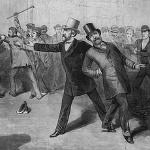
HARRY MONROE: The assassin was Charles Guiteau. When he fired the gun, he shouted that he supported Roscoe Conkling's political machine.
Charles Guiteau was insane. He believed God had ordered him to kill the president. But the words he shouted caused many people to wonder if others might be involved. After all, the vice president -- Chester Arthur -- supported Roscoe Conkling, too. If James Garfield died, Chester Arthur would become president.
History has provided no evidence that Roscoe Conkling, Chester Arthur, or any other political leader had a part in the shooting. Guiteau is believed to have acted on his own. Yet the situation did cause a great deal of tension while the nation waited to see if Garfield would survive.
KAY GALLANT: The president was carried to the White House. A doctor tried to remove the bullet from his back. He could not find it. Days passed. The president's condition changed from day to day. Doctors pushed their instruments into the wound as they continued to look for the bullet. The wound became infected. Garfield grew worse. Then he grew better. He asked to be taken to the sea shore.
Two months later, the doctors warned the Cabinet and Vice President Arthur that Garfield was dying. The end finally came on September 19th, 1881.

The president's body was taken back to Washington. Memorial services were held there. And then the body was taken to his home state of Ohio for burial.
HARRY MONROE: Not until after Garfield's death did doctors find the bullet that killed him. It lay only a few centimeters from the wound. Tissue had grown around it. The bullet itself would not have killed the president. What killed him was the effort made by doctors to find the bullet. Their instruments had spread infection throughout his body.
James Garfield had been president for six months. He was the second American President to be assassinated. The first -- Abraham Lincoln -- had been shot just 16 years before.
KAY GALLANT: The man who shot James Garfield -- Charles Guiteau -- was tried by a court in Washington. He was found guilty of murder. Like those found guilty of plotting to kill Abraham Lincoln, he was hanged.
Vice President Chester Arthur was in New York when he received news of President Garfield's death. He quickly sent for a judge to give him the oath of office as President. Arthur was in his early 50s. He would serve one term as leader of the United States.
That will be our story next week.
(MUSIC)
SHIRLEY GRIFFITH: Our program was written by Frank Beardsley. The narrators were Kay Gallant and Harry Monroe. Transcripts, MP3s and podcasts of our programs are online, along with historical images, at voaspecialenglish.com. Join us again next week for THE MAKING OF A NATION - an American history series in VOA Special English.
American history: settlers rush to claim western land
American history: Custer's last stand against the Indians
American history series: Indian wars
American history: songs cowboys sung
American history: gold, land drive settlers West
President Hayes promises only one term in office
Hayes wins hotly disputed 1876 election
Grant’s second term worse than first
American history series: Grant's political battles
American history series: the election of 1868
American history series: rebuilding the South
American history series: Trial of Andrew Johnson
Andrew Johnson faces a fight over aiding South
American history series: the final surrender
American history series: after Lincoln's murder
President Lincoln is shot at Ford's Theater
American history series: Robert E. Lee's surrender
American history series: Confederate capital falls
Lincoln defeats McClellan in 1864 election
Sherman burns Atlanta in March to the Sea
American history series: the battle of cold harbor
Victory at Vicksburg splits the Confederacy
American history series: Lincoln at Gettysburg
South sees protests in North as an opening
American history series: Lee and his army cross into the North
The South wins a battle, but loses Stonewall Jackson
American history series: at Bull Run, a terrible defeat for the North
American history series: South defends its capital
American history series: the Civil War at sea
Lincoln names a general to defend Washington
American history series: the North loses the first major battle of the war
American history series: the Civil War's first days
(來源:VOA 編輯:陳丹妮)
 |
 |
 |
 |
 |
 |