
中國網站品牌欄目(頻道)
|
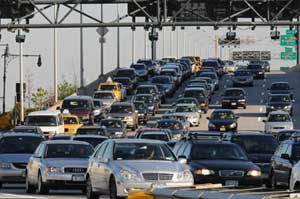 This is New York but, according to a new study, drivers in Beijing and Mexico City experience the world's worst traffic. |
IBM, which has developed new technology for predicting traffic flow, has identified the cities with the worst commutes in the world and other cities that are successfully easing the congestion.
Slowdown
The IBM Commuter Pain Study surveyed 8,000 commuters in 20 cities, from Moscow to New Delhi and Los Angeles to Johannesburg. They were asked how long their daily commute was. IBM's Naveen Lamba says researchers also wanted to know how being stuck in traffic affected their state of mind.
"Is it causing you stress?" he says. "Does that cause you anger? How is that affecting your performance at school or at work? Have you ever just given up on your trip and gone back home?"
Lamba says about one-third of the surveyed commuters reported increased stress, increased anger, and traffic so bad in the last three years that they turned around and went home. Commuters also complained about other drivers' rude and aggressive behavior when traffic started to slow or stop.
And where was commuting pain the worst?
"The worst traffic in the cities we looked at was in Beijing and Mexico City," says Lamba. "Johannesburg in South Africa was pretty close to them as well."
Getting moving
Those cities and others around the world, he says, can learn from the top-ranked city on the list: Stockholm, Sweden.
Lamba says officials there have introduced special programs to reduce traffic problems.
"One example of what they have done is what they call a Congestion Management Program where everybody driving into the central city pays a congestion fee and the idea there is to discourage people from driving, but take public transportation instead," he explains. "So what this program has done is the amount of traffic is gone down by 20 to 25 percent. So, even more people switch over to public transportation. And then in terms of providing good information to travelers as to what different travel choices based on real time conditions on the roads. There are another set of solutions deployed from that perspective also."
IBM's top-ranked US city is Houston - a sprawling metropolis on the Gulf Coast of Texas.
"I'm pleased that we're making some progress towards mitigating the levels of traffic congestion in our region," Alan Clark is the region's director of Transportation Planning.
He says fighting traffic congestion is an on-going challenge because this urban area continues to attract more jobs and more people.
"For example, the number of hours that we consider to be congested has grown gradually over time," he says. "Now we have what we would call rush hour conditions or peak travel conditions for as much as eight hours during the day - about three to four hours in the morning and similar time in the evening."
High cost of traffic
Clark sees traffic congestion as one of the most serious problems of our time - for a variety of reasons.
"It's estimated that the average commuter in our region, congestion costs that person in excess of $1000 per year in lost time," he says. "It also adds to our problem of air pollution. The time that we spend in congested conditions significantly adds to the amount of fuel cars and trucks are burning. And that in turn leads to additional emissions of harmful pollutants and our area is very concerned about improving air quality as one of the key ways to make our communities even better places to live and work."
To ease traffic congestion, Clark says, Houston transportation officials created special safety programs to reduce the number of accidents, which tie up traffic. They also encourage people to work from home on a regular basis and use mass transit when they do commute. That's why they support a website created by private businesses called NuRide.
"At the NuRide web site, we encourage those who are looking to share a ride to be able to register for carpooling, vanpooling, and other kinds of activities or to investigate the use of transit," he explains. "On that web site, we give the participants points. They can be redeemed for discounts at restaurants, for coupons at grocery stores, those sorts of things."
The long term solution to the traffic congestion problem, Clark says, is not building more roads, but changing the way we design our cities and how we live our lives.
"I think there are many communities that have done an excellent job developing or redeveloping their communities to permit new economic growth that does not generate as much additional vehicle traffic," he says. "These ideas are probably better seen in some European communities where they have a long tradition of trying to preserve their historical development identity and had, in the past, much more orientation to walking and the use of transit. In the United States, it's newer because, for example, Houston - being a relatively new city - really was developed around the automobile."
Transportation planning expert Alan Clark says traffic congestion is a complex problem whose solution calls for a comprehensive approach.
And since it's a global problem, he adds, it will always be helpful for cities around the world to exchange ideas and experiences to benefit from each other's innovative solutions.
sprawling: spreading in an untidy way(蔓延的;雜亂無序伸展的)
(來源:VOA 編輯:陳丹妮)
 |
 |
 |
 |
 |
 |