|
 Click here for more words about the Spring Festival Click here for more words about the Spring Festival
Chinese New Year starts with the
New Moon(新月)on the first day of the new year and ends on the
full moon(滿月)15 days later. The 15th day of the new year is called the
Lantern Festival(元宵節), which is celebrated at night with lantern displays and children carrying lanterns in a parade.
The Chinese calendar is based on a combination of lunar and solar movements. The
lunar cycle(月運周期)is about 29.5 days. In order to "catch up" with the solar calendar the Chinese insert an extra month once every few years (seven years out of a 19-yearcycle). This is the same as adding an extra day on
leap year(閏年). This is why, according to the solar calendar, the Chinese New Year falls on a different date each year.
New Year's Eve and New Year's Day are celebrated as a family affair, a time of reunion and thanksgiving. The celebration was traditionally highlighted with a religious ceremony given in honor of
Heaven and Earth(萬物), the gods of the household and the family ancestors.
The sacrifice to the ancestors, the most vital of all the
rituals(儀式), united the living members with those who had passed away. Departed relatives are remembered with great respect because they were responsible for laying the foundations for the fortune and glory of the family.
The presence of the ancestors is acknowledged on New Year's Eve with a dinner arranged for them at the family banquet table. The spirits of the ancestors, together with the living, celebrate the onset of the New Year as one great community. The communal feast called "surrounding the stove" or weilu. It symbolizes family unity and honors the past and present generations.
 The Origin of Chinese New Year The Origin of Chinese New Year
The Chinese New Year is now popularly known as the Spring Festival because it starts from the Begining of Spring (the first of the twenty-four terms in coodination with the changes of Nature). Its origin is too old to be traced. Several explanations are hanging around. All agree, however, that the word Nian, which in modern Chinese solely means "year", was originally the name of a monster beast that started to prey on people the night before the beginning of a new year.
One legend goes that the beast Nian had a very big mouth that would swallow a great many people with one bite. People were very scared. One day, an old man came to their rescue, offering to subdue Nian. To Nian he said, "I hear say that you are very capable, but can you swallow the other beasts of prey on earth instead of people who are by no means of your worthy opponents?" So, it did swallow many of the beasts of prey on earth that also harrassed people and their domestic animals from time to time.
After that, the old man disappeared riding the beast Nian. He turned out to be an immortal god. Now that Nian is gone and other beasts of prey are also scared into forests, people begin to enjoy their peaceful life. Before the old man left, he had told people to put up red paper decorations on their windows and doors at each year's end to scare away Nian in case it sneaked back again, because red is the color the beast feared the most.
From then on, the tradition of observing the conquest of Nian is carried on from generation to generation. The term "Guo Nian", which may mean "Survive the Nian" becomes today "Celebrate the (New) Year" as the word "guo" in Chinese having both the meaning of "pass-over" and "observe". The custom of putting up red paper and firing fire-crackers to scare away Nian should it have a chance to run loose is still around. However, people today have long forgotten why they are doing all this, except that they feel the color and the sound add to the excitement of the celebration.
Traditional New Year Foods
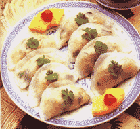 Probably more food is consumed during the New Year celebrations than any other time of the year. Vast amounts of traditional food is prepared for family and friends, as well as those close to us who have died. Probably more food is consumed during the New Year celebrations than any other time of the year. Vast amounts of traditional food is prepared for family and friends, as well as those close to us who have died.
On New Year's Day, the Chinese family will eat a vegetarian dish called jai. Although the various ingredients in jai are root vegetables or fibrous vegetables, many people attribute various superstitious aspects to them.
Other foods include a whole fish, to represent togetherness and abundance, and a chicken for prosperity. The chicken must be presented with a head, tail and feet to symbolize completeness. Noodles should be uncut, as they represent long life.
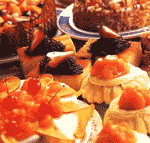 In south China, the favorite and most typical dishes were nian gao, sweet steamed
glutinous rice(糯米)pudding and zong zi (glutinous rice wrapped up in
reed(蘆葦)leaves), another popular delicacy. In south China, the favorite and most typical dishes were nian gao, sweet steamed
glutinous rice(糯米)pudding and zong zi (glutinous rice wrapped up in
reed(蘆葦)leaves), another popular delicacy.
In the north, steamed-wheat bread (man tou) and small meat dumplings were the preferred food. The tremendous amount of food prepared at this time was meant to symbolize abundance and wealth for the household.
The 15-Day Celebration of Chinese New Year
The first day of the Lunar New Year is "the welcoming of the gods of the heavens and earth."Many people abstain from meat on the first day of the new year because it is believed that this will ensure long and happy lives for them.
On the second day, the Chinese pray to their ancestors as well as to all the gods. They are extra kind to dogs and feed them well as it is believed that the second day is the birthday of all dogs.
 The third and fourth days are for the sons-in-laws to pay respect to their parents-in-law. The third and fourth days are for the sons-in-laws to pay respect to their parents-in-law.
The fifth day is called Po Woo. On that day people stay home to welcome the God of Wealth. No one visits families and friends on the fifth day because it will bring both parties bad luck.
On the sixth to the 10th day, the Chinese visit their relatives and friends freely. They also visit the temples to pray for good fortune and health.
The seventh day of the New Year is the day for farmers to display their produce. These farmers make a drink from seven types of vegetables to celebrate the occasion. The seventh day is also considered the birthday of human beings. Noodles are eaten to promote longevity and raw fish for success.
On the eighth day the Fujian people have another family reunion dinner, and at midnight they pray to Tian Gong, the God of Heaven.
The ninth day is to make offerings to the Jade Emperor.
The 10th through the 12th are days that friends and relatives should be invited for dinner. After so much rich food, on the 13th day you should have simple rice congee and mustard greens (choi sum) to cleanse the system.
The 14th day should be for preparations to celebrate the Lantern Festival which is to be held on the 15th night.
Auspicious words:
|

|

|

|

|
| Treasures fill the home |
Business flourishes |
Peace all year round |
Wishing you prosperity |
|

|

|

|

|
| Harmony brings wealth |
May all your wishes come true |
Everything goes well |
The country flourishes and people live in peace |
|

|

|

|

|
| Money and treasures will be plentiful |
Wishing you every success |
Promoting to a higher position |
Safe trip wherever you go |
|




