Traditional folk toys
Research indicates that kites were invented not as toys, but rather for military purposes, communication and surveying. They became playthings during the Song Dynasty, and the Ming and Qing dynasties perfected the making and flying of kites.
When kites first became toys for children, they were mostly simple affairs, with three bamboo strips forming the cross braces — two forming a cross and one arching over one end of the cross — that was covered by a piece of paper with a paper streamer or two as the tail. Such kites were nicknamed "tiles," and they were the first lesson for children learning kite making. They are still loved by children today.
Through the centuries, kite making has grown into a sophisticated handicraft. Functionally, they come in four categories: toys, decorations, stunt and application kites. Toy kites are the most diverse variety, while decorative kites have a greater visual appeal than flying characteristics. The third category is known for its aerial stunts, such as diving, soaring and somersaults. Application kites are used for communication, surveying, taking photographs and spreading leaflets.
Apart from "tiles," the huge family of toy kites includes winged (hard and soft), flat, train and convertible kites. Hard-wing kites are made of whole skeletons, so their wings cannot be folded and removed. Some soft wings are fixed on one bamboo strip, leaving the lower wings free to fly with the wind. Kites in the shape of birds and insects mostly use this type of soft wing. There are also soft wings that are removable, or can be folded.
Flat kites are mostly in geometric shapes to better present the maker’s painting skills, but they are more demanding to fly. Train kites are composed of many single kites — ranging from 20 to more than 100 — connected by a string.
Dough Figurines
 |
|
|
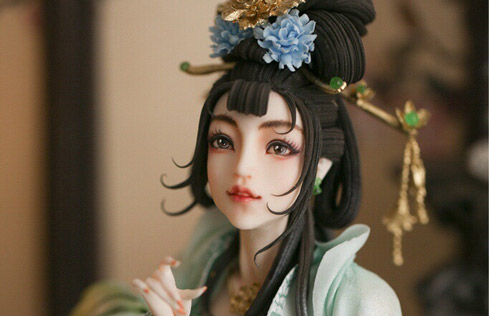
Dough figurines are the embodiment of the Chinese belief that art comes from life, as they were invented by housewives. There are two types of dough figurines: edible and inedible. During Spring Festival and on some other special occasions, housewives — particularly rural ones — mold dough into various patterns before steaming them. These "floral steamed buns" are then exchanged as gifts among relatives and friends, and presented to deities and ancestors as offerings. There are also buns made into animal shapes, which are given to children as edible toys.
The wheat growing provinces of Shanxi and Shaanxi are well known for dough figurines. Their "jujube hill" steamed buns are a special offering to Heaven and Earth. One "jujube hill" takes two kilograms of flour. First, a piece of dough is rolled into a flat triangle, and jujubes are arranged one against the other. Then pieces of dough are made into patterns of clouds, coiled dragons and other auspicious objects before being placed on top, with dough peony flowers, tigers, deer, rabbits and other lovely images studded about. "Jujube hills" are tokens of gratitude to Heaven and Earth for providing people with a good harvest and affluence.
Pure toy dough figurines are not meant for eating. They are made of wheat and sticky rice flour, cooking oil, salt, pigments and preservatives, and their motifs are mostly cartoons and legendary images loved by children. Their workmanship is relatively simple compared with collectible decorative suites based on folk tales, such as the "Eight Immortals Crossing the Sea" and "Zhong Kui Marries off His Sister."
Cloth Toys
 |
|
|
 |
|
|
As an agricultural people, the ancient Chinese lived by a clear division of labor, with men tending the fields and women staying at home cooking and sewing. Like the "floral steamed buns," cloth toys were invented by housewives.
The cloth tiger is a star of cloth toys and comes in many varieties. In Chinese philosophy, the tiger is a symbol of peace and luck, a protector of family safety and wealth, and a guardian against evil spirits and disasters. In rural areas, children grow up with cloth tigers, in the form of toys, pillows, clothes, shoes and hats.