An egg and a name
One would normally agree that eggs and naming babies have nothing to do with each other. In China, however, there is a very significant reason for relating these two things with each other. This is the baby naming ceremony, also called a Red Egg and Ginger party. In traditional China, a baby was not named until it was a month old, and at this time a party was thrown in honor of the child, so that friends and family could come and celebrate. this first month party is considered to, "...mark the first month of life and underscore the uncertainty surrounding the child's early existence." ( Smith, Richard - China's Cultural Heritage)

The baby naming ceremony has been an important part of the Chinese culture throughout it's history. It is not as widely celebrated now as it was in traditional times, and it has come to mean different things, but it is still a practiced tradition.
The Baby Naming Ceremony
As with many cultures, it is important to every family to have a male child carry on the family name. Girls were considered an unnecessary investment because the majority of them would eventually get married and leave the family. Although some families left the unfortunate female babies to die, especially right after the one child policy was enacted, when each couple hoped for a son, many of the female infants were sold into prostitution or, if they were lucky, put up for adoption. (To learn more about the role of females in China you should visit Lessons for a Woman) In the past, only the male child was given an elaborate naming ceremony, while the daughters were given a small dinner party with the family. Today, having a female child is not considered as bad as it once was, but most families still hope for a male child.
In order to understand the ceremony it is necessary to explain the importance of a male child, or any child at all. there was a high infant mortality rate in china, especially before the 1900's. This is why the ceremony is not given until the baby is a month old. After this time the family is reassured that the child will live. Most of the deliveries are now taking place in clinics or hospitals, which attributes to the growing rate of healthy infants, but even so, there are still villages in which only an experienced old woman is there to help. The other and child often are forbidden to go outside, sometimes until the full month after birth has passed. This varies depending on the family. After the ceremony, thirty to forty days, the regular tasks of the mother are restored and everything returns to normal.
Picking the Name
Now that some of the stipulations of this custom have been explained, the traditions of the actual ceremony can be described. The first thing a family must do is to pick a name for the baby. This can be done in a variety of ways. It is up to the family to decide if the given name at the party will be the child's formal name or a "milk name." the milk name is a nickname used until the child starts school, or even up until marriage. If given a milk name, often a girls' name will be chosen for a boy, because it is thought that a male child was the " special prey of evil spirits" and that these spirits will be tricked if the boy has a girl's name. A female, and sometimes a male child, is given an animal name or called some sort of derogatory name in a joking sort of way.
A child's formal name is usually picked by it's grandparents. Sometimes the name is picked simply for it's sound or meaning. In most places siblings share a common character in their names and in some villages this sharing goes further than the immediate family, and a common character is added to all the males of a specific lineage. In a few places, though, the grandparents do not pick the name, but a fortune teller does. He selects one that makes up for any deficiencies the child might have in it's spiritual make-up, including, water, fire, earth, wood, and metal. These were considered necessary for the survival of the child, but the superstitions surrounding the choice of a baby's name are not as strong as they used to be and many parents now name their own children.
For more information about Chinese names you can visit NAMES, where you will also find links to finding your own name in Chinese.
The Actual Celebration
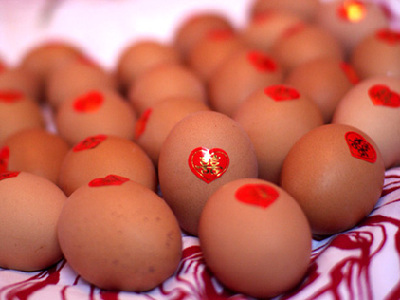
After the name is chosen, invitations are sent out to those who honored the baby's birth. They sued to send a hard- boiled egg, dyed red, to let friends and family know of the up coming festivities. In present day celebrations in the bigger cities, brightly colored eggs are placed on the table and guests may take one home for good luck. the guests at these celebration often get an egg and some ginger to take home with them, too. This red egg tradition started long ago when it was customary for the maternal grandmother to visit and bring gifts. She almost always brought clothing and eggs for the baby. Eggs were considered a delicacy in China, and that was how one knew someone special had come to visit. The grandmother also brought sweet cakes. Often these cakes had pictures on the showing various good luck symbols, especially the apricot flower. However, they are not supposed to use white because that is the color of mourning and sorrow. the eggs, usually duck eggs, were stamped with pictures of children, and flowers. Now there are no special rules for grandmothers to follow, as this was before 1941, when everything started to change.
After World War II the customs of China started changing because the different government and how they felt about these customs were changing. Most officials felt that the traditions of the CHinese were too elaborate and a waste of money. The wedding traditions changed a lot, and so did some of the funeral proceedings. However, since the baby ceremony was not as big to begin with, most of the traditions remained the same.
It used to be that the baby's head was shaved during the feast. The girls' head was shaved before the image of "Mother", the Goddess of Children, and the boy's head was shaved before the ancestral table. The symbolism of this practice is not entirely known, but it is speculated that this is the removing of the birth hair, to mark the point of the child's independent existence. traditionally, a big banquet is thrown, with thirty to forty people in attendance. The guests often bring gifts of clothing, or "lucky money" envelopes, which are called Li-shihs. The baby is is taken around the room to be introduced and admired. After that, the guests eat and visit with each other.
Instead of sending thank you cards to the guests for their gifts, the baby's parents send presents to them. This gift usually consists of small round biscuits with pork in them, a little like char-sui baus, or pork buns. Although the meaning behind these used to be more pronounced they are still considered an adequate thank you, even though the families do not usually send the 50 to 100 they might have sent in the past.
As you can see, this ceremony is very important because the Chinese believe that one's name can influence everything that happens in life. How this ritual is celebrated depends more on each specific family than on traditional rules. There are many other traditions surrounding the baby's birth, up through adulthood, but the naming ritual takes precedence over them all.?