Zooming in on the mainland movie market
|
Song Dai, chairman and general manager of Sil-Metropole Organisation Ltd Photo by Edmond Tang / China Daily |

Hong Kong moviemakers are excited at the potential for big business on the mainland. Despite the immense market, one major problem stands in the way - there are not enough screens to show the movies already produced every year. Guo Jiaxue reports.
The huge potential of the mainland movie market rests upon a very simple number problem for Song Dai: There are less than 5,000 movie screens on the mainland, while the number is more than 20,000 in the United States.
Just imagine with an increase of 1,000 screens a year - even after continuously fast growth for a decade, there is still lots of ground for the mainland to catch up with the US.
"People already see that. I dare not say quite a long time, but eight to 10 years (of steady increase) can already be seen," said Song, chairman and general manager of Sil-Metropole Organisation Ltd, a movie company boasting a history of six decades in Hong Kong.
Song noticed unprecedented growth of the mainland movie market in recent years, especially after 2008. He called it "the first-ever strong boom of Chinese movies in the local Chinese market".
This can be easily illustrated by the huge numbers at the box office. For movies such as Aftershock (2010), If You Are the One (2009 and 2010), Inception (2010), The Founding of a Republic (2009), box offices can reach as high as several hundred millions yuan. "Which is not a small number, even in the US," he said, "box offices of over 100 million yuan are not a big deal nowadays: There were 17 such movies in total by 2010."
What's more, the Chinese government also placed the development of the movie industry on the national policy level. The official action led to an upsurge of capital entering the field.
From Song's perspective, the best part of the exciting market boom is that it brings support not only for mainland movies but also for Hong Kong ones.
"These years, the most successful money-making co-productions are all mainland-Hong Kong ones," Song said. He feels certain that Hong Kong is going to make fortune in the huge mainland market through co-production.
He has his reasons. The movie industry and market system on the mainland have just stepped onto the national stage, while Hong Kong has a mature movie industry and high-level cultivation. Industry professionals from Hong Kong are familiar with categorized production, and have more refined division of work and a higher industry standard.
The Closer Economic Partnership Arrangement (CEPA) has already opened the mainland market to Hong Kong. That provides Hong Kong huge potential. "Just think of how big the consumption is there, a population of 1.3 billion! Here we've got only 7 million," he said. In addition, there is also the integration of Guangdong province and Hong Kong. "Only the 80 million people in Guangdong are already big enough."
"Therefore, the benefit is so real," he said. The return on investment on a movie mainly relies on the mainland. "Today, if a movie doesn't have the mainland market, Hong Kong companies dare not invest in it. Neither do I."
Yet the CEPA also dissolved the privilege of Sil-Metropole in Hong Kong. Cooperation with Sil-Metropole used to be the only way to reach the mainland market.
It certainly brings disadvantages to the company in a short term, Song said, but he believes the distinction still exits. It can take the role of gatekeeper by providing advice from the initial creation period to the post-editing stage. These works proved effective in helping Hong Kong movies adapt to review by the authority.
The change also forced Sil-Metropole to take a firm transformation towards commercialization. It's good for the company to face the age of great integration between Hong Kong and the mainland from a long-term view, Song said.
"The market is rising. Sil-Metropole, as a part of the system, will also be the same," Song said. Song makes no attempt to veil his emphasis on commercialization. He says a good movie company is good in four aspects: artistic creation, industrial production, commercial production, and commercial implementation. "If I have to pick the most important one, I would say commercial implementation."
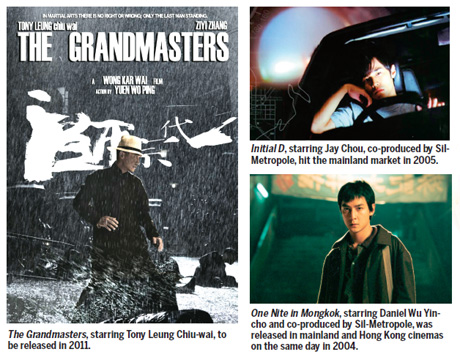
The movie The Grandmasters to be released in 2011 after eight-year preparation will surprise the audience with a fresh new appearance for an old movie company, Song said.
It's the first step of Sil-Metropole's transformation towards big-budget productions, Song said.
The movie, starring Tony Leung Chiu-wai and directed by Wong Kar-wai, has gathered a group of famed actors and moviemakers from the mainland, Hong Kong, Taiwan, and South Korea. The ambitious big co-production marks Sil-Metropole's new direction to ride the market trend in full swing.
"And it's just a start. We're going to have three more such movies this year," Song said.
Producing good movies comes first, Song said. Sil-Metropole will invest in two to three big-budget productions every year, with an investment from HK$80 million to HK$100 million each, as well as two to three small productions, with HK$8 million to HK$10 million investment in each. In light of the extreme disparity between big and small productions, Song will also make sure that a number of middle-budget productions are shot every year. Together with seven to eight co-productions with other companies, annual productions are expected to range from 15 to 20.
Sil-Metropole is also determined to develop a national digital cinema line on the mainland. It is expected to be completed within two years. There are only several hundred theaters, 40 cinema lines, less than 5,000 movie screens on the mainland. "Some two-thirds of movies produced in China can not make it in theaters," Song said.
The growing business of new media cheers Song. New media and digital technology have been seen as a huge threat to traditional media, but Song saw great value-added potential. Copyright management on new media platforms makes the old stock of around 500 movie into a new gold mine.
"We have already made 200 million yuan on the mainland so far, and we are continuously selling," he said.
Song said he is not selling the old movies outright, as Shaw Brothers and Golden Harvest did more than 10 years ago, but he is seeking new portals such as websites and TV operators.
The movie industry giant is considering whether to seek a market listing in future.
In response to the impression of "left-wing movies" when people talk about Sil-Metropole, Song said, "it's all past now."
He said its political function is fading away and the business function has instead become paramount.
The only thing that Sil-Metropole has insisted upon for the past six decades and will continue to do in future is, Song said, to present movies according to its formula of truth, beauty, and goodness.