Worship goes green
|
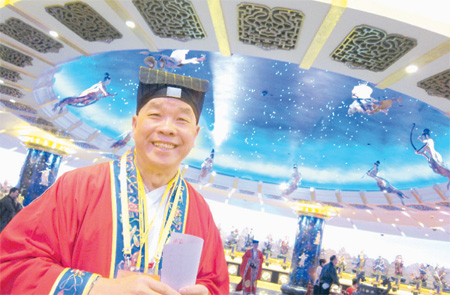
A Taoist priest volunteers to guide prayers to worship Taisui. Behind is the heaven ceiling created in accordance with ancient Chinese astrology and embellished with more than 100 LED lights. Guo Jiaxue / China Daily |
A Taoist temple has just spent a fortune to clean up its environmental footprint. But some people are not pleased about the high cost of worship and the high-tech embellishments that go with it. Guo Jiaxue reports.
After paying HK$100 admission, you may walk through the tri-roller gates where you encounter a large tripod for burning incense. A number of Taoist priests, in their red ritual robes, walk across the wide marble floor.
Were it not for the incense stand and the priests, you may find it difficult to distinguish the place from a Mass Transit Railway station or a supermarket. But this brightly illuminated modern room, presenting no traditional Chinese-style wooden structures, is actually the newly constructed hall of a Taoist temple.
It took three years and cost over HK$100 million to build the new hall at Wong Tai Sin Temple. The hall is dedicated to the worship of Taisui, the yearly god in China's Taoist tradition. There are 60 Taisui gods, also known as the 60 heavenly generals, who are charged with assisting the Jade Emperor to oversee the well being of the world.
The new structure breaks with tradition, however, in a number of ways. The burning of paper ingots, wax candles and the forms with written messages to Taisui on them are not permitted. The temple was built to be environment-friendly and energy-saving. It is even equipped with LED lights.

Worshippers may burn three sandalwood incenses when they come to pray - but not joss sticks which create too much smoke. Paper forms may not be burnt, but can be placed into collection boxes set before each of the Taisui gods.
When the written prayer offerings are dropped into the box, comes the most striking difference. A beam of red light shines out, illuminating the supplicant's face, communicating that the prayer has been "well-received" by the Taisui god. From the rear of the Taisui, a white mist rises to set a feeling of spirituality.
The bold idea to go electric lit up the age-old, yet seldom discussed topic - the environmental impact of temples.
Burning incense, candles, and paper offerings produces smoke and CO2, said Lee Yiu-fai, chairman of Sik Sik Yuen, the Taoist organization that manages Wong Tai Sin Temple. It's one of the most popular temples in Hong Kong with an enduring reputation for "what you request is what you get". The chairman has pressed the environmental issue aggressively, having forbidden the practice of burnt offerings at the temple since he took office. The exception to the rule is that worshippers may burn thin incense sticks. "It used to be very smoky; you can see how thick it was in old photos or movies," he said.
Moreover, the temple also has chosen trendy, energy-efficient LED lights in spite of their high price.
"We might be the most advanced in the whole of Asia," Lee said with evident pride.
It's not that all incense is banned at the temple, only the heavy sticks. It's a tenet of Taoism that prayers are carried to heaven on the smoke of incense, but one stick is sufficient. It's not as if the more the better, Lee explained.
Traditional temples have been cited by the environmental movement for years because of the burning. Joss sticks have been getting bigger, paper offerings more plentiful. Thick smoke emerging from temples became an issue, particularly in Hong Kong with temples in residential areas.
The Hong Kong Productivity Council has developed an advanced smokeless joss paper furnace to remove smoke and fumes from burnt paper offerings. Some Taoist temples, such as Man Mo Temple in Sheung Wan, Kwan Yam Temple in Hung Hom and Tin Hau Temple in Stanley, have already adopted the new furnace, according to the Hong Kong Taoist Association.
Andy Ho is among those who detest the smoke but he has carried his objections a step further. He has been posting photos and articles to make his views known through the Internet. He considers the traditional ways to be a source of significant air pollution, including smoke and dust. Ho even cites a study showing that incense smoke can cause cancer. Huge joss sticks and elaborate paper offerings are merely modern embellishments as far as he is concerned, and far distant from actual religious tradition.
He also agrees that most environmental groups "seem not interested" in the issue.

Among all groups it appears only the Conservancy Association has carried on a similar campaign to limit burning in worship, but it focuses on individual behavior occurring outside temples. Campaign Officer Roy Ng Hei-man contends that the plastic part of paper offerings is the major source of toxic chemicals.
The organization has proposed replacing burning with presenting bouquets and online worshiping, but receives little response.
Ng welcomes the changes at Wong Tai Sin Temple, "from an environmental point of view".
"But religious culture is overshadowed by commercial elements in this case," said the environmental activist.
Indeed, the red light and dry ice fog is unacceptable to many Taoists and even general public. One complained the ritual embellishments look like "electronic games".
Another mocked, "May I ask does Wong Tai Sin have a facebook page?"
These flourishes in the name of environmental protection also come at a rather high cost. Admission costs HK$100 and the fee for ceremonial worship is another HK$300 and people are complaining.
Lee of Sik Sik Yuen explained the charges exist only because of the high construction and maintenance cost of the underground temple hall. The replication of the heavens on the ceiling, designed in accordance with ancient Chinese astrology, required over 30,000 wires and more than 100 LED lights. The hall spends as much as HK$200,000 on electricity and water every month, he said.