Man of letters
A veteran translator recalls the heady days of the 1930s when he and his colleagues worked on Marxist literature by the light of kerosene lamps in the caves of Yan'an. Zhao Ying from China Features reports.
 |
|
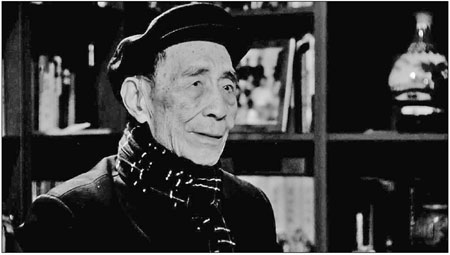
He Xilin, 96, was the first official translator employed by the Communist Party of China to translate Marxist writings. Photos Provided to China Daily |
Working with other young men to translate Marxist writings by the light of a kerosene lamp in a mountain cave is one of 96-year-old He Xilin's most cherished memories of the tumultuous beginnings of the Communist Party of China (CPC).
"The eight years I spent in Yan'an are the most meaningful in my life," He says. Although now too weak to walk, he suddenly becomes energetic when recalling the past.
He was the first official translator employed by the CPC to translate Marxist writings.
Born to a family of landowners in 1915 in the northern port city of Tianjin, He studied at a private high school in Beijing (then known as Peking), followed by a stint at Yanching University.
Uncomfortable with lack of an academic atmosphere there, He moved to renowned Peking University to study economics in 1934, when many Chinese were still struggling to make a living.
His study of English allowed him to read the English versions of Marxist and Communist literature - a dangerous habit at a time when the Kuomintang was still in power.
One of the books He read was by Rosa Luxemburg, a philosopher and co-founder of the German Communist Party.
"I finished the 500-page book overnight, squatting on the floor of the public restroom of my dormitory when I was in high school. My passion for Communism began to grow," He says, but can't recall the book's title.
In 1935, he joined a civil association, helping the group to translate and promote Marxist theories in China. The next year, he became a CPC member.
Unable to establish contact with the CPC for a couple of months, He traveled to Yan'an in Shaanxi Province in early 1938.
Yan'an, with its distinctive cave dwellings and yellow loess hills, was the main revolutionary base of the CPC between 1935 and 1948.
On May 5, 1938, the 120th birthday of Karl Marx, the CPC leadership opened the College of Marxism and Leninism in Yan'an.
He's educational background gave him the opportunity to become the first translator to work in the college's compilation department, where he interpreted and translated Communist writings for the reference of CPC leaders.
Compared to many other Party members, He and his nine colleagues lived in much better conditions, with well-equipped "cave homes" and kerosene lamps. Most Party staff relied on cheap soybean oil lamps at the time.
These were just some of the preferential treatments they enjoyed when almost everything was in short supply in the landlocked town of Yan'an, He recalls.
Whenever there was an urgent translation assignment, He and his team always worked overnight to make sure the work was finished on time.
Yan'an adopted a free supplies system, in which people received daily necessities or subsidies according to certain criteria, He recalls.
"Mao Zedong received a 5-yuan subsidy each month, and we got 4.5 yuan. The subsidy for the staff of the CPC military cadre's university was just 1 yuan," He says.
 |
|
The site of the College of Marxism and Leninism opened by the CPC leadership in Yan'an on May 5, 1938 |
"We even received remuneration for our translation work, but we donated it for the publication of Marxist books," he says.
In addition, the translators were not required to join in farming or other labor-intensive activities, most of which were mandatory for other Party staff.
The translators also attended classes along with senior military officers, joined group discussions and listened to lectures by Chairman Mao and other CPC leaders.
"This special treatment didn't make us feel extraordinary or distinctive from others," he says, stressing that it was the translation work that the Party attached great importance to.
He moved to several other work units in Yan'an, but translation was always his main task. His responsibilities included compiling US newspaper reports into a brochure for Party leaders.
Once, upon running into Mao outside his cave, he asked the leader if his translation work had been helpful, to which Mao replied, "every word is useful. As you know, we are all blind"!
The remark left a lasting impression on the young translator. "I felt the desperate need of CPC leaders to know the world and fully realized the significance of my work," He says.
The biggest challenge for He and the other translators was a lack of dictionaries and reference books in Yan'an. There was only one dictionary between the 10 of them, and the college had only limited reserves of books.
They were allowed to use Chairman Mao's private library, which was full of Chinese books. Many of their translation queries went unresolved.
However, He and his team still had several significant achievements to their credit. The translation of writings by Karl Marx and Friedrich Engels, as well as the translation of five volumes of The Selected Works of Lenin were among their greatest victories.
In their spare time, He and the translators entertained themselves with banquets and opera performances, which were staged in Yan'an almost every Sunday, He says.
He moved to Northeast China's Jilin province to take up an administrative post there in 1946, just three years before the Communists entered Beijing.
In the following years, He taught at a university in Northeast China, was vice-president of Nankai University in Tianjin, and then worked as a researcher at the Chinese Academy of Social Sciences.
He later moved to the Central Compilation and Translation Bureau (CCTB) in Beijing at the age of 63 and retired nine years later.
"Conditions for translation work have greatly improved and I'm glad to see that the Party continues to attach great importance to the cause," He says.
The CCTB, founded in 1953 by CPC, has translated the complete works of Marx, Engels, Lenin and other Communist philosophers. The bureau has also translated works by Mao, Deng Xiaoping and other Chinese leaders for foreign readers.
The CCTB is currently working on the second Chinese edition of the complete works of Marx and Engels. The 70-volume project, launched in 1986 with the approval of the CPC Central Committee, is expected to be finished before 2020 and will provide a comprehensive, authoritative and precise version of the works for researchers.
"The Party has not only carried forward Marxism and Leninism, but has been trying to develop their theories in a Chinese way," He says.
Suffering from poor eyesight and hearing, He and his wife now live with his son's family in a four-bedroom apartment in downtown Beijing. Frugal as ever, He condemns the wastage of electricity in their home.
He donated more than 100,000 yuan ($15,400) to the CCTB in 2009 and 120,000 yuan earlier this year for the 90th anniversary of the founding of the CPC.
The CCTB leaders visited He recently, promising to establish a foundation with his donation to encourage hardworking young people.
"He sighed and frowned when we told him that part of the college in Yan'an had fallen into disuse," says Zhang Wencheng, director of the CCTB's office for senior citizen affairs.
"He seldom talks to his family about his experiences, but we know that Yan'an is never far from his mind," Zhang says.