Comments()
  Print
Print  Mail
Mail  Large Medium Small
 |
|
Standing amid the riot of flowers in the Forest of Steles, one may get a sense of the idea of harmony Confucius talked about. [Photo/China Daily] |
At the Confucius Temple complex in Qufu, Chitralekha Basu found herself surrounded by more than just historical charm.
We are in Confucius (551-479 BC) country, walking around the Confucius Temple complex dedicated to the man, whose influence over Chinese thought and lifestyle practices has been sustained over the last 2,500 years.
 |
|
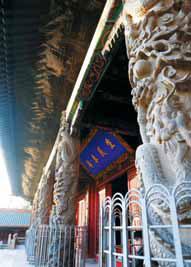
The Hall of Great Perfection. Wang Hui [Photo/ China Daily] |
Yet this massive monument to wisdom and scholarship in Qufu, Shandong province -sprawled out over 16,000 square meters and second in terms of scale only to the Forbidden City in Beijing whose model it emulates - moves me not so much because of what it is, but rather what it grows.
Tall coniferous trees line up on both sides of the approach road to the fortress-like entrance, leading to Linxing Gate. Long and thin stems of weeping willows, glittering under the mid-day sun like tinsel, bend over the moat around the wall to touch the rippling waters beneath.
Inside, it is the cypresses lording it over. Their serrated trunks spread out and twist in impossible formations, growing bulbous knobs in odd places. Sometimes, the trees slant dangerously, kowtowing to the forces of gravity.
The most legendary among the trees in this compound, of course, does not exist any more. But a red-pillared, yellow-tiled pavilion marks the spot where it once stood.

The apricot, under whose shady boughs the great seer would discuss and interpret some of the ancient classical Chinese texts - The Book of History, The Book of Rites, The Book of Odes, The Book of Music and The Book of Changes - with some of his disciples is memorialized with due reverence. This was after Confucius had returned to the State of Lu after a long-drawn, hazardous journey across China but did not wish to be re-instated as a high-ranking official, preferring a quieter and more contemplative life instead.
In Confucius' turf, the mythology around trees seems to build and prosper even independently of the great philosopher, one of whose themes was about man's communion with nature. For instance, there's a cypress under which an elderly Emperor Qianlong (1711-1799) of the Qing Dynasty (1644-1911) - who visited the temple eight times as his daughter had married into the Kong family - was supposed to have rested. Legend has it that the bark of the tree crinkled and grew warts to resemble dragon hide, resonating with and reinforcing its imperial associations.
There's a juniper tree that is supposed to have been planted by Confucius himself but, as our guide says, it is probably only about 300 years old. Not too far away from the centerpiece in this courtyard, the Hall of Great Perfection - where sacrificial offerings would be made in Confucius' memory in ancient times - a gingko tree from the Song Dynasty (960-1279) and a Chinese scholar tree from the Tang Dynasty (AD 618-907) appear fresh and resplendent in the golden light of a summer afternoon.
There are more leafy surprises in store as we move on to the courtyard of the Kong family residence, where 32 generations of Confucius' descendants lived for 880 years, until the 76th and the 77th in the line fled to Chongqing in 1937, after the outbreak of the War of Resistance against Japanese Aggression (1937-1945). They eventually moved to Taiwan in 1949, coinciding with the defeat of the nationalist Kuomintang and the founding of the People's Republic of China.
Vines twirl up around the four-storied Tower of Refuge, built in the late Qing era as a hideaway at the time of a possible crisis, but never put to use.
The family had reasons to fear for their lives. They were close to the Kuomintang leader Chiang Kai-shek who was invited to attend the wedding of the 76th generation Kong Decheng and his fourth wife in 1936. But the Xi'an Incident happened and Chiang went on the run, eventually captured by his former ally, the Manchurian warlord, Zhang Xueliang.
The high-profile guest never got to attend the wedding, but the bedchamber and the Wedding Hall of Double Happiness, still done up in nuptials-related paraphernalia, remains indelibly linked with a turning point in Chinese history.
In the courtyard, a Chinese scholar tree, its trunk curiously split into five equal parts by lightning, stands like a metaphor of the tensions and dissonance that its last set of residents had seen.
In the backyard of this family home, an intense growth of purple flowers and buttercups, interspersed by wispy dandelions, sprawls out, covering the expanse up to the boundary wall. The foot-high carpet of shrubbery is punctuated by maple trees, resplendent in myriad shades of red at the height of spring.
The way to the Forest of Steles - where Confucius' descendants down to the 78th generation lie in eternal rest - is through a paved avenue, flanked on either side by cypresses and pines that are at least a thousand years old. The cemetery - covering an astounding 17 sq km area - looks like a never-ending sea of purple flowers, its bounty overwhelming the several thousand-odd steles, dwarfed by the unregulated growth.
There used to be 100,000 of these at one time, put up since the Han Dynasty (206 BC-AD 220), but only about 3,600 remain, the rest having been vandalized by the Red Guards during the "cultural revolution" (1966-76) or fallen to natural decay.
Tender green creepers spiral up around ancient oak tree (jixiang in Chinese, also meaning excellent or auspicious) trunks. Many of these were supposedly planted by Confucius' devout student Zi Gong in his teacher's memory. Nature's constant renewal is in evidence as fresh, mint green leaves sprout from the earth under which lie two millennia of the dead.
The tombstones dedicated to Confucius were put up much later, by a member of the 51st generation of the Kong family, and another one in the recent past. These stand on the spot of Imperial sacrifices made in honor of the philosopher-statesman, as Confucius' grave was never located.
There is possibly a bit of poetic justice in the fact that it remains untraceable. Confucius had talked about heaven and humanity becoming one, imagined humankind and the natural world in perfect harmony.
Standing amid the riot of purple flowers, inundating the ornamental tombstones, blurring the line separating the flowers and pale blue horizon, one might get a sense of what he was talking about.



Copyright 1995 - 2010 . All rights reserved. The content (including but not limited to text, photo, multimedia information, etc) published in this site belongs to China Daily Information Co (CDIC). Without written authorization from CDIC, such content shall not be republished or used in any form. Note: Browsers with 1024*768 or higher resolution are suggested for this site.
License for publishing multimedia online 0108263 Registration Number: 20100000002731