Comments()
  Print
Print  Mail
Mail  Large Medium Small
The city is replete with history. But, our reporters, Chitralekha Basu and Song Wenwei, were intrigued by much more.
Every evening feels like Christmas Eve at the four-point crossing at Xinjiekou. The place is awash with lights. Streams of illumination pour down the sides of the towering chrome-and-glass structures. Giant digital display boards play advert clips, showcasing multinational brands in endless reruns.
Store windows glow like expecting mothers, panting yet happy under the staggering weight of merchandize. Headlights from fast-moving vehicles incessantly crisscross.
This could well be passed off as an image of a bustling shopping or commercial hub in any modern metropolis, anywhere in the world.
What gives Nanjing's identity away is Sun Yat-sen's sculpture standing at the intersection, dressed in Western formals. The "father of modern China" spearheaded the Xinhai Revolution in 1911, leading to the country's liberation from monarchy and anointing Nanjing as the capital of the Republic of China in 1912. He appears to look over the steady stream of traffic and pedestrians with authority and detachment.

Sun Yat-sen's Mausoleum
The marble sculpture in his mausoleum wears a slightly more solemn look. He is seated on a high pedestal, in the Sacrificial Hall, atop the Aztec pyramid-style structure in the Zhong Mountain scenic area, 20 km east of downtown Nanjing.
Sun is clad in a traditional Chinese "changpao", or long-gown, here. A scroll rests on his knees. But his gaze is directed forward, taking in, it seems, the entire length of the north-south axis, running vertically down the 80,000 square meter park dedicated to his memory.
The road to this shrine is through a triple-arched gate, flanked on either side by rows of pines, cypresses and gingko trees. The words inscribed on the frontispiece reads, "What is under heaven is for all" - the great man's pronouncement on the principles of egalitarianism.
A white star set against a blue backdrop, a design borrowed from the Kuomintang flag, glows from the center of the ceiling.
Jinling Woodblock Carving and Printing Center
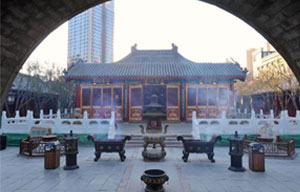
Like you can't tell a book by its cover, it's impossible to figure out that a rather nondescript courtyard house, tucked in a corner of Huaihai Road, contains 125,000 wooden blocks of Chinese characters used for printing Buddhist sutras. It is the largest in the world.
The center also houses an incredibly huge collection of ancient and rare Buddhist classics, including those translated by the monk Xuanzang (AD 602-664), who brought back seminal Buddhist texts from his journey to India during the Tang Dynasty (AD 618-907).
The publications that rolled off the first private printing shop for Buddhist texts in the late Qing Dynasty (1644-1911), run by Yang Renshan (1837-1911), form the foundation of this organization. Considering that Yang printed and distributed more than 1 million chapters of canonical texts - some lost during the "cultural revolution" (1966-76) - it was a solid and plentiful collection to build on.
The block-makers are, surprisingly, rather young. Wang Kang, 19, has seven generations of carving history behind him. When we meet Wang, the undergraduate specializing in old texts restoration is painstakingly etching out the contours of traditional Chinese characters - quite literally proving himself to be a chip off the old block.
Patience is key. It takes a week to complete work on two sides of the board with 80 characters. "One needs two to three years to learn the basic, and about 10 more to perfect the skill," says Wu Yankou, director of the research unit of the center.
But Wang is ready to give what it takes. "It's a feeling of sheer joy to be able to complete an assignment with the required finesse," he says, working on an intricately carved image of Sakyamuni.

Nanjing Massacre Memorial
The first thing that strikes one about the Nanjing Massacre Memorial is the scale on which it has been conceived. The space spreads out over 180,000 square meters, including the "Pit of 10,000 Corpses".
The memorial is built on the very location in Jiangdongmen in southwest Nanjing where thousands of the more than 300,000 Chinese slaughtered by the Japanese army in December 1937 were dumped. It is an overpowering reminder of mass-scale mutilation.
A giant sculpture of a bewildered woman stands almost dwarfed by a vast sea of pebbles, their color and size giving the impression of skulls and bones. Sculpted hands reach out from a wall of blindfolded captives, carved in relief, waiting to be slaughtered. Real skeletons lie scattered in a tangled heap in the pit.
Gruesome images of sadistic torture perpetrated on women, who truly did not have anything to do with the war, except for being at the wrong place at the wrong moment, are displayed inside the exhibition hall. It is jarring. But that's the idea. Lest we forget.
The memorial hall is a surreal dark room, lit up intermittently by candles.
The flames multiply indeterminately as they reflect against the water streaming across the floor and the polished black walls, illuminating the verses inscribed on them.
These are fervent appeals to put an end to such acts of human brutality, silently screaming, "never again".
The road to this hall is paved by cast iron slabs, containing the footprints of holocaust survivors. In a corner stands a life-size bronze sculpture of Iris Chang, who documented the story of the holocaust in Rape of Nanking.
Reliving the macabre experience on behalf of those who suffered it proved so unnerving for Chang that she found it impossible to live with it any more, eventually taking her own life. Her large eyes look up to the skies, in a mute appeal to arouse the righteous instincts in humanity.
The legend of Zhang Lihua
From the Yilin Press office, located on the top floor of a building on Hunan Road, we catch a panoramic view of the misty cobalt-blue waters of Nanjing's famed Xuanwu Lake, girdled by dark hills on three sides. An apocryphal story about a beauty, who had plunged with her imperial lover into the depths of the majestic Xuanwu Lake, has notched up its romantic appeal for us.
Soon afterwards, Shirley Xie, assistant president of Yilin, clarifies that Zhang Lihua - the maiden's name - did not drown in the lake. In fact, she hid in a well in the temple of Jiming, only a stone's throw away.
"She was the favorite concubine of Emperor Chen Shubao (AD 553-604) of Chen Dynasty (AD 557-589)," informs Xie. "He wrote many poems extolling her beauty, among which the most famous was A Jade Tree Blossoms in the Backyard. The poem later acquired an iconic status - a metaphor for men pursuing beautiful women at the cost of neglecting their vocation."
Zhang Lihua was famous for her hair, which, according to historical records, was 2.33 meters long, silky smooth and so shiny that it could double as a mirror! When the invaders from the north occupied Nanjing, which was the Chinese capital at that time, the emperor, who had been too preoccupied with writing paeans to his luscious-haired lady love, had no recourse but to jump into the well with her.
"When they were discovered and pulled up from the well, the rouge on the cheeks of Zhang Lihua rubbed off, leaving a stain against the side of the well, thereby giving the well a new name - rouge well," Xie says.
We visit the well on our way back. It seems like a really constricted hole to have contained two fully-grown people. What an ignominious and un-romantic end to a love story that, at the outset, had seemed to hold a lot of promise.




Copyright 1995 - 2010 . All rights reserved. The content (including but not limited to text, photo, multimedia information, etc) published in this site belongs to China Daily Information Co (CDIC). Without written authorization from CDIC, such content shall not be republished or used in any form. Note: Browsers with 1024*768 or higher resolution are suggested for this site.
License for publishing multimedia online 0108263 Registration Number: 20100000002731