Comments()
  Print
Print  Mail
Mail  Large Medium Small
 |
|
A typical morning in Ipoh begins with a cup of white coffee. |
 |
|
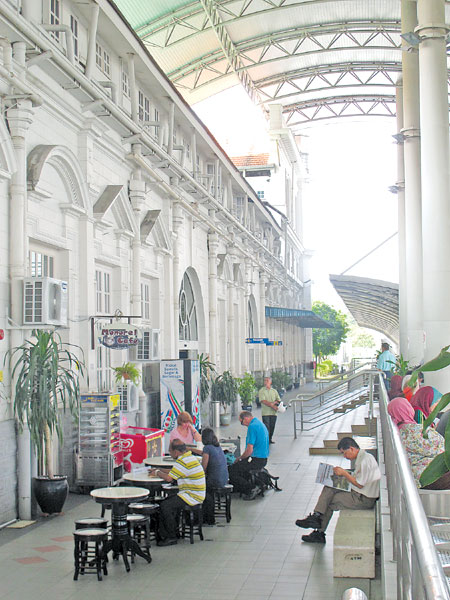
The railway station is just one example of Ipoh's colonial-era heritage. Photos by Wang Kaihao and Provided to China Daily |
 |
|
Shops with Chinese and Malay signs line the narrow streets of Ipoh's old town area. |
 |
|
The fishing village of Kuala Sepetang in Taiping is a good choice to enjoy the sunset. |
Wang Kaihao visits two northern towns of Malaysia, which brings back memories of China during his childhood days.
The first thing that comes to my mind about Ipoh is: It is the hometown of famous Hong Kong actress Michelle Yeoh, who starred in global hits, such as the James Bond movie Tomorrow Never Dies and Memoirs of a Geisha.
Little did I know that this Malaysian city is home to a huge Chinese diaspora. Chinese people make up some 70 percent of the population.
The capital of northern Perak (which means "tin" in the Malay language) State, has been a well-known tin mining capital since the late 19th century, attracting scores of laborers from China's Guangdong province, who braved the South China Sea in search of fortune.
Thus, when taking the electric train northwards from Malaysia's capital Kuala Lumpur, I expected to see many mines on the way.
But I did not see any.
Related: A Chinese oasis in Manhattan
The ore in Ipoh has almost all been dug up and the collapse of the tin market in the mid-1980s led to depression in the industry. Despite that, the influence of the early immigrants can be felt deep in the veins of the city.
A typical morning in Ipoh begins with a cup of white coffee in a coffee shop or kopitiam as the locals call it. The word kopitiam is a combination of the words "coffee" in Malay language and "shop" in the Chinese dialects of Fujian or Chaozhou.
This cream-colored coffee roasted in margarine was the brainchild of a local Chinese and has become a symbol of Ipoh for over a century. Unlike some coffee, which has a slightly sour taste, the smooth and mellow Ipoh white coffee suits my palate perfectly.
Breakfast is not complete without a few sticks of satay, which reminds me of Beijing meat skewers during summer, plus a few rolls of popiah, a Malaysian-style spring roll.
The kopitiam I visit is just beside the famous Concubine Lane, where the tycoons in this "city of millionaires", kept their mistresses during the turn of the 20th century. The lane also used to be a hub for gambling and opium.
Although the street has undergone a "clean up", and the houses are now empty, I can almost feel the aura of the place during the tin-mining days, as I peep into the spacious rooms and spot delicately designed staircases through the rusty windows.
Walking along the alleys in the older part of Ipoh is like wandering in a big Chinatown. Various shops with bilingual signs (Chinese and Malay) line the narrow streets, portraying a panorama of southern China.
The shops range from those selling traditional cookies, which I ate as a child but have not seen for years, to dental clinics and shops selling Chinese herbs and medicines.
In the arcade by the street, some people are seen playing cards. As I walk further, the pungent smell of the king of fruits fills the air and then, I see the source of the aroma - a group of hawkers with their durians at one corner of the street. Along the way, an old woman selling various types of ointments smiles at me and says she can tell my fortune.
The scene reminds me of a typical opening setting of a Hollywood movie about Chinatown. It arouses mixed feelings within me. In China, such scenes have disappeared with accelerating modernization, but time seems to have stood still in this "small town" (though Ipoh is Malaysia's fourth largest city). That is perhaps the reason why director Ang Lee chose to shoot some scenes in his movie Lust, Caution in Ipoh to reflect old Shanghai.
In spite of the strong Chinese flavor, the streets are also dotted with some old Indian shops with colorful facade, selling Indian clothes, trinklets, cosmetics, groceries and other stuff. Exotic scents and the sign "product from Madras" immediately transports me back to the colonial era. Madras officially changed its name to Chennai in 1996.
Locals are tolerant toward the colonial-era heritage buildings left by nearly 150 years of British rule in Malaysia. Apart from Ipoh railway station, which mixes Indian and British architectural styles, buildings such as the old city hall, court house and some schools remind visitors of the colonial days.
A memorial built in 1909 for James Birch, the first British resident of Perak, lies just opposite a giant mosque. Birch held the post for only a year before he was assassinated for what's popularly believed to be his arrogance and disrespect for the locals.
History aside, Ipoh is also known for its religious sites. I spend some time touring Kek Lok Tong (Cavern of Utmost Happiness), a Chinese temple in a limestone cave, which turned out to be a great sanctuary from the scorching afternoon sun.
I was told that pilgrims from all over the country and other parts of Southeast Asia visit the temple to ask for favors or return to pay homage for answered prayers. On the other side of the limestone mountain is another popular temple, Sam Poh Tong, named after the 14th century Chinese Admiral Zheng He, although the explorer was said to be a Muslim.



Copyright 1995 - 2010 . All rights reserved. The content (including but not limited to text, photo, multimedia information, etc) published in this site belongs to China Daily Information Co (CDIC). Without written authorization from CDIC, such content shall not be republished or used in any form. Note: Browsers with 1024*768 or higher resolution are suggested for this site.
License for publishing multimedia online 0108263 Registration Number: 20100000002731