Comments()
  Print
Print  Mail
Mail  Large Medium Small
分享按鈕
0
Large Medium Small
分享按鈕
0
 |
|
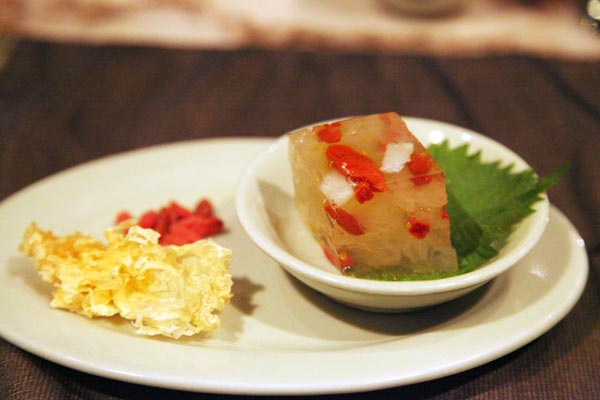
Water chestnut cake with Chinese wolfberries. Photos by Fan Zhen / China Daily |
It is a bold chef who dares to add unfamiliar ingredients to a whole season's menu, but the experiment seems to have brought the dining experience up a notch. Fan Zhen and C.J. Henderson look at Huang Ting's new herbal menu from two perspectives.
Great traditions never die. Connoisseurs will always savor, harbor and reinvent, just like Chef Xu Chiping of the Peninsula Hotel in Beijing. In his autumn menu, the chef attempts to realize his long-cherished dream of using Chinese medicinal herbs in haute cuisine.
And he has done it.
On a cool autumn night when we arrived at the restaurant, we were greeted at the entrance by a vintage Chinese medicine cabinet with colorful dried herbs in its numerous drawers. That was our first hint of what was to come.
The six-course dinner was delicately presented in bite-sized portions. The herbs used in the dishes were not only shown off in small saucers accompanying each course, but also vividly illustrated in a handmade sepia-toned menu.
Herbs are mostly used as medicine in the northern cities of China, whereas in the south, we use them in dishes, drinks or even snacks.
The southern part of the country has a more humid climate, and people believe that toxins accumulate in the body because of the heat and damp. Herbs are often used in mild doses in meals to cleanse livers, enhance digestion and above all, maintain the inner balance of our bodies.
As a young child, my grandmother never fed me Western medicines because she thought they were far too strong for me. Instead, she picked yuxingcao (Herba houttuyniae) from our backyard, and boiled the pulp.
That was my cough syrup. She also fed me the herbs, using them in a salad with sweet peppers, seasoned with aged vinegar and crushed garlic. My throat always felt better immediately, and my appetite certainly improved.
The appetizer at Huang Ting set me off on a journey of rediscovery.
The flavor of the Chinese red dates or jujubes was enhanced by a slow-simmered sauce of heshouwu - a common herb in the Chinese pharmacology, and osmanthus flowers - the floral herald of autumn. Topped with fresh lily bulbs, the dates took on delightfully sweet notes from the two fragrant flowers.
Along the way, we were also treated to plump poached scallops simmered in a broth of chuanxiong and baizhi, steamed diced chicken in danggui sauce accentuated by a vegetable "blossom", chewy braised bean curd sticks which sang in chorus with crisped huaishan and lotus seeds. Finally, a jelly dessert dotted with orange wolfberries wrapped up a night of indulgence.
At the end of the meal, we were definitely warmed by both the herbal tonics and the cozy ambience. We would go away with more lustrous hair, thanks to the heshouwu, stronger kidneys thanks to the huaishan, and better circulation and digestion, thanks to the danggui.
The inspiration for the herbal dinner came to Chef Xu a long time ago, when he was still a novice to cooking. He became fascinated with the concept, and was determined to refine and elevate herbal dishes to haute cuisine, thereby broadening their appeal.
"I left Shanghai with my family for America when I was a kid. But I was always curious about Chinese traditions. The herbal meal is one of the traditions that comes with an interesting history," he says.
More than 5,000 years ago, the legendary Shen Nong, the father of agriculture, was the first to study the healing properties of plants. He also established the theory of yin and yang, which became the foundation of Chinese culture and philosophy. These opposing, yet complimentary forces make up the whole.
So when illness occurs, Chinese doctors believe there is an imbalance in the body. Food can then play a role in correcting and maintaining this balance.
"The herbs we use are very mild, not like 'real medicine'," the chef says. "They don't have a strong taste or unpleasant smell. Traditional Chinese herbal cuisine is not only a science but an art. It will definitely be the next culinary trend."
Contact the writer at fanzhen@chinadaily.com.cn.
Copyright 1995 - 2010 . All rights reserved. The content (including but not limited to text, photo, multimedia information, etc) published in this site belongs to China Daily Information Co (CDIC). Without written authorization from CDIC, such content shall not be republished or used in any form. Note: Browsers with 1024*768 or higher resolution are suggested for this site.
License for publishing multimedia online 0108263 Registration Number: 20100000002731