Comments()
  Print
Print  Mail
Mail  Large Medium Small
 |
|
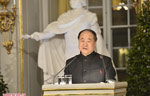
Chinese writer Mo Yan signs copies of his new book, Frogs, at a book fair in Shanghai in 2010. Gao Erqiang / China Daily |
 |
|
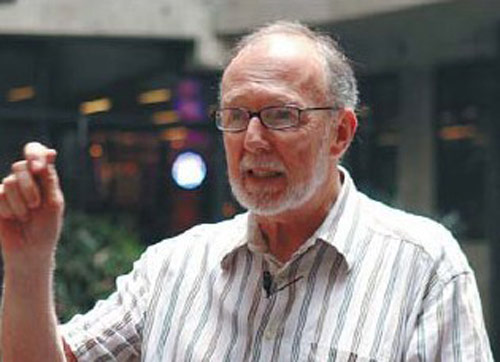
Howard Goldblatt: a world-famous translator of Chinese Literature |
Editor's note: As speculations intensify over this year's Nobel Prize in literature, much attention has been focused on Mo Yan, a heavyweight on China's literary scene since the mid-1980s. China Daily's Liu Jun interviewed two experts familiar with the author. Professor Howard Goldblatt, a world-leading US translator of contemporary Chinese literature, has dedicated years to introduce most of Mo's works to the English-speaking world. Shelley Chan, one of Goldblatt's students and an associate professor of Chinese language and cultural studies at Wittenberg University in Ohio, also has conducted in-depth research on the author. Following is an excerpt of an e-mail interview with the two.
Q: Which are your favorite works by Mo Yan?
Goldblatt: That's a bit like asking which of your children you like the best. I truly like, and enjoy translating, all of Mo's fiction (I've even translated his short memoir, Change), and usually for different reasons.
For instance, The Republic of Wine may be the most technically innovative and sophisticated novel from China I've read; Life and Death Are Wearing Me Out is a brilliant extended fable; Sandalwood Death is, as the author contends, musical in its beauty. I could go on, but you get the idea. A translation of Frogs is under way, and if Mo's name is announced on Thursday, I imagine I'll have an opportunity to translate some earlier works I've not had time for.
Chan: Mo is very experimental, and each novel has its own uniqueness. Therefore, it is hard to single out one book. If you really want me to choose one or two, I would say The Republic of Wine and Life and Death Are Wearing Me Out are my favorites.
Could you compare Mo's works to those of other contemporary Chinese writers?
Goldblatt: All the best-known contemporary writers have a unique personal style; it would be unhealthy if it were otherwise. Mo tends to be more "historical" than many of his contemporaries. Whether it's the Boxer Rebellion or the "cultural revolution" (1966-76), he seems most comfortable with a historical perspective.
There are, of course, exceptions, such as POW!. Few of his works deal with up-to-date urban themes, which appear to be all the rage these days.
Mo is a "maximalist" (if there is such a word), a writer who extensively probes the Chinese language for its expressive qualities. He is, as well, a writer whose work appeals to all the senses. Finally, he is particularly apt at defamiliarization, creating new and arresting realities with his prose.
Chan: In terms of contents, Mo, like other root-seeking writers, frequently writes about his own hometown, Gaomi (in East China's Shandong province). But he writes differently. In terms of style, Mo is unique and hard to compare with anyone else. You may say sometimes he is as playful as Wang Shuo, yet it's a very different kind of playfulness.
Can you think of any similar Western writers in style, content or others?
Goldblatt: When I read Mo I'm often reminded of Dickens (I know he's not a contemporary): big, bold works with florid, imagistic, powerful writing and a strong moral core. I see parallels with works like William Vollmann's Europe Central, with its historical sweep (Red Sorghum) and trenchant criticism of monstrous behavior by those in power (The Garlic Ballads).
And, of course, there are writers Mo seems to prefer, the modernist Faulkner, the magic-realist Garcia Marquez, and the Japanese Oe Kenzaburo. And don't forget another "oldie": Rabelais, with his bawdy humor and scatological exuberances.
Chan: Mo admitted that he had been influenced by William Faulkner and Garcia Marquez. The reader may find some peculiar elements of these two writers in Mo's works, such as setting the stories in a small town, very rich imagination, and even the style of magic realism.
Mo is perhaps the best-known contemporary Chinese author in the West, thanks to translators' hard work. Many other Chinese authors can stand a chance for international literary prizes, with more funding from the country.
Goldblatt: Please keep in mind that Mo has talented translators in many countries, most notably Japan, France, Italy, and Germany, and they have contributed mightily to his international reputation.
China has been behind the curve on promoting and funding translations of its literature in foreign countries by native speakers in those societies. The US, some European countries and Japan actively fund literary translations and help to get them in the hands of domestic readers. China ought to do much better than it has so far.
Chan: I think you (Liu Jun) are right. Shi Tiesheng, for instance, one of my favorite writers, definitely deserves more international attention.
What's the general payment for translating Chinese novels?
Goldblatt: I have translated novels for nothing (rather more often than I should, I'm afraid), and the range of fees is considerable.
It's always a struggle to receive adequate compensation for a job that requires training, talent, and a lot of time (any worthwhile full-length translation easily eats up six months or more). Most of the time, publishers cannot and won't pay a translator what she/he is worth, and that is where outside-funding organizations come in. Competition for funding is fierce, as you can imagine.
For me, it is, first and foremost, a love of what I do, of good writing, and (maybe perversely) of seeing the results of that work in a book whose effect on people I'll never meet will almost never be known to me.
What do you think of the attention Chinese put on the Nobel Prize in literature?
Goldblatt: I don't have a problem with the prize; it's the popular obsession over it that I find objectionable. For populations in countries like China and South Korea, it has become a matter of national validation if successful, and national scorn if not. Come on, folks, it's an individual prize for a writer's (or poet's) body of work. I know, that's not how a lot of people see it, but ... really!
Contact the writer at liujun@chinadaily.com.cn



Copyright 1995 - 2010 . All rights reserved. The content (including but not limited to text, photo, multimedia information, etc) published in this site belongs to China Daily Information Co (CDIC). Without written authorization from CDIC, such content shall not be republished or used in any form. Note: Browsers with 1024*768 or higher resolution are suggested for this site.
License for publishing multimedia online 0108263 Registration Number: 20100000002731