Comments()
  Print
Print  Mail
Mail  Large Medium Small
 |
|
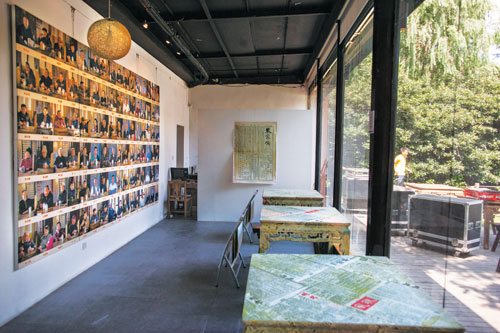
Photos and antique newspapers are displayed at Deke Erh's Archive: Oral and Visual Documentary exhibition in Shanghai. Provided to China Daily |

A photography show offers a stroll through a century of memories. Zhang Kun reports in Shanghai.
Contemporary art has no boundary date, says Qiu Zhijie, curator of the 2012 Shanghai Biennale. A special project of the city's most important contemporary art event this year is dedicated to history.
The Zhongshan Park Project is an off-site program of the Shanghai Biennale at Edo Museum in Zhongshan Park, Shanghai, showcasing Deke Erh's photographs and visual documentary.
Deke Erh's Archive: Oral and Visual Documentary opened to the public on Sept 11 and runs through Dec 26.
The museum space is divided into three parts. The patio and front hall feature visual and audio records of traditional crafts and lifestyles from the waterfront town of Zhujiajiao in suburban Shanghai.
One of the two main exhibition rooms features documentaries by the Shanghai American School from 1937-49, and the other presents archives from three prestigious universities in Shanghai in the early half of the 20th century. They are Aurora University, University of Shanghai and St. John's University.
Deke Erh is the pen name of 53-year-old Er Dongqiang, who has worked as a freelance photographer in Shanghai for the past 30 years, documenting the changing landscape of the city. He is also a self-appointed historian, collecting antiques and stories from previous generations.
"Er Dongqiang's career has shown how a photographer has the power to penetrate the dust of history, to reach the darkest and softest parts of our collective memories," Qiu says.
"He started as a photographer and turned into a visual historian. In his work, I found the revival of a tradition, when traveling photographers used to take pictures and write journals alongside."
Through the decades Erh has published 20-30 photo albums at Old China Hand Press, a publishing house in Hong Kong, as well as Shanghai Ancient Books Publishing House. Many of his books are about old architecture in Shanghai and other parts of China. A few years ago, he expanded his work to the comprehensive record of the lifestyle and memories of the past.
He opened a photo gallery in Zhujiajiao. In front of it he set up square tables and benches to sell tea. "Traditional big-bowl tea, 1 yuan (16 cents) per cup," says Wu Yuquan, a retiree who helped to manage the teahouse for Erh.
Many old people came to have tea, and their chats inspired Erh to record their stories. Erh and his team interviewed more than 150 people, and learned a lot about traditional professions and crafts that have disappeared in the modern age.
"For example, there was an old way of making mosquito-repellent incense," Wu recalls.
"They would mix sawdust with herbs at a particular proportion, and wrap it up in thin slices of paper - it was done in a very scientific way and would not harm human health."
Even Wu, who is in his 60s and has lived most of his life in Zhujiajiao, found these stories novel.
As he collected antique papers and documents about Zhujiajiao, Ehr was surprised to find the small town hosted as many as 35 newspapers from 1912-49. When he exhibited the antique newspapers in Zhujiajiao, elderly visitors shared their memories of some of the incidents reported.
"We worked more actively than the official archives," says Wu, who worked with Erh at Zhujiajiao. "We live here, and see closely how people age and die, taking their memories with them."
As a photographer, Erh used to feature antique buildings in his work. But in the past decade, more and more old houses were torn down to make room for skyscrapers. He decided to preserve a piece of history and record stories from those who experienced it.
"I want to introduce the idea of oral or individual history," he says. "When the material legacy is gone, the only true evidence of history is the memories of people who lived through it."
One of the exhibition halls showcases the archives from three prestigious colleges in old Shanghai. Erh also put a computer with an Internet connection in the exhibition, inviting the public to provide information about the students in the archives through the Twitter-like micro blog Sina Weibo.
He has flown to the United States to participate in the Shanghai American School alumni reunions, interviewing 86 students and teachers of the school from 1937-49 and collecting more than 800 antique photographs to make the book Deke Erh and Shanghai American School (SAS) Students and Teachers.
"The work just can't wait any longer," Erh says in his studio on Taikang Road in downtown Shanghai. "They are aging, getting frail. Of the few people surviving to tell the story, even fewer are healthy enough to travel to the alumni reunion in China."
Wang Zhengwen, 85, and his British wife Betty Barr took on much of the editing work for the book about SAS. Barr was a SAS student.
"That part of history is rarely mentioned now. But it's important to tell the stories, the friendship between China and the United States and other Western countries, and how expats helped Chinese people in many ways," Wang says, particularly during World War II.
"I couldn't help but shed tears during our work on the book. They suffered as much as we Chinese did, sometimes even worse - my wife Betty, for example, was among many expats who were put into the concentration camps by the Japanese."
The exhibition will go on tour in other cities, such as Xiamen in Fujian province, Hangzhou in Zhejiang province and Taiwan. Then, a more extensive version of the exhibition will be presented at Shanghai Museum of Contemporary Art after the biennale.
Contact the writer at zhangkun@chinadaily.com.cn.



Copyright 1995 - 2010 . All rights reserved. The content (including but not limited to text, photo, multimedia information, etc) published in this site belongs to China Daily Information Co (CDIC). Without written authorization from CDIC, such content shall not be republished or used in any form. Note: Browsers with 1024*768 or higher resolution are suggested for this site.
License for publishing multimedia online 0108263 Registration Number: 20100000002731