Cold noses, warm hearts
 |
|
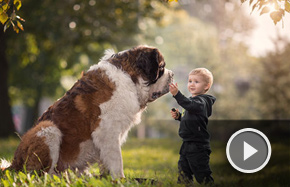
Children who have difficulty communicating with other kids usually respond better to four-legged playmates. Photos Provided to China Daily |
 |
|
Therapy dogs bring comfort and joy to the elderly at a senior care center. |

Dogs have always been man's best friend. And when your closest companion is down, you should offer help, support and encouragement. Nicole Kwan and Shi Yingying look at how puppy love helps humans in need.
When you visit a nursing home in Singapore and hear excited barks echoing down the hallway, get ready for some tail-thumping action. Just around the corner, you may find dogs of all shapes and sizes, chasing balls, performing tricks for treats or nestling contentedly in laps. But this isn't all fun and games. These canines are at work, doing what they do best - bringing happiness to the home's residents.
They are therapy dogs.
Therapy Dogs, Singapore (TDS) is a volunteer-driven organization established in 2004 that conducts regular pet-assisted therapy visits to eldercare facilities and other beneficiaries, including homes for the disabled, special-needs schools and a mental health institution.
What exactly is a therapy dog?
Some believe it refers to dogs undergoing treatment or seeking therapy for some sort of physiological or psychological relief. Others think therapy dogs guide the blind or aid the disabled in daily life. Nothing could be further from the truth.
The terms "therapy dog" and "service dog" are often used interchangeably. In fact, the two are mutually exclusive.
According to Pet Partners, an established advocate for animal-assisted therapy programs in the United States, a service dog is one specifically trained to aid in activities for the disabled that isn't considered to be a pet, although some live with their assigned clients.
A therapy dog, on the other hand, is a personal pet that joins its owner on visits to provide therapeutic aid to others, who include but are not limited to people with disabilities. They aren't required to have any special skills or training but must be of good temperament.
The first canine-assisted program originated in the 1940s, at the New York Pawling Air Force Convalescent Hospital for war veterans, who suffered from physical injuries, emotional distress and fatigue.
In 1969, "pet therapy" - a term coined by Yeshiva University psychology professor emeritus Dr Boris Levinson - became recognized as a viable therapeutic treatment by the American Psychological Association.
In Singapore, TDS founder Charlie Ho started the organization because he believes dogs are capable of more than simply being house pets.
"Ultimately, TDS is about people. Our dogs are just a means of extending our care toward the underprivileged in our community," he says.
TDS undertakes two types of pet-assisted therapy work - animal-assisted activities (AAA) and animal-assisted therapy (AAT).
AAA is more of a laissez-faire "meet and greet" monthly visit. AAT is an eight-week program that allows one-on-one interactions between canines and clients, with individualized activities designed according to physiotherapeutic and occupational therapy goals.
Before these canine companions are allowed to participate in TDS' therapy work, they are required to undergo a temperament assessment to ensure they're suitable. They must enjoy people, tolerate handling by more than one person at a time and get along with other dogs.
Head of the animal-assisted therapy subcommittee Dr Fiona Seow explains: "Animal-assisted therapy reaches out to people from various backgrounds - from the shy child who doesn't dare to read aloud, to abuse victims who find it hard to interact with others."
Elderly care home residents who live with the impacts of strokes or dementia typically experience loneliness, depression and, sometimes, limited physical mobility. During a TDS visit, they benefit from simple activities such as petting a dog, brushing its fur or playing fetch.
Animal-assisted therapy also provides children with autism, who have difficulty communicating with others, opportunities to learn about routine and emotional regulation, without the pressure of communicative speech.
The benefits of working with dogs flow both ways.
"Therapy dog work can be immensely rewarding," TDS president Valerie Gan says. "I have been fortunate to witness frowns turn into smiles without my so much as saying a word. Withdrawn people come out of their shells, laughing and reaching out to our dogs, while people who refuse to cooperate with anyone carry out tasks happily simply because it involves a dog."
Although still in its infancy, animal-assisted intervention is becoming a recognized source of supportive therapeutic work. As the awareness and acceptance of it grows in urban centers, therapy dogs and their owners may well redefine the meaning of the saying: "It's a dog's life."
Almost 2,500 km away in the Chinese city of Shenzhen, a pug, a poodle and a Bichon Frise are the center of attention in a roomful of senior citizens - most of whom are in wheelchairs or leaning on canes.
It's a special day for Shenzhen Yuandong Community's Daycare Center. Therapy dogs are visiting.
Hui Guoying, 94, attempts to attract the attention of Dengdeng, the 8-year-old pug.
"Look at his fur! It's stunning!" She insists on hoisting the 16 kg dog on her lap, even though her legs can no longer support her own weight.
Next to her, 76-year-old Zeng Jiao tells everybody in the room not to eat dog meat, while cuddling Momoco, a 4-year-old poodle.
"This dog looks like my old dog, which I had to leave in Guangzhou with my eldest daughter," Zeng says. She lowers her head, and her eyes turn red, but cheers up as Momoco licks her.
Dengdeng and Momoco are "doctor dogs" - domestic pets trained as therapy dogs. "Therapy dog" may not be a new term in Western or Western-influenced countries like Singapore, but the idea is still relatively new in Chinese mainland.
The Hong Kong-based animal welfare group Animals Asia Foundation introduced the concept into Asia 21 years ago.
"I began Dr Dog in 1991 in Hong Kong, where street dogs and pedigree dogs were being thrown away when people no longer wanted them," Animals Asia Foundation founder Jill Robinson explains.
Dr Dog was introduced to the mainland in Sichuan's provincial capital Chengdu in 2004. Now, more than 150 dogs in Chengdu, Shenzhen and Guangzhou are licensed.
"We weren't allowed in any mainland hospital," says Zhu Fangrong, Dr Dog's coordinator in Shenzhen, remembering the initial hurdles.
"Dogs were thought to carry infectious diseases. But later, people warmed to the idea. Who can say no to a canine charmer?"
The foundation's spokeswoman Chen Minjie remembers when the therapy dogs visited Chengdu's terminal cancer wards.
"The patients were very sick and the doctors were encouraging these dogs to walk to these people's beds," she says. "They reacted so well to one another. Dogs don't judge."
But there can be risks, to the dogs.
For example, during a visit to an elderly care center, a resident rolled a wheelchair over a tail.
"In situations like this, we need to make sure the dogs don't jump, bark or bite. They should never attack," Chen says.
As in Singapore, all therapy dogs must undergo behavioral and health checks. Shock tactics are sometimes used to test the dog's temperament.
"They threw a thick book at my dog, but he acted like nothing happened," Dr Dog volunteer and Dengdeng's owner Gan Hui recalls.
Pang Wenying, the father of a 7-year-old autistic boy, says his son Yanyan has benefited from playing with therapy dogs. Pang says communication is a main problem.
"He waits for other kids to come to him rather than actively seeking them out," the father says. "And he doesn't understand how to judge others' moods from their expressions."
But Yanyan has no problem communicating with the dogs, he says.
Contact the writers at sundayed@chinadaily.com.cn. Huang Yuli in Shenzhen contributed to the story.