Keeping his word securely
My China Dream | Ted Tokuchi
Ted Tokuchi, 60, is a senior executive of China's largest securities company. Clad in suit and tie, just like the image of investment bankers projected on Hollywood screens, Tokuchi has just come out of an important meeting with the management commission at his upmarket central business district office in Beijing.
With his Asian face and Beijing accent, most would find it hard to distinguish him from the average local high-flyer, except that Tokuchi is Japanese.
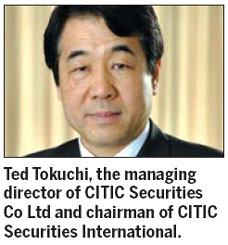
"Up to this year, I have kept the promise I made a decade ago to commit my career to CITIC Securities for at least 10 years, no matter what troubles crop up," says Tokuchi, the managing director of CITIC Securities Co Ltd and chairman of CITIC Securities International.
As far back as in 2002, when Tokuchi joined the Chinese securities company, he had decided to take on the challenges that come with China's expanding capital market.
During his decade here, he has seen the country' stock market value reach 25 trillion yuan ($4 trillion) by the end of 2011, accounting for 53 percent of total GDP, making it the world's third largest after the United States and Japan.
By the end of 2011, 2,327 Chinese enterprises were listed in the mainland stock market, with a total issue of 826 billion yuan shares. The IPOs issuing volume has been the world's largest for three straight years since 2009.
"The flourishing Chinese stock market in the past decade reminds me of the first boost in the Japanese capital market in the 1980s," Tokuchi says. Before working in China, he had worked with Daiwa Securities in Japan since 1980, plotting a "golden decade" for the Japanese securities industry until it started contracting in the 1990s.
"During my 30-year career, I have been excited twice - once by the fast growth of Japan's securities sector in the 1980s and the other by the incredible development of China's financial system," he says, acknowledging that he was fortunate to be in the thick of things.
He says China can learn from the many lessons and experiences in Japan and other countries to better develop the sector based on sustainable economic growth and financial innovation.
"After the dramatic ups and downs in the stock market and the regulation rectifications, China's securities industry is improving and more mature. The process is similar in Japan," he adds.
Tokuchi first visited China in 1964, in the sixth year of his primary school. "I came to Beijing because my parents were working here," Tokuchi says.
It was a difficult time for him, as one of the only few foreign students in class. China was still a closed country and Sino-Japanese bilateral ties had not yet been restored.
"The teacher always tried to give me chances to answer her questions in class, but I stood up and barely a word came out, as I didn't know how to speak Chinese," he says.
"My classmates often made fun of my language and I even had fights with the boys, resulting in many bleeding heads and faces."
Tokuchi had to spend an extra year in primary school, as he adapted to life in China.
"At that time, I was living in a big courtyard with many other little fellows. We played together and gradually became friends. I got more involved with local life after a year, and became more familiar with the language."
This experience of life in Beijing gave him better insight into Chinese culture and the people.
After China launched its reform and opening-up policy, an increasing number of foreign enterprises started to seek out business opportunities in the emerging market, and Daiwa Securities was one of them.
"Daiwa Securities was looking for someone who could speak Chinese and understood the culture to help introduce Japanese business in the market," he says. "I was one of the handful of Japanese who knew China quite well, so I started work as a translator."
Wang Daohan, the former president of the mainland's Association for Relations Across the Taiwan Straits, was once leader of a Chinese delegation to Japan. He was one of Tokuchi's first Chinese guests, meeting him three weeks after he joined the Daiwa Securities.
Wang had encouraged Tokuchi, saying that there was a long road ahead for China in the securities sector, but that the potential for growth was very strong and there would be plenty of opportunities for Tokuchi.
"His words made a deep impression and encouraged me to stay," Tokuchi recalls.
On Dec 5, 2012, Tokuchi received an invitation to attend a symposium in the Great Hall of the People in Beijing to meet with the Party's newly elected chief Xi Jinping. As one of 20 foreign experts invited, Tokuchi was the only participant from Japan.
"I had wanted to talk about the relationship between China and Japan, although it is facing a difficult time right now," he says. "The communication between the two countries in economic and cultural areas cannot be suspended. Instead, the development of friendly relationship should be accelerated.
"I agreed with what Xi said - that China's affairs should be left to the Chinese themselves - but that it needs support from foreign friends. China's development needs a peaceful, international environment, and it will continue to contribute to the world's peaceful development."
The Japanese investment banker says he is confident about China's economic growth.
"China is expected to develop at an average rate of 7 percent year-on-year in the next decade, if the reform and opening-up strategies remain," he says.
"Money is in favor of peace and freedom. So whether China can develop a peaceful and free environment is significant to the innovation of financial market."
chenjia1@chinadaily.com.cn
 |