In with old and in with new
 |
|
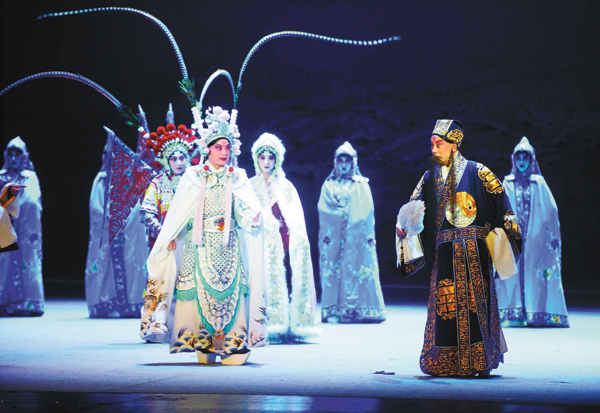
The Peking Opera Red Cliff, produced by the National Center for the Performing Arts, is staged at Hungary's State Theater in Budapest in July 2012. Luo Xiaoguang / Xinhua |
While a recent documentary on Peking Opera has come under fire from critics and purists, it could be a step toward bringing a new audience to the ancient art form.
An eight-episode documentary about the best-known of Chinese performing arts recently completed its premiere run on TV. Peking Opera is lavish and the narration brimming with purple prose. As soon as it went on air, it received plenty of attention and perhaps an equal amount of scrutiny.
A few minor factual errors were discovered, which the producers humbly acknowledged and said they would correct for repeat broadcasts. It was obvious the writer was not an insider of the profession, but used the curiosity of the first-timer to approach an art form as storied and as delicate as Peking Opera. A couple of slips in the voice-over text could be a small price to pay for attracting a potential audience whose knowledge of the art form remains limited to the television highlights of the old chestnuts, so to speak, such as Farewell My Concubine and The Intoxicated Lady.
Ditto for the profusion of re-enactment, which was also criticized by documentary purists. They accused the producers of making essentially a non-documentary where valuable interviews are condensed to snippets and soundbites, while demonstrations of performances are so elaborately staged as to qualify as scripted entertainment.
This kind of treatment, in my opinion, is designed for the non-converted rather than those already immersed in the history of Peking Opera. Just like other traditional forms of Chinese opera, Peking Opera is in dire need of cultivating a young audience. Widely considered the "national opera" of the country - not just because it was born in Anhui province and later flourished in the ancient city it's now named after - Peking Opera has a rapidly aging demographic among its most loyal supporters and it needs to change that.
There are several theaters playing Peking Opera in the capital city, and many of these cater to the tourist crowd. No, it's not like Broadway. It's exclusively foreign tourists, whose curiosity must be satisfied after they have climbed the Great Wall and trekked through the Forbidden City. The programs invariably comprise visually stimulating shows like the Monkey King tales, which are more acrobatic than vocal. The compilation of highlights is tantamount to a tray of appetizers that tantalize more than fill you up. There is little need to graduate to the main entree, which runs the risk of gluttony for someone who has just tasted it for the first time.
You cannot blame the presenters or the audience. Peking Opera is an acquired taste. It takes years to decipher the secret codes of appreciation. For one, the lyrics and dialogue tend to be impenetrable without title projection - that is for us native Chinese. And the emotions and motivations of the characters do not speak to modern audiences as much as, say, highly accessible pop music.
There was an effort to modernize the art form in the 1960s and 1970s. That repertory, called the "model operas", is in equal measure a source of nostalgia, and a reminder of pain and shame. They were not created by artists who worked under ideal conditions, to say the least, but rather, in abnormal situations where one wrong idea could land you in jail. But the end products fed a hungry nation devoid of any entertainment. In purely artistic terms, these ideology-driven operas were unqualified successes. For example, Western musical instruments were seamlessly incorporated to expand the range of expressiveness. Of course, you can argue that during those years nobody dared to offer a second opinion, and a tune repeated a thousand times would no doubt turn into a classic. But it could also be true that if you rounded up the nation's top artists and threaten them with all forms of terror, what they created wouldn't be too shabby.
For more X-Ray, click here