Living below the line
An expatriate in China looks at food from a different perspective, and takes part in a challenge that allows him only $1.50 a day for meals. Justin Ward tells us how and why he did it.

As one of the millions of Americans caught up in foodie trend that had hit the nation over the past decade or so, it is hard for me to think of food as anything other than an indulgence. I enjoy cooking and eating so much that I tend to forget that there are 3 billion people in the world who do not view food as a luxury. For them, it means life.
Partly in an effort to examine my own privileged status as one of the so-called foreign experts, I decided to take part in the Live Below the Challenge, a global campaign that calls on people to eat on less than $1.50 a day in a show of solidarity with those living in poverty.
Launched in May, the campaign was a cause du jour for celebrities, TV chefs and media personalities in the West. The public was treated to tales of anchormen living on off-brand bologna and movie stars giving up their lattes, but the perspective of a developing nation where a large proportion of the world's poor actually live was absent.
At various times in history, China faced famine on a mass scale because of invasion, political upheaval, civil war, natural disasters and any other form of calamity imaginable. Now, there are the new problems of rising costs of living and the increasing gap between rich and poor.
A fortunate outcome of the lean times is that the experience gave people tools to cope with the challenges. One is the traditional Chinese diet, which I followed rigorously to make it through the five days.
Over the week, it became painfully clear why the Chinese words for breakfast, lunch and dinner are translated to "morning rice", "noon rice" and "evening rice", and why the word for "to eat" literally means "to eat rice".
Rice became a large part of my own vocabulary and diet as well. I boiled it, fried it with green onions, made it into porridge with a hard-boiled egg for breakfast. And though I never really cared for them before, I learned to love noodles, the other Chinese staple.
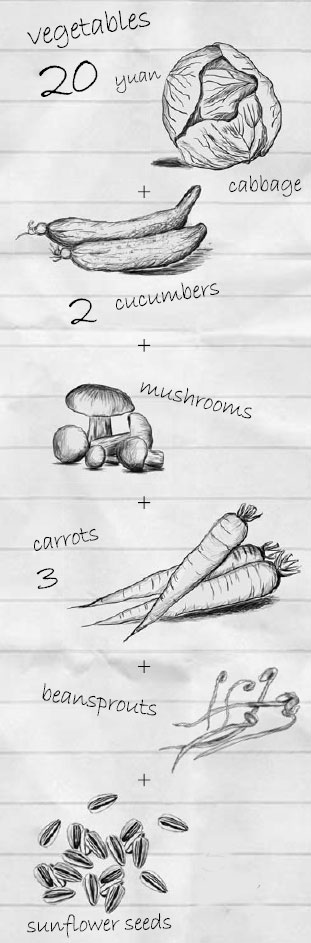
While most of my counterparts in Western countries were forced to cut out fresh vegetables for the week, I was able to afford some from the low-cost markets within walking distance from my apartment. Of course, calling them "fresh" might be a stretch. I usually found deals by going at the end of the day after the wares had already been picked over by early-rising retirees.
My breakfast of rice porridge, and my lunch of noodles with slices of carrot and bean sprouts cost so little that I was left on most days with enough in the budget to afford a couple of cucumbers or tomatoes and eggs.
Striving not to waste anything made me realize how much I had been wasting in the past. Everything that was left from a meal I packaged into containers and reused. Yesterday's soup and rice joined forces to become today's porridge.
I was able to make it through the week without becoming miserable. Sure, I bemoaned the lack of ice cream and I began to miss the convenience of food that I did not have to cook myself, but in the end, it was not all that bad.
In a way, it was enjoyable thinking up creative ways to push the boundaries of the standard of living to which I am accustomed.
Poverty has many dimensions, and the cost of food is just one.
This week has given me a new take on the value of food. My usual breakfast is at least 3 yuan (49 cents). And I often spend more than my entire food budget for the challenge just for the delivery fee of the food I order in.
Before I began, my idea of hardship, as an expat, was lack of access to deli meat and tortillas. While I cannot say I know what it is like to live in poverty now, I think I am one step closer to knowing how little I really know.
Related:
|
|
|
| City living | Rolling stone finally settles |

A day in the life of a foreign supermarket shopper
Unwilling to be a silent victim of waste