Celebrating a melting pot
 |
|
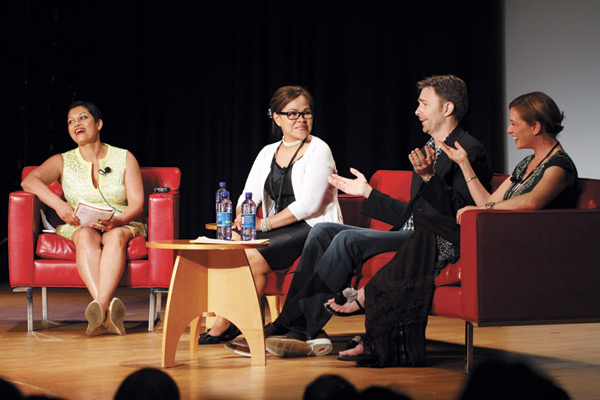
A panel discussion at the Asian-Latino Festival features cookbook author Anupy Singla (far left), White House chef Cristeta Comerford (second from left), Master Chef America Judge Trevor Corson (second from right) and Mexican-American chef Pati Jinich (far right). Sandra Vuong / For China Daily |
A festival in the United States is exploring how Asian and Latino groups in the country have interacted and influenced each other. Kelly Chung Dawson reports from New York.
This month the Smithsonian Institute presents a festival devoted to the cultural links between Asian and Latino communities. Featuring public events, an interactive social media campaign and a private gathering of academics and artists, the monthlong activity will cover a variety of topics including food and art.
"The Asian-American and Latino communities are the two fastest-growing populations in the US, and it's really important for us to think about the experiences of each community, while recognizing that they don't exist in isolation," says Lawrence-Minh Davis, initiative coordinator at the Smithsonian Asian Pacific American Center. "They have a long history of overlap, with the communities interfacing and influencing each other, through music, food and various forms of culture. We're hoping to explore the many dimensions of those intersections."
The festival represents an ongoing cooperative project between the Smithsonian Asian Pacific American Center and the Smithsonian Latino Center, which will continue its exploration of cultural intersections between the communities into 2014 and possibly beyond.
One online component to the project showcases Korean barbecue taco trucks, a popular blending of the two cultures that has manifested itself across the country. Mexican-American chef and TV host Pati Jinich, who participated in a festival panel recently about Latino-Asian connections in cuisine, noted the prevalence of Chinese-Mexican restaurants in Mexico, where chop suey and tacos sit side-by-side on the same menu.
Chefs and home cooks of Asian, Latino and other backgrounds have also explored fusion food in the last decade, trading and mixing ingredients. For example, in Los Angeles in the 1960s, sushi chef Ichiro Mashita experimented with the introduction of avocado, a traditionally Mexican ingredient, and created the California roll.
The panel, titled "Gourmet Intersections: Asian-Latino Food Crossings", featured White House executive chef Cristeta Comerford and Iron Chef judge Trevor Corson in a discussion that touched on topics including food traditions, home cooking and the evolution of Asian food in the United States.
Although some of the cultural overlap has been the result of the shared experience of being immigrants in America, the blending of the two cultures has most often been the result of simple proximity, says Ranald Woodaman, exhibitions and public programs director at the Smithsonian Latino Center.
He points to the prevalence of Latino staff in Chinese restaurant kitchens in California.
"What are the children of those workers eating at home? We're looking at those questions because cultural intersections in America are natural, and part of the American experience. Too often people talk about the history of ethnic communities within a bubble or just in relation to the dominant society, in this case white culture. But on many occasions in US history, immigrant communities have played off of each other, giving and taking, and influencing each other's identities in ways that haven't been examined before."
Other overlaps between the cultures have been more intentional, like the 1965 labor strikes in which Filipino-Americans and Mexican-Americans joined together to fight for labor rights. The Chinese Exclusion Act also contributed to the current dependence on Mexican labor in the US, Woodaman says.
The festival continued with "Art Intersections: An Asian-Latino Pop-up Gallery" on Aug 6 and 7, in the Veterans Plaza in Silver Spring, Maryland. Silver Spring is a hub for immigrant communities who have moved to the suburbs outside Washington.
The pop-up event featured art and film projections by Asian and Latino artists, including Audrey Chan, Shizu Saldamando, Albert Reyes, Mia Nakano and Monica Ramos.
The featured artists explored a variety of subjects including urban culture, street art, immigration and identity, Davis says. For people living in Southern California, the blending of Asian and Latino cultures can be especially resonant, and the subject of immigration arises often.
Audrey Chan's video Chinatown Abecadario: A Folk Taxonomy of La's Chinatown, which was featured in the pop-up gallery, has voiceovers in English and Spanish.
A convening of scholars and artists discussed the future of the project, with hopes of continuing to host events, exhibits and panel discussions that explore Asian-Latino connections. The conference wasn't open to the public, but visitors can expect to see the outcome of that discussion in the next year or two, Davis says.
"These are two communities that are changing the face of America, and it's important that we think about them in new ways," Davis says. "It's not just happening in places like California, but really all over as we become a more diverse country. Part of what we're exploring or rejecting is the idea that Chinese or Latino cultures are homogenous, because we have complexity and diversity even within our own identities."