We have launched E-mail Alert service,subscribers can receive the latest catalogues free of charge

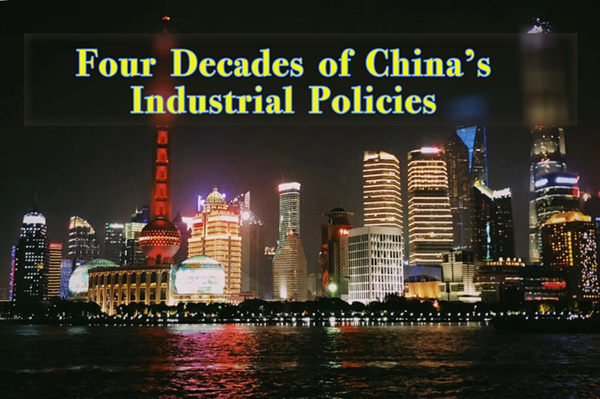
Four Decades of China’s Industrial Policies
2018-10-31


By Wei Jigang, DRC
2018-9-10
In the past four decades since the reform and opening-up, the industrial policies promulgated by the Chinese government can be concluded in a nutshell: the aspects they cover are numerous and the range they involved in are wide, their impact are strong and the achievement they have made are remarkable. According to the process of the reform, the development phases and changes in the international environment, the industrial policies in the last four decades can be roughly divided into the following four stages: the institutional transition period, the period when the market economic system was initially established, the period from the beginning of the new century to before the breakout of the international financial crisis, and the period from the breakout of the crisis to 2018.
I. Industrial policies in institutional transition period (1978-1991)
The convening of the Third Plenary Session of the 11th Central Committee in 1978 marked the beginning of China’s reform and opening-up. During the institutional transition period of China’s national economy from 1978 to 1991, the focal point of industrial policy was to rationalize the industrial structure, correct the imbalance of major proportion relations of industrial structure, accelerate the development of short-term industries and restrict the development of long-term ones so as to readjust the structural proportion imbalances in various aspects. During this period, the market economy system was yet to be fully established and the government was playing a big role in pushing ahead with the industrial structure adjustment and the development of industries, and the measures of industrial policies were made up of more direct interventions such as governmental investment, bank credit, taxation and certain plans, with indirect interventions as supplementary support.
II. The industrial policies during the period of the initial establishment of the market economy system (1992-2001)
The pace of the reform and opening-up has been accelerated notably since the year of 1992 when Deng Xiaoping inspected the work in Southern China and delivered his important speech and the 14th CPC National Congress was held. Establishing and improving the socialist market economic system became the major task and defined goals of the reform. After the industrial structure adjustment in 1980s and the development of various industries in different degrees, the goals and major task of industrial policies in 1990s changed a lot. At this stage, the industrial policies continued to lay emphasis on the adjustment and upgrading of the industrial structure. And at the same time efforts were made to push forward the development of various industries including the development of fundamental, pillar and newly-emerged and high-tech industries, and attention was paid to the transition of growth models in industrial development. During this period, the market economic system gradually took its shape and the direct intervention of industrial policies were reduced and guided indirect interventions were increased with the comprehensive utilization of economic, legal and administrative means.
III. The industrial policies since the beginning of the new century and before the breakout of the international financial crisis (2002-2008)
Marked by the convening of the 16th CPC National Congress, China’s economic development and reform and opening-up entered a new stage. On the one hand, its industrial structure and development reached a higher level, and its industrialization cause marched towards the intermediate and later stages; on the other hand, some new problems occurred before the old ones got totally solved. For example: the task of industrial structure adjustment and its optimization as well as upgrading were still heavy, the constraints from land, resources, energy and the environment became more and more obvious, and some of the underlying contradictions became prominent during the development of the industrial structure and industries of all types towards higher levels. In addition, the development gap between different regions and between urban and rural areas, social contradictions among various strata, and the increasing intensified international competitions also demanded higher requirements on the objectives, tasks, directions and measures of the industrial policies. The key point of industrial policies at this stage was the readjustment, optimization and upgrading of industrial structure so as to realize the fundamental transformation of industrial development from quantity to quality. At this stage, the market economic system had been basically established, and industrial policies focused more on the functions of market mechanism and incentive mechanism as well as providing guidance for the actions of market entities, and comprehensive measures through economic, legal, environment -protective and other necessary administrative means were adopted.
IV. The industrial policies since the breakout of the international financial crisis (2008-2018)
The international financial crisis in 2008 has dramatically reshaped China’s international and domestic situations, and its economic development has encountered major difficulties and challenges. On the one hand, the international market demand has shrunk, global currency deflated notably and trade protectionism began to surface, the external economic environment became challenging and the uncertainties have increased notably. On the other hand, China’s domestic economic growth has seen sharp decline, and the institutional and structural contradictions still exist, which have restricted the healthy development of China’s economy for a quite long period. Over-capacity occurred in some industries and the development of tertiary industries lag behind, self-innovation capability is yet to be enhanced, energy and resources consumption is too high, environmental pollution is still too heavy and the development gap between urban and rural areas and between different regions is widening. At this stage, the key point of industrial policies still lies in industrial structure adjustment and accelerating the transformation and upgrading of industries. Besides, efforts are also made to give play to China’s comparative advantages in line with the market demand changes and the new trend of technological advancement to develop a modern industrial system featured with optimized structure, advanced technology, cleanness and safety, high added-value and a strong capacity to promote the employment rate. During this period, China’s industrial policies emphasize more on technological innovation and vigorously cultivate newly-emerge industries of strategic importance, strengthen energy conservation and ecological environment protection, and push ahead with the coordinated development of regional economy.
V. How to evaluate the effect of China’s industrial policies?
First, in the past four decades, the industrial policies promulgated by the Chinese government cover many aspects and a wide range, and they have great impact and have made remarkable achievements: 1. notable progress has been made in industrial structure adjustment; 2. various industries have witnessed remarkable development and the their respective inherent quality has been greatly improved; 3. the industrial competitiveness has been strengthened. Second, the role of industrial policies in addressing the underlying problems of China’s industrial development and industrial structure adjustment needs to be further strengthened: 1. the problem that the hysteresis of industrial structure adjustment has not been fundamentally solved; 2. the long-lasting extensive way of industrial growth has not been fundamentally changed; 3. some of the industrial policies have brought certain negative impact on the overall development of industries during the formulation and implementation of the policies, and some of them even evoked controversy; 4. some problems also emerged during the formulation and implementation of industrial policies.
All in all, we need to take an attitude of critical thinking when China’s industrial policies are viewed. The role of market mechanism should not be denied simply because of the great achievements made by the industrial policies, and the role of industrial policies should not be neglected simply because of their defects. On the contrary, this is the reason why the industrial policies call for further improvement in the new era.