Host City
|
Xi'an attractions: decoding the Mausoleum of Emperor Qin Shihuang
|
||||||||
|---|---|---|---|---|---|---|---|---|
|
By Dong Jirong
|
||||||||
|
Updated: 2011-03-04
|
||||||||
|
|
||||||||
|
It took 720,000 workers and nearly 40 years to build the mausoleum. The last workers and their supervisors were buried alive along with the dead emperor, taking the secret of its construction to their graves. Designated a World Heritage Site by UNESCO in December 1987, the mausoleum of the First Qin Emperor, better known as the site of the terracotta warriors, is the largest underground tomb in the world, and has kept its secrets safe for over 2,000 years. Emperor Qin Shihuangand his mausoleum
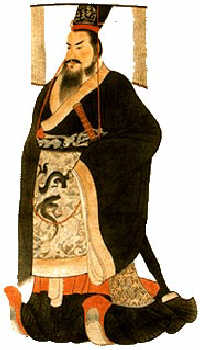
Located at the northern foot of Mt. Lishan in Lintong County, 35 km east of Xi'an, NW. Shaanxi Province, the mausoleum is the largest underground imperial tomb ever discovered. Archeologists began work on it in the early 1960s. The subsequent decades saw the discovery and excavation of burial pits surrounding the center of the mausoleum. Though the splendid necropolis is yet to reveal all its mysteries, it's famous for its incredible size and impressive burial treasures. But who was it built for? Who was warranted this kind of honor? In the third century BC, China was split into several independent and warring states. Qin Shihuang successfully defeated all rival ducal states and unified China by establishing the first centralized feudal dynasty in 221 BC. The emperor initiated a series of reforms to consolidate the nascent empire. He standardized the currency, weights and measures, as well as the width of axles and the Chinese scrip; and established the system of prefectures and counties. He also joined several defense walls around the country into the Great Wallin order to fend off invasions from the Huns in the north. All of these accomplishments helped centralize the country. But it is perhaps the creation of his enormous tomb that is the most intriguing of all his feats. Like many rulers in ancient China, Qin Shihuang was deeply superstitious and intensely focused on seeking immortality in the afterlife. His mausoleum, a subterranean world that mirrored his power and influence in real life, is the most spectacular evidence of this focus. The mausoleum was built on a site with Mt. Lishan to the south and the Weihe River to the north. Records state there were large amounts of gold on the southern side of Mt Lishan, with an abundance of jadeon the northern side. The site was considered an ideal place for the emperor's tomb because of its location. High above sea level, with mountains behind and a river in front, the geography of the site fits well with the concepts of feng shui (pronounced fung shuay), the traditional Chinese system of choosing sites and positions. It was also vast enough to realize the emperor's dream of building his tomb as big as possible to display his majesty and power. Another reason for the emperor to build his mausoleum here was that this site was also the burial site of his ancestors. The tomb of his father lies only about 10 km to the west. The mausoleum above ground level
The mausoleum covers 56.25 square km - 78 times the area of the Forbidden City. However, the hill-like grave mound is the only remaining part of the above ground structure. Years of weathering and damage have reduced its total area from the original 250,000 sq m to 120,000 sq m. and its height from 115 m to 87 m. Contemporary archeologists have reproduced on canvas some of the grandeur of the mausoleum based on the site's ruins. It was designed in accordance with the layout of the emperor's capital, Xianyang, 25 km northwest of Xi'an. The tomb was enclosed by two walls; an inner city wall and an outer city wall, forming the shape of the Chinese character hui (meaning to return). Some palaces and homes of workers in charge of gardens and temples are among the above ground structures discovered so far. The emperor's underground palace There are descriptions of the underground tomb and its layout in historical documents. The tomb was very deep and solid with a vermilion stone wall to block groundwater, making it waterproof. Inside the tomb were palaces and the burial places of all Emperor Qin's high officials. Treasures and jewels were stored there and whale-oil candles burned 24 hours a day. Booby traps such as hidden arrows protected the tomb from robbers and looters. The underground palace where the emperor's burial chamber is located has long been a mystery and speculations as to the exact location abounded. Although it has yet to be fully excavated, results from remote sensing tests show what it was really like when it was built. The palace is 170m long and 145m wide and lies about 35 meters beneath the burial mound. It symbolizes the emperor's actual palace when he was alive. The rectangular-shaped burial chamber of the emperor, situated in the middle of the palace, is about 15m high, 100-110m long and 64-75m wide - about the same size as a soccer field. Only two passageways have been discovered so far in the chamber, which is inconsistent with the usual four passageways leading in four directions in the tombs of other emperors over 2,000 years ago. A thick and solid earth wall, about 168m long and 141m wide, encircles the burial chamber. During the construction of the wall, its hardness was constantly tested. A worker standing at a distance would shoot at the wall with an arrow. If the arrow could penetrate through the wall, it had to be rebuilt. On the inner side of the earth wall is a stone wall. These two walls were made to ensure the safety of the burial chamber. Despite several devastating earthquakes in this area over the past 2,000 years, there are no signs of collapse in the tomb. This incredible feat, according to experts, might be due to the protection of the solid surrounding wall. The land where the Qin tomb was built slopes down from southeast to northwest Damage from ground water seepage was thwarted by a huge dam stretching over 1,000 m built inside the tomb to waterproof it. The dam is actually an 84 m wall, with a 17 m thick waterproof base. Interestingly, almost the same waterproofing technology was used in the construction of the National Grand Theatre of China in 2004. A large quantity of mercury was used in artworks in the underground palace, as described in The Historical Records: "mercury was used to symbolize surging river, lakes, and the sea." The use of mercury in depictions of the netherworld conveys the emperor's ambition to rule the land forever. In addition, mercury is a highly poisonous metal that can kill robbers and prevent bodies and burial articles from decomposing. Burial pits surrounding the mausoleum Can you believe the emperor was buried with the whole of the Qin Empire? Over 100 satellite burial pits and tombs, both large and small, have so far been unearthed. The largest and most attractive is undoubtedly the one housing the Qin terracotta army. About 8,000 life-size terracotta warriors and horses, covering an area of over 20,000 sq m, were built to protect the emperor in the afterlife.
Another well-known pit is the one holding two sets of painted bronze chariots. The half life-size burial articles are believed to be deluxe sedans for the emperor to go on inspection tours in his afterlife. They were originally painted in exquisite colors and appeared much more magnificent than they look today.
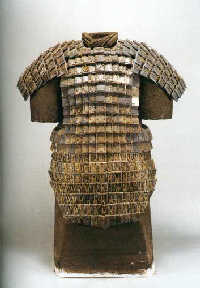
A rectangular pit containing stone armor suits was unearthed some 200 m southeast of the grave mound. The armor was made of stone flakes and intended as burial articles rather than for practical use. Tests show it would take a worker between about 350 and 450 days to make a suit of armor with 600 stone pieces if he worked eight hours per day, excluding preparation time. In Xinfeng town, six kilometers north of the mausoleum, materials, tools and semi-finished stone armors have been discovered, suggesting it was an armor-processing site. The emperor remembered to bring his civilian officials with him into the next life and a special burial pit for them. The pottery figures' costumes and headgear reveal they were Emperor Qin's high-ranking civilian officials. They do not carry any weapons, but each has a knife and sharpener at their waist which was used to scrape off incorrect writing inscribed on wood or bamboo in the days before paper was invented. Four yues (similar to tomahawks) symbolizing imperial power to punish disobedient workers were unearthed in this pit. A newly discovered pit containing pottery acrobats and a bronze tripod tells us there was more to the emperor's life than political affairs. Clad in short skirts, the life-size figures vary in postures as if they were performing on the stage, and are more active and expressive than the terracotta warriors. They might be modeled after the acrobats who served in the imperial palace to entertain the emperor. The unearthed bronze tripod (ding), delicately shaped with rich, fluid and beautiful patterns, was probably a sacrificial vessel.
 Thirty-one pits containing bones of rare animals have been discovered, indicating the emperor was also fond of hunting. Each pit contains a kneeling pottery figure with a pottery basin or jar lying in front showing they were attending these animals. A pit of bronze water birds is thought to be the emperor's underground amusement park. Mausoleum workers included criminals, unpaid peasants, craftsmen and slaves. A huge burial pit covering over 1,000 sq m and full of a thick layer of bones was discovered in a village near the mausoleum. That was the end result for many of the builders. The tomb's construction required a lot of stones. Under primitive conditions without modem transportation, it was a gigantic task to push, pull and move the large stones. In a village northwest of the mausoleum, iron fetters, iron hammers and semi-finished stones were discovered, indicating that it was a stone-processing site. An embankment about 3,500 m long and 40 m wide was built between the Mt. Lishan and the mausoleum to divert water from the mountain to the Weihe River and protect the tomb and the burial pits from water. The mausoleum seems to depict the whole of the China in miniature. For anyone who wants to know more about China's past, this splendid necropolis is definitely not to be missed. |
 |
 |