Following the retreat to Taiwan in 1949, the defeated Kuomintang pledged to launch a counterattack against the mainland within five years.
In preparation for the attack, junior soldiers in the army - many of whom were in their early 20s - were forbidden from marrying to ensure that they were focused on the task ahead. The atmosphere became so fraught that Taiwan residents who attempted to cross the Straits could be charged with spying for the mainland, an offence that carried the death penalty.
However, the disparity in military strength meant the attack never materialized. Meanwhile, as the young soldiers aged and were released from military service, they found themselves living alone. To make matters worse, most were on the bottom rung of the social ladder and lacked financial security.
In 1979, as the reform and opening-up policy began to make a mark, the mainland published an open letter to Taiwan calling for an end to confrontation and suggesting direct cross-Straits links for transportation, mail and trade.
In the 1980s, a wave of "go-home movements" launched by homesick veterans and civilians - many of them unmarried 60-somethings - pressured the authorities in Taiwan to rethink the decades-old policy of isolation. As a result, in 1987, Taiwan residents were finally allowed to travel to the mainland to visit relatives.
However, most of those who had relocated in 1949 - along with Chinese soldiers who were sent to the island after being captured during the Korean War - were unable to return home, according to Xia Hengfang, who heads a program run by the Shenzhen Longyue Charity Foundation, a mainland NGO that helps veterans and their relatives in Taiwan find their families.
"Even after they were allowed to visit the mainland, many failed to return due to a variety of reasons," she said.
"Some could not afford the trip; some had remarried on the island and were afraid to face their families on the mainland; while others were daunted by the political bias in Taiwan against the mainland."
Now the older generation is beginning to die off, Xia is not surprised that their descendants are taking up the baton to reunite with their relatives on the mainland.
"'Who am I and where I am from?' These are questions that trouble many of the younger generation born and raised in a nostalgic environment in Taiwan," she said.
Chou Sz-yu, a 27-year-old from Taiwan who lives in Beijing, is the head of Jinri Toutiao's "family reunion" program.
She said many homesick veterans died before they were allowed to return to the mainland, but their dying wish was that their children should make the trip when circumstances allowed.
"More than three decades have passed since Taiwan residents were allowed to visit the mainland, and the bias against the mainland has abated as cross-Straits communication widens and deepens," she said.
Some of those who relocated visited the mainland after the ban was lifted, but failed to keep in touch.
"After they die, their children will want to re-establish Cross-Straits relations," Chou said.
'Impulse to return'
Xia, from the Longyue charity, said traditional culture is still paramount in Taiwan, and people attach great importance to maintaining their bloodline and respect for their native soil.
She is confident that interpersonal connections across the Straits will not be severed as the older members of the relocated population die. "The impulse to return home is in the genes of many of the younger generation in Taiwan," she said.
While Tang Yonghong, deputy director of the Taiwan Research Center at Xiamen University, Fujian province, echoed Xia's comments, he expressed concerns about Taipei's propaganda program and its education system, which advocates independence for the island.
"Given that the younger generations have very few shared experiences with their mainland compatriots, these messages could be quite misleading," he said.
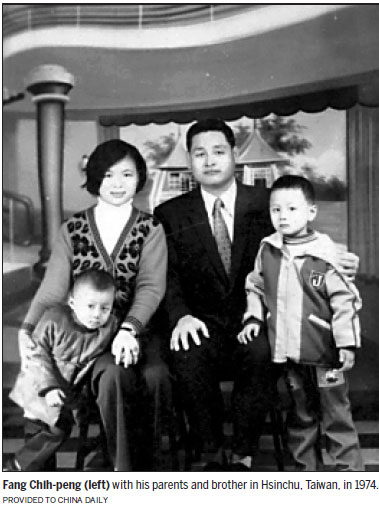
Despite the uncertainty about the future, Fang Chih-peng is still basking in the glow of his recent reunion with his long-lost family.
For him, the cross-Straits relationship is like the one that exists between distant relatives. "The key to keeping it healthy and robust is to maintain it through greater interaction," he said.
Contact the writer at lilei@chinadaily.com.cn