Giving voice to ethnic-song preservation
Updated: 2012-11-30 12:45
By Wei Wei for China Daily(China Daily)
|
|||||||||||


|
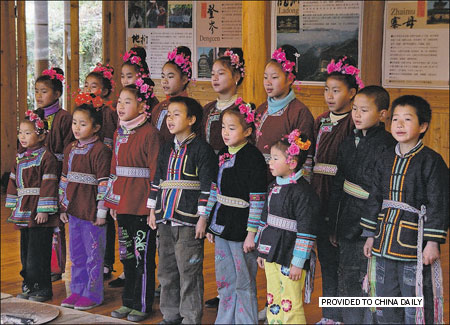
Dong students sing during their weekly musical training session in Dimen, in southwestern China's Guizhou province, as part of the 100 Dong Songs program. |
|
US first lady Michelle Obama presents the Inter-national Spotlight Award at a White House ceremony on Nov 19 to a Chinese community group that's preserving the cultural heritage of the Dong ethnic group. Next to her is Wu Lianyun, a 13-year-old girl of Dong ethnicity; Ren Hexin, head of the Western China Cultural Ecology Research Workshop; and Deng Hongbo, deputy chief of mission at the Chinese Embassy in Washington. |


Dong minority pins hope on 'young heirs' to keep its musical heritage from fading
A day after she was honored at the White House and hugged by first lady Michelle Obama, 13-year-old Wu Lianyun was en route to Dimen, an enclave in the mountains of southwestern China's Guizhou province.
All of Dimen's residents, including Wu, are of the Dong minority.
In Washington, Wu had helped represent the 100 Dong Songs program organized by the Western China Cultural Ecology Research Workshop. Along with the group's secretary, Ren Hexin, the teenager collected an International Spotlight Award at a White House ceremony on Nov 19.
The award is given by the US National Arts and Humanities Youth Program to outstanding community-based extracurricular initiatives. Among this year's dozen honorees, 100 Dong Songs was the only winner from abroad.
Part of a broader Dong-culture effort, 100 Songs is dedicated to preserving the ethnic minority's folk music. Established in 2003, the musical effort has cultivated over 800 "young heirs" to this indigenous tradition, according to Ren.
Taught by seasoned Dong singers, about 100 young people like Wu sing every Saturday morning in a Dimen cultural museum. About 100 folk songs were collected from the region and recorded on CD with lyrics translated into Mandarin for use in the music classes of local primary and middle schools.
"Because young people are key to perpetuating these cultural traditions, the Workshop plays an important role in inspiring Dong children and youth to appreciate and preserve their heritage," read the White House description of the Dimen-based program. It was nominated for the award by the Asia Society.
Numbering over 2.9 million and one of China's 55 acknowledged non-Han ethnic groups, the Dong had no written form of their language, Kam, until 1958. They had been passing down their culture and knowledge through songs.
Dimen, founded during the Tang Dynasty (AD 618-907), is the second-biggest Dong enclave in China and a historical source of folk songs.
Amy Tan, the Chinese-American author of The Joy Luck Club and other novels, wrote about the Dong tradition of communicating through song in a 2008 article in National Geographic magazine.
From 2005 to 2007, Tan visited Dimen three times in preparing for a San Francisco Opera production of The Bonesetter's Daughter based on her 2001 novel of the same name.
"Entering into the village I had little girls singing those songs - those Dong songs, the welcoming songs - one at each elbow. And they sing on key, on rhythm, perfectly a capella, in tune with one another," Tan wrote in her National Geographic essay, headlined "Village on the Edge of Time".
Sadly, this heritage, recognized by the United Nations Educational, Scientific and Cultural Organization in 2009, has been fading from the Dong's daily lives for about 30 years, according to Ren, who grew up in Liping County, where Dimen is located.
"Unlike Peking Opera or other Han people's art that is independent from life, Dong songs used to be part of Dong people's lives," he said. "But the soil for this 1,000-year-old singing tradition has almost disappeared."
Dong songs were banned during China's "cultural revolution" (1966-76) when many art and cultural forms were condemned, but even after the ban was lifted, the predominance of Mandarin made singing in their native tongue unnecessary for Dong people, Ren said.
Joanna Lee, who is active in trying to preserve Dong culture through her work for the Western China Cultural Ecology Research Workshop, has seen the upside and downside of economic development in Dimen. Ten years ago, Ren took Lee and her husband, Ken Smith, an arts critic for Britain's Financial Times, on the couple's first trip to the village.
"It wasn't until 2002 that Dimen had electricity," Lee recalled. "But suddenly, in 2006, almost every household had a television. People's lives improved further, after the abolition of agriculture taxes in 2007. But because of television, popular culture and everything coming in, people don't value as much what is actually their own. They don't have an interest in learning Dong songs."
The trend of urban migration has also meant severe challenges for the Dong's centuries-old traditions. In 2008, according to Tan, about half of Dimen's 2,400 residents worked and lived elsewhere. Immersed in the modern lifestyle, most can sing no more than a few simple Dong songs.
Wu Lianyun had been living with her parents, who for years worked at factories in the southern coastal province of Guangdong. Before returning to study in Dimen last year, the Internet-savvy teen, who has her own mobile phone, couldn't sing any ethnic songs.
Even children who grow up in Dimen usually speak Mandarin at school and get little exposure to their indigenous culture or language other than from grandparents.
Without any written music, Dong songs are literally kept in the memory of the older generation. Statistics from the Intangible Heritage Protection Center of Guizhou province show that the 244 "singing masters of Dong songs" recognized by the central and provincial governments have an average age of 68. The oldest master is 92.
"The population of Dong singers is so small. If, gradually, people are all singing popular songs, in two to three generations, the Dong songs will probably disappear," said Lee, who visits Dimen every year with her husband.
Tension between tradition and modernity prompted Ren and the Workshop to draft a proposal on preserving Dong culture for the Liping County government right after Lee's 2002 trip.
"It is inhumane to force the Dong people back to follow their ancestors' way of living, but we can't just do nothing but watch the songs die, as they carry the history and wisdom of the ethnic group," Ren said.
The broader initiative, Passing Down Dong Culture, was established in 2003 when the Workshop was tasked to advise the county government and Ren was named the group's executive director.
The first step was 100 Dong Songs. In 2003, Ren selected 30 Dong teenagers who had recently graduated from ninth grade, from Dimen and neighboring villages to begin intensive vocal training. With guidance of the "singing masters", they shared the folk music in their villages and traveled around to understand the songs' context.
At a common age for Dong people to leave school, five students quit the program to seek work outside their mountainous home region, while the 25 who remain have been the backbone of the Saturday morning song sessions since 2005.
"It is like an experiment," Ren said of the weekend training. "Now we try to make the after-school activity a new conduit for Dong songs, but if it doesn't work out well, we will seek new ways to preserve the culture."
He said tourism of any sort beyond that of academic visitors conducting research would be disruptive to the lives of Dong people in Dimen.
In recent years, the village has embraced "high-end" guests thanks to efforts of Lee and her husband. Apart from Tan, National Geographic photographer Johnson Lynn and composer Stewart Wallace have sought inspiration in Dimen. In 2007, Nobel-laureate economist Joseph Stiglitz and his wife set foot on the village at the invitation of Lee and Smith.
In 2004, the couple helped produce a Dong music recording, of which several pieces were later used in a production of Yellow Face by Chinese-American playwright David Henry Hwang (M Butterfly, Chinglish).
Amid increased attention to his cause, along with numerous awards, Ren is clear-eyed about the prospects for Dong culture. He heard that Wu told reporters she wasn't that interested in singing Dong songs.
"It is understandable and pretty common among kids in Dimen," Ren said. "But to ensure the future existence of their own culture, we have to keep them exposed to the songs and try to make it more interesting."
Dong songs require multiple-part vocalizing, so students must practice and perform in a group and take different parts within it. Wu, despite winnowing passion for the folk art, can sing about 10 Dong songs including celebratory and drinking numbers, and one titled I Want to Be A Singer When I Grow Up.
According to Ren, it wasn't so much vocal skill as a willingness to reach out and share the craft that made Wu the chosen representative of her fellow students. Since she joined the Workshop program a year ago, she has brought about 15 peers from her village every Saturday to take the singing course. Other students have been organized in the same way by "little leaders" such as Wu.
"Kids tend to go with the flow," Ren said. "If their friends sing in the museum, they will follow suit."
Cai Chunying contributed to this story.