|
|

An employee stands near a F3DM, a hybrid car manufactured by Chinese company BYD Auto, at the Guangzhou Autoshow. Car sales have been robust due to the government's tax policies. Tyrone Siu / Reuters
|
1. Six RRR hikes
The People's Bank of China raised the reserve requirements ratio (RRR) for banks six times this year. Each time the RRR was hiked by 50 basis points, from 15.5 percent at the end of 2009 to a record high of 18.5 percent in December 2010 to mop up excessive liquidity.
On Dec 10, the central bank announced the third hike of banks' RRR in a month to curb inflation, which had accelerated during the past two months. Before that, Chinese mainland stock markets traded lower for a week as investors speculated about an interest rate increase.
Analysts said raising the RRR in preference to interest rates indicated government caution over concerns that a tightening monetary policy could hamper economic growth.
2. Efforts to cool down property market
Central government has been working to restrict the number of apartments a family can buy in 2010. Families that apply for loans for their second home must pay more than 50 percent of the price as a down payment. Also, prospective buyers whose first house is more than 90 square meters must pay at least 30 percent of the total value before arranging a mortgage.
These rigorous real estate policies, allied to rumors that Beijing and Shanghai will be among the first cities to undertake property tax trials, slowed price growth in the housing market.
November home prices in 70 major cities climbed 7.7 percent from a year earlier, slower than the 8.6 percent increase in October and the 9.1 percent growth in September, the National Bureau of Statistics said on Dec 10.
3. Shift to 'prudent' monetary policy
At 2010 China's Central Economic Work Conference, policymakers endorsed the replacement of a "relatively loose" monetary policy with a "prudent" one.
At the end of November, China's M2 measure of broad money supply, which covers cash in circulation and all deposits, had increased 19.5 percent year-on-year to 71.03 trillion yuan ($10.76 trillion). New data from the National Bureau of Statistics showed that the inflation rate in China reached 5.1 percent in November, the highest in 28 months, prompting the government to make liquidity tapping a priority.
To reshape a consumer-led economic growth pattern in the coming 12th Five-Year Plan period (2011-2015), the authorities considered policy guidelines during the conference including improving macro-control, promoting modern agriculture, and reforming the income distribution mechanism.
4. Equal tax treatment
China started to levy two taxes on foreign companies from Dec 1, marking the beginnings of a standard national tax regime for both Chinese and overseas enterprises.
China will charge foreign firms operating in the country two additional taxes (a construction tax and an education surcharge), according to a State Council announcement in late November.
The measure will force a rise of up to 10 percent in local operating expenditure for foreign enterprises. However, analysts said the effect on foreign investors will be limited.
Data from the Ministry of Commerce showed that between January and October, China's foreign direct investment (FDI) grew by 16 percent from a year earlier, and October was also the 15th consecutive month that FDI had registered positive growth.
5. Car tax
Tax preferences on car purchases of vehicles with smaller engine capacities will expire from 2011, said the National Development and Reform Commission, China's main economic planning body in early December.
The end of tax reductions and subsidies next year boosted car sales in November. According to data from the China Passenger Car Association, more than 1.28 million cars were sold in November, a 27 percent rise from a year earlier and 10.5 percent higher than October. Experts said domestic market sales form 2010 will pass 17.5 million units.
In Beijing, automobile ownership had reached 4.67 million by late November, and is expanding by more than 3,000 vehicles a day, up 200 percent year-on-year, and imposing huge pressure on the city's transportation sector.
6. High-speed rail on the fast track
China will invest 3 trillion to 4 trillion yuan ($451-601 billion) in the high-speed railway industry as part of the 12th Five-Year Plan (2011-2015), the China Securities Journal reported.
During the seventh World Congress on High-Speed Rail, China signed eight memoranda and agreements with eight counties to work together on railway construction, which led to a gain for stocks of rail-related companies.
As the Beijing-Shanghai high-speed railway, the longest and fastest in China will become operational in 2011, thousands of kilometers of high-speed track are under construction now.
The Minister of Railways Liu Zhijun said China leads the world with a high-speed rail network of 7,531 km. That is set to expand to 13,000 km by 2012, and 16,000 km by 2020.
7. The clean-energy drive
Clean energies, such as nuclear, wind, and solar photovoltaic power, have enjoyed a favorable policy environment during 2010 as China aims to increase its proportion of clean-energy production to about 15 percent during the 12th Five-Year Plan period (2011-2015).
According to data from the National Energy Administration, 62 percent of growing investments in the past three quarters were in the clean-energy industry. China's installed capacity of nuclear power is more than 10 million kilowatts, and will rise to nearly 40 kilowatts by 2015.
The bureau predicted that China's total installed wind power capacity will reach 35 million kilowatts in 2010, while solar energy will reach 600,000 kilowatts, double the wattage of last year.
8. City clusters
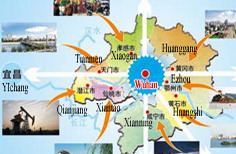
The government promised to create six city clusters to promote the development of Central China, according to an August directive from the National Development and Reform Commission.
The six city clusters include those at Wuhan in Hubei province, Changsha-Zhuzhou-Xiangtan in Hunan province, and Poyang Lake in Jiangxi province.
City clusters are built to provide more concentrated industries and more equitable source distribution, to balance development among China's different regions.
According to the directive, the local governments of six provinces in Central China should finish the plan by the end of this year.
9. Culture industry to become an economic pillar
China's culture industry has grown at a rate of more than 15 percent during the past five years.
That fact prompted a government proposal to "promote the culture industry to one of the pillar industries of the economy" at the Economic Work Conference earlier this month.
As China further embraces reform in this field, 2010 will be seen as the turning point in the development of the culture industry.
According to a report from the Chinese Academy of Social Sciences, China's culture industry was worth 800 billion yuan ($120 billion) in 2009. Digitalization of content, and cooperation with the private sector are considered the next steps in the development.
10. Electric cars on full charge
China's top economic regulators and four related ministries launched a subsidies statement about individual purchases of electric cars in June.
The policy targets plug-in hybrid electric vehicles and vehicles powered exclusively by electricity, with a 50,000 yuan subsidy available in five cities of Shanghai, Shenzhen, Changchun, Hangzhou and Hefei.
According to the Shanghai Electric Cars Promotion Office, there will be 100,000 electric cars in the city by 2012, worth 30 billion yuan to the industry. Around 60 percent of these electric cars will be owned by individuals.
China Daily
(China Daily 12/23/2010 page14)
|