Ancient Xanadu still amazes
By Wang Kaihao and Yang Fang (China Daily)
Updated: 2013-07-21
In the Merriam-Webster Dictionary, "Xanadu" means an idyllic, exotic, or luxurious place. Luckily we have a chance to experience it firsthand.
The road leading to the site of Xanadu in Zhenglan Banner, the Inner Mongolia autonomous region, is too rugged to enjoy the grasslands outside the window.
However, the unpleasant off-road drive is overshadowed by the excitement of approaching this summer capital of the Yuan Dynasty (1271-1368), the only UNESCO World Heritage site in Inner Mongolia.
Built in 1259, Xanadu shaped Westerners' perception of a wealthy Oriental land after Marco Polo described the town in flamboyant language in his work: Book of the Marvels of the World (commonly called The Travels of Marco Polo) to describe this remarkable place.
As soon as we step onto the path leading to the old city gate it begins to rain heavily. Despite it being late-June, it feels a little cold in the wind.
"There is a gorgeous marble palace, which is wholly painted golden with various elegant designs of animals and flowers. You can feel both visually and heartily pleasant when facing it," Marco Polo once wrote.
The Mongol emperors of the Yuan Dynasty spent half the year in Dadu, predecessor of today's Beijing. They moved to Xanadu during the summer.
Merchants, missionaries, and travelers from the Middle East and Europe gathered to this international hub for business and culture, whose population reached a peak of 14,000 in the 14th century.
Many historians describe Xanadu as the heart of world in that epoch. It also explains why today's standard spoken Mongolian language in Inner Mongolia is based on the dialect of Zhenglan Banner. The two-capital system is probably also a reflection of Mongol's nomadic tradition moving around the grasslands in different seasons.
Many marvelous buildings in Xanadu were burned down in the wars at the end of the Yuan Dynasty. Still, the glory of times past lingers.
The relic of the old city covers an area of 4.2 sq km, and the foundations of more than 1,000 buildings have been unearthed since large-scale archeological studies begun in 1996.
However, a lack of historical records means the history and past purpose of many of the buildings remains a mystery. Surrounding grasslands of 45 sq km have been fenced to stop herding and better protect the relic after it was listed as a World Heritage site in 2012.
The city's three-layer homocentric outline is almost intact, but it is not as symmetrical as other ancient capitals in China, and is a combination of Han aesthetics and Mongolian habits.
The city walls are in disrepair, however the piles of black bricks still look solid. They are glued together by cohesive mix of eggs, sticky rice and lime. An elm tree struggles to grow from a crack in the wall. It is said to have stood there for 500 years. Many locals of the Mongolian ethnic group have donated khatag - a long blessing silk piece - to this tree, which honors the rebirth of this metropolis' everlasting spirits.
Remains of beacon towers are still erect on the mountains by the city. In the case of an emergency, information could be transferred to Dadu within 20 minutes via a beacon relay.
Da'an Pavilion is the main palace in the city where six of 11 emperors in Yuan Dynasty ascended to their thrones. Marco Polo first met Kublai Khan here in 1275.
The palace, which was said to be 70-meters-high, is embedded in square foundations and scattered stone pillars. One pillar carved with delicate images of dragons was stolen in 2007, but was soon found by police. It is now the one of the most precious remaining pieces at the site.
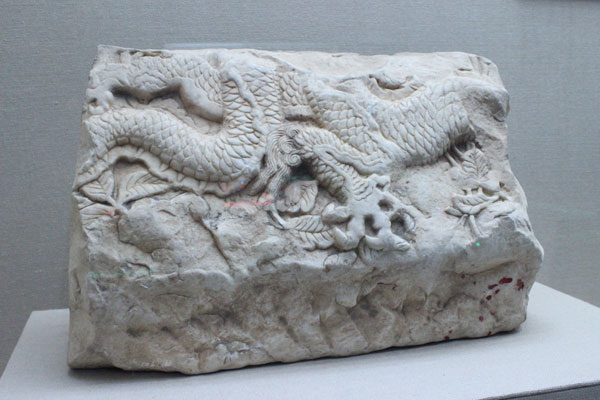
The rain has started to pour now, preventing further exploration of more sights. The grasslands in this area will be dotted with golden troll flowers from mid-July. It is pity we have come too early to see this stunning scene.
We go back to the seat of Zhenglan Banner to marvel at antiques and architecture discovered at the site but now exhibited in Xanadu Museum.
The pieces reflect the many aspects of life during the booming civilizations of the Yuan Dynasty. It is far beyond our expectations.
Mysteriously, as soon as we finish the journey and look for a restaurant to pause in to meditate on the history we have just encountered, the rain stops.

High-speed train debuts in Inner Mongolia
A bullet train departed Hohhot East Railway Station for Ulanqab marking the start of high-speed rail services using Inner Mongolia’s first newly-laid high-speed railway on Aug 3.