Impolitic gambit









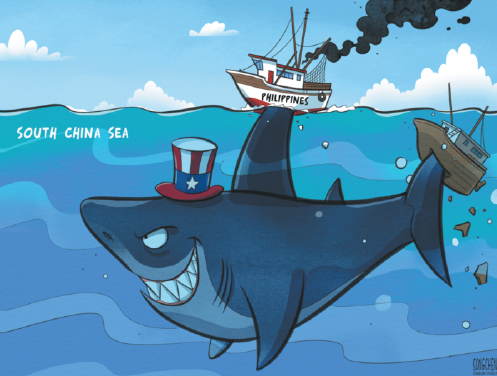
By allowing itself to be pulled into the US' 'Indo-Pacific' strategy, the Philippines is heightening the tensions in the South China Sea
The United States and the Philippines have enhanced defense cooperation to serve their respective strategic interests in recent years, stirring up tensions in the South China Sea and the Asia-Pacific region as a whole.
In its "Indo-Pacific" strategy issued in 2022, the Joe Biden administration said the United States' target is not to change China, but to shape the strategic environment around China. The "Indo-Pacific" strategy underlines the key roles of the US' allies and partners, among which, Japan is viewed as a major aide, while the Philippines is an important "piece "on the US' strategic chess board.
The strategic importance of the Philippines is reflected in three aspects.
First, it has a critical geographical location. The Philippines sits at the south of the First Island Chain in the West Pacific, and is an integral part of the US' strategy to encircle and contain China within the First Island Chain. Once there is a contingency in Taiwan or in the South China Sea, the US can use the military bases in the Philippines to intervene militarily.
Second, the US is trying to drag the Philippines onto its strategic chess board to serve its "Indo-Pacific" strategy by supporting the latter's territorial claims in the South China Sea. The US has called on China to comply with the illegal ruling of the 2016 South China Sea arbitration, and pledged to provide a security guarantee to the Philippines and defend its maritime rights.
Third, the Biden administration has been pushing for closer security cooperation among the US, Japan, Australia and the Philippines to challenge China's sovereignty and security simultaneously in the Taiwan Strait, the East China Sea and the South China Sea. The Philippines, as a military ally of the US in the Asia-Pacific, is viewed as a key node in the US' "Indo-Pacific" strategy to contain China thanks to its geographic proximity to Taiwan island, and its position as a gateway to the Pacific.
Since Biden took the office, the US-Philippines defense partnership has shown new developments.
First, the US has expanded its military presence in the Philippines.
In 2023, the Philippines allowed the US to deploy forces in four more of its military bases, bringing to nine the number of Philippine bases the US has military access to. The "Indo-Pacific" Command of the US plans to build 34 projects in the nine military bases in the 2024 fiscal year and accelerate the deployment of forces on the frontline of the "Indo-Pacific". The Philippine military bases, along with the US military bases in Guam and Okinawa of Japan, form the military barrier of the US along the First Island Chain.
Second, the US is conducting joint patrols with the Philippines in the South China Sea and intervening in the South China Sea disputes. The Biden administration has emboldened the Philippines to provoke tensions in the South China Sea and confront China. The US has even threatened the use of the US-Philippines mutual defense treaty against China.
Since 2023, the US started conducting joint controls with the Philippines in the disputed areas in the South China Sea to back the latter's moves to encroach on China's territorial rights. In April, the US, Japan and the Philippines announced in their first trilateral summit that they will hold joint coast guard patrols in the South China Sea this year, and conduct joint maritime military drills in the "Indo-Pacific "region in 2025.
Third, the US is drawing the Philippines into its geopolitical cliques in the Asia-Pacific. The Biden administration upgraded the Quad, created AUKUS, and has built other mini-multilateral security mechanisms with Japan, the Philippines and Australia in a bid to thwart China's maritime aspirations.
In their April trilateral summit, the US, Japan and the Philippines expressed "serious concerns" over the situations in the South China Sea and in the East China Sea, and reiterated the "importance of peace and stability across the Taiwan Strait". The US and Japan pledged to support Philippine coast guard capacity building, and provide maritime law enforcement training to the Philippines.
The three nations also seek to enhance cooperation in economy, science and technology, clean energy and supply chains. Through these moves, the US aims to incorporate the Philippines into its "Indo-Pacific" strategy.
By upgrading its defense partnership with the Philippines and dragging the country into its "Indo-Pacific" strategy, the US is heightening the tensions in the South China Sea and presenting new risks to the security situation in Asia-Pacific.
First, the US-led small anti-China cliques such as the Quad, AUKUS, the US-Japan-Republic of Korea alliance, and the US-Japan-Philippines alliance create bloc confrontation in the Asia-Pacific.
Second, as the US defines China as its primary strategic competitor and is forcing regional countries to pick sides between the US and China, the risk of a US-China conflict and a new Cold War in the region have increased.
Third, there is a growing risk of a China-Philippines conflict over their maritime disputes. Under former Philippine president Rodrigo Duterte, the ties between Beijing and Manila took a turn for the better thanks to the courage and vision displayed by Duterte, who withstood the pressure from the US and domestic nationalists to shelve the maritime disputes between China and the Philippines and promote joint development.
However, after Ferdinand Marcos Jr took office, despite his rhetoric on wanting to advance the traditional China-Philippines friendship, he has been emboldened by the US' support and incited by domestic nationalism to make one provocative move after another against China in the South China Sea. As a result, the China-Philippines maritime disputes have escalated sharply, and confrontation between the two countries' coast guards has become a normal occurrence in the waters surrounding Ren'ai Reef and Huangyan Island.
It is foreseeable that if the Philippines continues to ignore the consensus reached by the two countries on Ren'ai Reef and makes provocations in the South China Sea by relying on external forces, a maritime conflict may break out between China and the Philippines, which is not in either country's interest.
The author is a professor at the Center for American Studies at Fudan University. The author contributed this article to China Watch, a think tank powered by China Daily.
The views do not necessarily reflect those of China Daily.
Contact the editor at editor@chinawatch.cn.