



Tianjin: Timeline of CPC development, successes









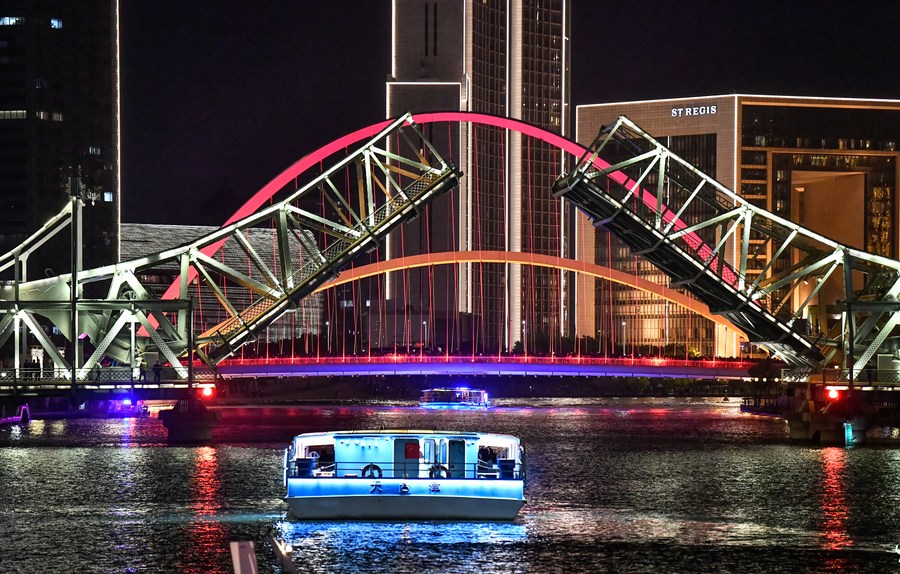
Editor's note: The Party School of Tianjin Municipal Committee of CPC provided authoritative results and historical records about the CPC's development in North China's municipality of Tianjin; the CPC's efforts to inspire local residents' awareness to rescue the country, fight against Japanese invaders and liberate the city; and also its campaigns to boost local economy and culture after the founding of the new China. Yang Cheng reports.
New Democratic Revolution Period (1919-1949)
1. Li Dazhao (1889 -1927) and the Beiyang Law and Politics Institute
Li was China's forerunner, co-founder of the CPC and the first person to advocate for Marxism in the country. He studied at the Beiyang Law and Politics Institute in Tianjin in 1907 and supported a series of movements and activities to boost Communism in the city. He once said the institute played a pivotal role in North China's political movements in the 1920s.
2. Zhou Enlai (1898-1976) and Deng Yingchao (1904-1992) and the Awakening Society
Former Chinese premier and CPC leader Zhou Enlai and his wife Deng Yingchao, a leading revolutionist, studied in Tianjin when they were young and joined in the great May 4th Movement in 1919, the beginning of China's Democratic Revolution.
On Sept 16, 1919, together with some 50 youth members, they set up the Awakening Society to spread Marxism.
3. The first CPC member in Tianjin and the Tianjin Socialist Youth League
Zhang Tailei (1898-1927), a pioneering Communist and leader in Tianjin's patriotism movement, joined the CPC at Tianjin University, becoming the first CPC member in the city.
He actively joined the May 4th Movement and built strong ties with Li Dazhao (1889-1927), China's forerunner in spreading Marxism and Communism, and Chen Duxiu (1879-1942), one of the founders of the CPC.
He started the Tianjin Socialist Youth League, an organization to boost interest among local youths in patriotism and learning from Marxism and Communism.
4. The executive committee of the Tianjin CPC
Since the founding of the CPC in 1921 in Shanghai, the Tianjin executive committee was set up to boost Marxism and began spreading Marxism, boosting the movements among the youth, women and industrial workers.
Yu Fangzhou (1900-1927) founder of the Tianjin Socialist Youth League, a Tianjin native and leading student movement leader, was tapped as the Party chief for the committee. He led the workers' movements but was killed by an enemy after a rebellion in Yutian, Hebei province.
5. The CPC North China Bureau and the North China Anti-Japanese National United Front
In 1936, Liu Shaoqi (1898-1969), a political leader and a pioneer in CPC history, set up the CPC North China Bureau in Tianjin in 1936, promoting the formation of the North China Anti-Japanese National United Front.
In January 1937, the CPC mobilized local Kuomintang military leader Song Zheyuan (1885-1940) to jointly fight against the Japanese invaders, marking the inauguration of the North China Anti-Japanese National United Front.
6. The Anti-Japanese Base Area in Panshan Mountain
Since the full-scale outbreak of Anti-Japanese Aggression in 1937, the city was occupied by the enemy on July 30.
The CPC members beefed up their efforts to unite advanced classes in the society to join the fight and set up Panshan Mountain, a mountain bordering Beijing and Tianjin.
It became the headquarters of the whole city's fight against the Japanese invaders and played a pivotal role in the victory in the region.
7. Tianjin Liberation
Due to the failure in negotiations with Kuomintang, the People's Liberation Army liberated the city in January 1949.
The victory of the Tianjin Battle ended the history for the commercial city's nearly 50-year half-colonial and half-feudal era, and opened a new chapter for the city.
Socialist Revolution and Construction Period
1. "Tianjin Talk"
The then Party secretary of the CPC Central Committee Liu Shaoqi came to Tianjin in April to May 1949.
He did in-depth research into the local private economy, made a famous speech in Tianjin – later recorded in the history as "Tianjin Talk" -- to explain the Party's blueprint for the country and boost local reforms for the private economy there.
From 1951 to 1953, the local economy saw major recovery.
2. Revitalizing local economy
In June 1953, the country entered its first Five-year Plan period (1953-1957). The city played an important role in the country's industrial development.
The city's economy transformed from light industry as its pillar into full-swing development in the sectors of steel, metallurgy, machinery manufacturing, chemistry, textile, paper printing, rubber and food.
During the period, the city took pride in how the country's first domestically made bicycle, trolleybus, jeep and watch were all produced there.
Local cultural facilities were renovated including the Workers' New Village and the Water Park, the largest park in the city, while a series of swimming pools and schools were also set up during the period.
3. Haihe River renovation project
In 1963, a huge flood hit Tianjin. Under the instructions of CPC Chairman Mao Zedong, a campaign was launched during the year to improve the Haihe River, Tianjin's main waterway.
The river had its facilities upgraded and received a major facelift, benefiting local livelihoods for the rest of the century.
4. Earthquake rescue
In 1976, a major earthquake happened in nearby Tangshan, Hebei province, which also affected Tianjin with severe casualties.
Led by the local CPC municipal committee, the city set up 230,000 temporary houses and focused its utmost efforts on providing relief to disaster-stricken people and helping the local economy recover.
The Reform and Opening-up and the Socialist Modern Construction periods
1. "The development area has enormous hopes."
In 1984, Tianjin was selected by the central government for the first batch of cities for opening-up.
The Tianjin Economic-Technological Development Area was set up in 1984 and became internationally influential within three years.
Then CPC leader and chief architect of China's reform and opening-up Deng Xiaoping (1904 -1997) visited TEDA in 1986 and inscribed the words "The development area has enormous hopes" to inspire its economic takeoff.
His instruction, inspection and inscription in Tianjin gave guidelines for the reforms and opening-up and the fledging development areas throughout the whole country.
2. Water diversion project from Luanhe River to Tianjin
Since the 1960s, Tianjin had been suffering from water scarcity, experiencing drought in the 1980s.
From 1982-1983, a massive campaign was launched to divert water to Tianjin from Luanhe River, located 200 kilometers away in nearby Hebei province.
The move put an end to Tianjin residents drinking saltwater from the Haihe River, accelerated industrial development, effectively controlled the subsidence in the ground, and also boosted rainwater drainage, inland river shipping and environmental protection.
3. Network of three ring roads and 14 new roads
In the early 1980s, the city began constructing three ring roads and 14 new major roads connecting them.
Within just three years, the road network was completed, boosting the local transportation network and aiding local economic recovery.
4. The renovation of shanty towns
From the early 1990s to the early period of the 21st century, the local CPC municipal committee and local government launched a campaign to renovate shanty towns for the whole city.
Statistics indicated that a total of 1.63 million local people benefitted from the renovation project.
The renovation project bolstered the local GDP by 2.8 percentage points.
5. The development of Binhai New Area
In 1994, the coastal Binhai New Area was included in the national development strategy.
Its economic growth has become an engine for the whole city and has played a pivotal role in the regional development.
In March 2008, the State Council designated the area as the second reform development area after the Pudong New Area in Shanghai.
The municipal Party committee seized historical opportunities to spur its growth, and overcame a number of difficulties including the global financial crisis to hit the targets for the city's 11th Five-year Plan period (2006-10).
The Socialist New Era with Chinese Characteristics
1. Fight against the COVID-19 pandemic
Under the leadership of CPC Secretary General Xi Jinping, Tianjin took the lead in winning the battle to fight against the COVID-19 pandemic in 2020.
Its emergent prevention efforts at the Costa Serena cruise liner won global applause around the world.
The massive nucleic acid testing of 3 million people in Binhai New Area within three days after an outbreak in November reflected the CPC's responsibility to safeguard public health.
The economic recovery amid the COVID-19 pandemic was solid, as the city's 2020 GDP edged up 1.5 percent year-on-year and 371,000 people found new jobs amid the pandemic.
2. Volunteer service
Tianjin has been a pioneer in providing volunteer services in China in grassroots communities.
Led by the local CPC committee, the country's first community volunteer association was set up in Chaoyangli Community in the city in March 1989.
During the past 30 years or so, the city has mobilized numerous local residents to provide volunteer services for the needy and the elderly at a community level.
In Jan 17, 2019, Xi paid a visit to the community and highly lauded its efforts.
He stressed that Party committees at different levels should provide more platforms to inspire volunteer services and play a key role in social management.
3. Tianjin Port
In 1952 Tianjin Port resumed its business, but it only handled 740,000 twenty-foot equivalent units of cargo then.
In 2001, the port became the first one in North China with a handling capacity beyond 100 million TEUs.
To date, it has connections to over 800 ports in some 180 countries and regions and has driven synergistic growth to create a world-leading port cluster in the area.
4. Promoting coordinated development among Beijing, Tianjin and Hebei province
In 2014, the coordinated development among Beijing, Tianjin and Hebei province became a national strategy.
Tianjin has played a pivotal role in regional development, relieving Beijing's industrial burdens and supporting the development of Xiong'an New Area, an emerging area in Hebei.


- Lawmakers call for action on 'invisible overtime'
- F1 Chinese Grand Prix returns with major upgrades
- Taiwan's 'goodwill mission' criticized as futile bid for 'independence' support
- Chinese biotech innovator Jacobio Pharma reports its 2025 annual results
- Xinyang aims to become open gateway in southern Henan, says NPC deputy
- Honor launches its latest foldable smartphone Magic V6





