The rulers of the Northern Wei Dynasty created the Yungang Grottoes as a way to unite China's war-torn ethnic groups under Buddhism. Sun Ruisheng and Li Yang report
Even for those who are not interested in Buddhism or sculpture, when they first arrive at the Yungang Grottoes, they can't helped being touched by the perfect combination of religion, arts and nature presented to them.
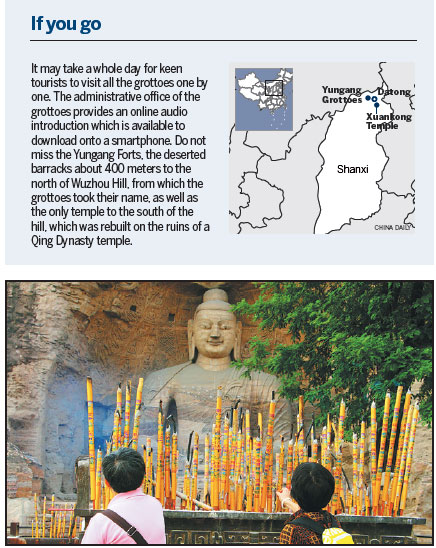
It takes about an hour to give a hurried and cursory glance at the grottoes that stretch for about a kilometer along the southern slopes of Wuzhou Hill, which lies 16 kilometers west of Datong in North China's Shanxi province.
But the lines, colors, angles and shadows that the grottoes present will linger for a long time in the memories of the tourists that visit them long after they return home.
The many comments by the buyers of books about Yungang have prompted curious minds to read more about the cultural treasures on the border between the Loess Plateau that lies to the south and the Mongolian Plateau to the north.
The royal families of the Northern Wei Dynasty (386-534) started to build the Yungang Grottoes in 460, and the project that had entailed national resources right through until the fall of the dynasty founded by the Xianbei, a nomadic people from the northeast of Asia.
As one of the four greatest ancient grotto complexes in China - Mogao, Maijishan, Yungang and Longmen - Yungang takes an important position in history because it marks the beginning of Buddhism's spread into Central China.
Built in 366, the Mogao Grottoes are located in Dunhuang at the western end of the Hexi Corridor, while the Maijishan Grottoes were built in 384 in Tianshui, at the eastern end of the corridor. The Yungang Grottoes built on the northern border of Central China retraces the footprints of Buddhism on its eastward journey from South and Central Asia.
After the North Wei moved its capital from Datong to Luoyang, Central China's Henan province, in 494, the rich families living in Datong took up the mantle left by the departing royal families to continue the Yungang project, while the Xianbei royal families initiated the Longmen Grottoes in Luoyang. So as Yungang increasingly served as a turning point in the eastward spread of Buddhism, it helped Buddhism to continue onward to Central China.
The appearance of the statues, their clothes and posture vary between all the sites between Mogao to Longmen. The sculptures of Mogao and Maijishan grottoes look like people from South and Central Asia, while the statues at the Longmen Grottoes look more like the Han people of China. And just as the sculptures in Yungang represent the transition from foreign features to Chinese looks, Wuzhou Hill, a mountain range running from east to west, also marks the border between the nomadic and farming civilizations. And Datong, which is home to Wuzhou Hill, has always been a crossroad for exchanges among civilizations.
The climates to the north and south of Wuzhou Hill are very different. In the spring, when the north is still cold and windy, plants start to bud south of the mountain range.
The Northern Wei rulers deemed the hill as holy site and offered sacrifices to the heavens on the hill. That's why they chose it for the site of the grottoes, employing Buddhism as tool to comfort the war-torn nation, unite all the ethnic groups and consolidate their regime.
The geological makeup of the hill consists mainly of arkose, a type of sandstone that's ideal for excavation and carvings.
A monk named Tan Yao was assigned to take charge of the project in 460. The five most representative grottoes in the early stages of the project are called the Five Grottoes of Tan Yao, which are famous for the grandiose scale of their statues.
The middle stages of the project took place between 494 to 526 when Datong city fell to invaders, and the grottoes there are beautifully rich in bright colors, and the statues smaller than Tan Yao's works.
At that time, there were temples built leaning into the hill. During the following Han-dominated Sui Dynasty (581-618) and Tang Dynasty (618-907), the sites were repaired from time to time.
Over the following 1,000 years, the grottoes and temples were partially destroyed, rebuilt and expanded by the Qidan, Nvzhen and Manchurians - all nomadic peoples from Northeast Asia - and the founders of the Liao Dynasty (907-1125), Jin Dynasty (1115-1234) and Qing Dynasty (1644-1911) respectively, and constantly maintained by the Mongolian and Han Chinese founders of the Yuan Dynasty (1271-1368) and Ming Dynasty (1368-1644) thereafter.
It is interesting that the main builders of the grottoes were all ethnic minorities, who were eager to reinforce their rules and smooth over ethnic frictions with Buddhism.
During the Ming Dynasty, two defensive forts were built near the grottoes, named the Yungang Forts. The current name of the grottoes stems from the forts which were previously referred to as the Wuzhou Grottoes Temple for most of the time.
There are a total of 254 grottoes now, among which 45 are major ones, and they contain a total of around 51,000 statues. The highest one is 17 meters tall, and the smallest is only 2 centimeters high. The statues, together with the large areas of frescos, are a treasure trove of Buddhism legends and historical stories.
The grottoes came under the central government's protection in 1961. The then French president Georges Pompidou visited the grottoes, accompanied by former premier Zhou Enlai in 1973, which had initiated intensive repair and protection projects of the cultural heritage that have remained in place until this day.
The World Heritage Committee of the UNESCO inscribed the Yungang Grottoes on the World Heritage List in 2001, in recognition of its exceptional and universal value as a cultural site.

|
Yungang Grottoes are a cradle of Buddhist art, in which reside more than 51,000 sculptures of the sage. Photos provided to China Daily |
|
The Buddha figure in the Five Grottoes of Tan Yao. Photos provided to China Daily |
(China Daily 06/18/2018 page10)