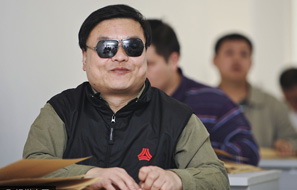
An architect ahead of his time, self-described rebel Wang Shu struggled for years with no commissions before going on to win the coveted Pritzker Prize
When officials of Fuyang approached Wang Shu in 2012 to ask him to design an arts center, the Pritzker Prize-winning architect had a rather unusual condition.
He wanted to have a hand in designing homes for local villages as well.
Fuyang is located about an hour's drive from Hangzhou, Zhejiang province, and sits on the north bank of the Fuchun River, a place renowned for its natural beauty. Earlier this year, it became a district under the city of Hangzhou.
|
A view of the roof of the Gongwang Art Museum. The building is part of an arts complex that houses an archive and another museum. |
The local administration promptly agreed to Wang's request. The prospect of securing the services of this famous figure in the architecture world was reason enough to do so. In a display of just how much they revered Wang, the local authorities dedicated a prime piece of land near a mountain and by a river for the arts center.
Should that piece of land in this location be used for real estate development today, it would be valued at a staggering 1 billion yuan ($150 million; 142.6 billion euros; 5121.5 billion). Such was Wang's influence.
The arts center will comprise three buildings - Gongwang Art Museum, Fuyang Archives and Fuyang Museum - all of which will be designed by Wang. The Gongwang Art Museum is already open to public, while the other two segments are still under construction.
Wang, 53, is the first Chinese person to win the world's top prize in architecture. Based in Hangzhou, Zhejiang province, he is currently dean of the School of Architecture at the China Academy of Art.
A lover of traditional art, Wang grew up in the Xinjiang Uyghur autonomous region, where his mother worked as a schoolteacher. During the "cultural revolution" (1966-76), when schools across the country were shuttered, teachers and many others were forced to become farmers. As a young boy, Wang enjoyed working in the fields as it enabled him to feel a connection with the earth. He said that he also found fulfillment in physical labor.
Wang loved reading and had fortuitous access to a range of books censored by the government when his mother was transferred from the fields to become a librarian.
When he was 10, Wang moved to Xi'an, Shaanxi province, where tents were used as classrooms. He later witnessed how the locals would build new classrooms and was fascinated with the bamboo frameworks used in the construction process.
As Wang was passionate about art and engineering, he decided to study architecture at Southeast University because he thought the discipline was a perfect blend of the two. He describes himself as a rebellious undergraduate who was always ready to challenge professors. Wang even wrote a thesis criticizing modern Chinese architecture.
A keen lover of traditional Chinese art, with a particular interest in ancient gardens and landscape paintings, Wang was eager to incorporate the aesthetics and building techniques of such places into his own creations.
But he was perhaps too far ahead of his time, because no one on China's architectural scene acknowledged or understood his ideas. For several years following his graduation, Wang had no commissions to work on.
He said it was his wife, Lu Wenyu, who smoothed the rough edges of his personality. In 1997, the two of them founded the Amateur Architecture Studio. In his new book How To Build House, Wang pays tribute to his wife, conceding that "for the first seven years of our married life, it was her who supported me".
The couple lived an idyllic life in Hangzhou where they would often stroll along West Lake and had plenty of time to spend sipping tea with friends. Wang says this calming experience nurtured his heart and in turn evoked a change in his perspective on life.
"You could spend a long time watching the rain, how it falls along the ridges of a building, how the streams flow and where the water drops. All this interests you. You would be thinking if it is possible to design architecture and show clearly where the rain comes from, where it flows, where it goes ... each turn and change in movement touches one's heart," he says.
Wang's unique style was eventually recognized and he was presented with the opportunity to design the Ningbo Museum in Zhejiang province. Construction of the museum, which featured the use of bricks salvaged from old buildings that were demolished to make way for modern developments, took place between 2004 and 2008.
Wang said he approached the structure as if creating a landscape painting.
"Looking at the museum from afar, you see the building as a painting of a mountain that is spreading out right in front of your eyes. When entering the structure, you'll find different landscapes at different positions, offering different perspectives. This is how traditional Chinese landscape paintings should be experienced, through free shifts of perspective and angles," Wang says.
After this project, Wang was a part of the World Expo 2010 in Shanghai, for which he designed the Tengtou Village Pavilion, inspired by a painting of a mountain dwelling by Chen Hongshou (1599-1652). He says that stepping into the doorway of the pavilion is akin to entering a cave where different landscapes unfold at every step, like "a page in an ancient leaflet of small paintings".
Wang also gained international recognition for designing a building on the Xiangshan Campus of the China Art Academy in suburban Hangzhou.
In 2012, Wang received the accolade that most people in his profession can only dream of. He won the Pritzker Architecture Prize.
The Pritzker jury praised his "unique ability to evoke the past, without making direct references to history", while calling his work "timeless, deeply rooted in its context and yet universal".
Wang describes his approach as a combination of ancient aesthetics with modern utility. As an architect working in contemporary China, he believes that "one has the opportunity to create something great, something lasting longer than his own life span."
For the Fuyang project, Wang was determined to reignite the ancient Chinese admiration for mountains and rivers which embodies a unique Chinese philosophy about seeking a life that is in harmony with nature. This was why he specified his unusual condition about designing homes for local villagers.
Together with employees from Amateur Architecture Studio and students from the China Art Academy, Wang visited 290 villages in the area to inspect old houses and become immersed in the traditional way of life. He says that nature plays an integral role in the simple yet charming way of life in such areas which is today on the verge of extinction. He laments how many of the homes being built in the country today are soulless "American-style big villas" or "fake antiques" with white walls and gray tiles.
Wang used the smaller residential structures in the village as a canvas for experimentating with ideas. He used stones, old tiles and materials usually considered worthless to construct new village homes and this process helped him determine what he would do for the design of the Gongwang Art Museum.
While the museum might be large, its imposing size is tempered by the roof's long and soft curves which are reminiscent of the mountain ridges in the distance.
But not everyone is in awe of Wang's creations. Some have raised concerns about leakage issues, high maintenance and how his buildings are too distinctive in style, drawing attention away from the exhibits on display.
However, Li Lei, director of China Art Museum Shanghai, begs to differ, saying that a fine piece of architecture of the kind Wang has created is "a bold challenge to pragmatism".
"The building itself is a piece of art. ... Apart from the skyscrapers that are mushrooming all over China, the country needs architecture for aesthetic appreciation and spiritual fulfillment, too," says Li.
"As the nation's ideas develop in tandem with economic growth, there will be cultural awakening, and people will soon be able to appreciate great architecture."
zhangkun@chinadaily.com.cn




Copyright 1995 - . All rights reserved. The content (including but not limited to text, photo, multimedia information, etc) published in this site belongs to China Daily Information Co (CDIC). Without written authorization from CDIC, such content shall not be republished or used in any form. Note: Browsers with 1024*768 or higher resolution are suggested for this site.
License for publishing multimedia online 0108263 Registration Number: 130349