After sending a probe to Mars in 2020, China plans to explore three asteroids and land on one of them to conduct scientific research, according to a Chinese asteroid research expert.
The "China's Space Activities in 2016" white paper, recently issued by the Information Office of the State Council, also mentioned asteroid exploration in outlining the major tasks for the country's space industry in the next five years.
"The experts' plan is to fly a probe by an asteroid; to fly side by side with an asteroid for a period; and to land on a third one to conduct in situ sampling analysis on the surface," said Ji Jianghui, a researcher at the Chinese Academy of Sciences' Purple Mountain Observatory.
So far, only the United States and Japan have landed probes on asteroids.
"China will send the Chang'e-5 lunar probe to the moon and bring samples back this year. If that mission succeeds, it would mean China, like Japan, would be able to bring back samples from asteroids to study in labs on Earth," Ji said.
Scientists will give priority to detecting near-Earth asteroids to analyze their probability of colliding with Earth.
They are also eager to study the formation and evolution of asteroids, which might shed light on the origins of the solar system, as well as the origins of life and water on Earth.
Chinese scientists plan to fly a probe side by side with an asteroid called Apophis for close observation, and land on the asteroid 1996 FG3. The whole mission would last around six years, Ji said.
Threats From Space
Discovered in 2004, Apophis is about the size of two football fields, with its longest diameter about 394 meters. Analysis shows it will come close to Earth in 2029, missing our planet by about 30,000 kilometers. The distance, a hair's breadth in astronomical terms, is within the orbit of the moon, and even closer than some man-made satellites. It will be the closest asteroid of its size in recorded history. The asteroid is supposed to come around Earth again in 2036.
Apophis was believed to pose a big threat to Earth when it was first discovered, though further study has shown it has only a one-in-a-million chance of hitting the Earth in 2029.
Scientists estimate there are about 300,000 near-Earth objects with a diameter of more than 40 meters, and only 3 percent of them have been discovered. An international asteroid warning network was set up in December 2013 to monitor potential threats.
China's Purple Mountain Observatory discovered three new near-Earth asteroids in January, and one of them, 2017 BL3, poses a potential threat to Earth, Ji said.
"In order to cope with the potential threat of the near-Earth objects, we don't just need ground-based telescopes to form a monitoring and warning system, but also space probes to conduct close investigations of the asteroids," Ji said.
China's exploration will help scientists understand the features of the near-Earth objects, and seek effective measures to deal with the possibility of a collision, Ji added.
Origins Of Life?
Some scientists believe asteroid 1996 FG3 might hide the secret of life on Earth.
At present, there are two main theories: One is that life was conceived on Earth itself; and the other that life originated in space. Scientists have discovered many meteorites containing organic compounds believed to be related to the origins of life.
Many asteroids also contain water, and some scientists believe the water on Earth might have been brought by asteroids or comets.
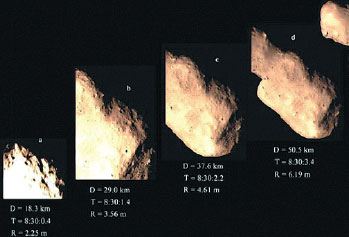
China has already conducted a flyby observation of an asteroid named Toutatis.
In 2012, China's second lunar probe, Chang'e-2, after successfully completing its mission, rendezvoused with Toutatis at a distance of 770 meters, as the space rock, bigger than a city block, swept by Earth at a distance of about 7 million kilometers.
It was the world's first close flyby observation of Toutatis. The probe took high-resolution images that provided a number of discoveries.
Ji and his team found that the ginger-root-shaped asteroid is about 4,750 meters long and 1,950 meters wide, and studied how it rotated in space.
The research also revealed new insights into the geological features and formation of the asteroid, showing it was essentially rubble and that the impact craters on its surface could be 1.6 billion years old.
Xinhua
|
High-resolution images taken by Chang'e-2 after the probe flew by Toutatis on Dec 13, 2012. Xinhua |




Copyright 1995 - . All rights reserved. The content (including but not limited to text, photo, multimedia information, etc) published in this site belongs to China Daily Information Co (CDIC). Without written authorization from CDIC, such content shall not be republished or used in any form. Note: Browsers with 1024*768 or higher resolution are suggested for this site.
License for publishing multimedia online 0108263 Registration Number: 130349