|
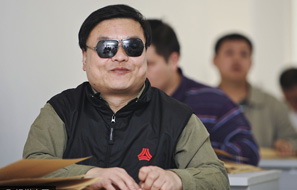
Nineteen young professionals including Tian Tingting (top) and Li Yidong (above right) restore ancient books at the National Library of China in Beijing. Photos by Jiang Dong / China Daily |
Li Yidong starts his day much like a baker. He makes a ball of dough, kneads it, allows it to rise and then washes the dough with water to extract the crucial ingredient: starch.
The 28-year-old is one of 19 book restorers at the National Library of China in Beijing, which is home to the world's largest collection of ancient Chinese books.
One of the first skills they learn is how to make a starch paste to glue together old pages.
"We don't use starch from the market," says Li. "Our teacher says there can be food additives in it. Proper strength is needed in restoration, so handmade paste is vital."
This year marks the 10th anniversary of the founding of the National Center for Preservation and Conservation of Ancient Books, which is headquartered in the library.
In China, "ancient books" refer to those published before the fall of the Chinese monarchy in 1911. In this library, there are 2.7 million such books.
The center estimates that there are about 50 million ancient books housed in the country's public institutions, but China had less than 100 full-time restorers for them before 2007, according to Chen Hongyan, director of ancient book department of the NLC.
"That's why we've endeavored to train more experts, especially new blood, for this industry, in the past decade," she explains. "Now, we have more than 1,000. The traditional master-apprentice model is still widely used, but relevant college education is getting more important."
Today, 12 of the 19 restorers in the library were born after 1980.
Li has been working in the restoration room for a year and a half, after studying ancient painting and calligraphy appraisal at the China Central Academy of Fine Arts. He still feels he has a lot to learn before he can begin repairing the most important books.
"Without five to six years' practice, I won't dare independently fix a book," Li says. "I'll follow the masters' advice. First of all, I have to learn how to make paste."
The restorers are now working on Tianlu Linlang (named after an auspicious animal and fine jade), the book collection of Emperor Qianlong (1711-1799). Many of the pages in the books are stuck together, so restorers have to work carefully to separate the pages without damaging the content.
Li's colleague Cui Zhibin has worked in the library for four years since graduating from Capital Normal University in fine-arts history.
"When the pages are before me, they look like puff pastry," says the 30-year-old. "Each page is adhered to another. The crispy paper is made of bamboo. When you touch it, it almost falls apart. You cannot be too careful when separating them."
The most common way to separate pages is the most simple: Steam them in a pot for six minutes and carefully peel them apart.
Pieces of puzzle
China has large collections of ancient books; printing is believed to have first started in China during the Tang Dynasty (618-907) and books were in wide circulation by the time printing was begun by Europeans in 1455.
Some of the books that need repair are in languages the restorers can't read such as Tangut, an extinct square-character writing system used from the 11th to 16th centuries in northeastern China. Sometimes the restorers can't put the pieces of a puzzle together until they refer to archaeologists.
They often find books that have been repaired by others in previous centuries.
"Fixing the books is also a dialogue with ancient people. You can see previous attempts at restoration throughout history. And people were sometimes careless.
"We can fix their errors, but sometimes we also preserve the previous attempt as historical proof. What we can do is to avoid leaving errors for the future."
Cui's reading isn't totally fixed in the distant past. She says she likes reading entertainment gossip from her cellphone on her way home to catch up with the modern world.
The young restorers are guided by Du Weisheng, who has worked as a restorer at the library for 43 years. The 65-year-old has taught thousands of students, and currently has eight apprentices.
"I would rather call myself their teacher, not the master," says Du. "In olden times, it was a tradition that masters only taught 70 to 80 percent of what they knew to apprentices for fear of being surpassed. But I want these young people to surpass me in skills."
Du says he has also learned a lot from his apprentices, who are more adept at using modern technology.
"It's more convenient to use machines to analyze the components of the paper and to help us choose the right materials," he says, but adds that machines can't do everything that human experts can.
The influx of young talent into the restoration room means it is no longer the quiet and solemn place it once was.
"Once no one dared to talk during work but the atmosphere is lively now, and it's necessary for people to communicate and solve problems," says Du.
Precious collections
First established in 1909 as China's first national-level modern library, the National Library now has royal book collections from all the dynasties since the Southern Song Dynasty (1127-1279).
The library's most highlighted collections include the Dunhuang manuscripts, which were found in the Mogao Grottoes in Gansu province in 1900; Zhaocheng Jinzang, a group of Buddhist canons, which were printed during the Jin Dynasty (1115-1234) and were once hidden in a coal mine to stop them from falling into the hands of the Japanese during the War of Resistance Against Japanese Aggression (1937-45); and Yongle Dadian, edited after an edict by a Ming Dynasty (1368-1644) emperor in the early 15th century, which remains the world's largest paper-based general encyclopedia.
Pan Fei, 28, has worked at the library for four years after graduating from the Jinling Institute of Technology in Nanjing, Jiangsu province.
She majored in ancient-book restoration. Her class had 39 students, but only 10 now work in libraries and museums nationwide.
Her course in college included literature, philology, ancient Chinese classics like The Analects of Confucius, library studies, museology, and computer programming. Not all of that is directly relevant to her day-to-day work.
Speaking about her course, she says: "The major was newly set up. Our school was still exploring what was needed to train a qualified restorer. The result was: We learned everything."
The work of restoring is highly collaborative, and restorers rely on each other for advice and assistance.
Pan says most of her colleagues will probably stick to the work for a lifetime, forming personal connections almost as strong as family ties.
Pan, who learned singing and ballet in childhood, says she still attends a chorus in her spare time to preserve her ties with music.
"The reason why my friends go to the chorus is that they are looking for self-satisfaction, which is absent in their jobs. I'm luckier. Once you fix a book, it's really something satisfying."
Besides working together, the restorers also eat together, using the byproduct from starch production. Once the starch has been removed from the dough, the remainder is wheat gluten, a staple of the Chinese diet.
"Fried gluten is really delicious," says Li. "You have to put it into the fridge first, and then cut it into slices. I like it with chili pepper."
Liu Yixi contributed to this story
Contact the writer at wangkaihao@chinadaily.com.cn




Copyright 1995 - . All rights reserved. The content (including but not limited to text, photo, multimedia information, etc) published in this site belongs to China Daily Information Co (CDIC). Without written authorization from CDIC, such content shall not be republished or used in any form. Note: Browsers with 1024*768 or higher resolution are suggested for this site.
License for publishing multimedia online 0108263 Registration Number: 130349