Premier stresses that economic conflict between the US and China would benefit neither
Chinese Premier Li Keqiang says it is not in anyone's interests for a trade war to break out between China and the United States.
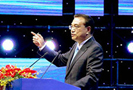
Speaking at a news conference following the closing ceremony of the National People's Congress, China's top legislature, on March 15, Li said he still remained optimistic that a workable relationship would be maintained.
"We don't want to see any trade war break out between the two countries. That would hurt both of us," he said.
"No matter what bumps the relationship runs into, we hope it will continue to move forward in a positive direction."
Li also insisted that maintaining good relations between the two countries is important for Asian regional stability.
"This relationship is crucial for not just China and the US but also for regional and global peace, security and stability. We must work together to continuously take it forward," he said.
US President Donald Trump threatened to impose a 45 percent tariff on Chinese exports during his election campaign.
Li, however, said that US companies had more to lose from any trade war than Chinese ones.
"Last year, trade and mutual investment created more than 1 million jobs in the US," he said.
"Recently I came across an article by an authoritative think tank. It said that if a trade war should break out between China and the US, it would be the foreign-invested companies - in particular, US firms - that would bear the brunt of it."
Li also rejected any suggestion that China was deliberately trying to lower the value of its currency to boost its exports.
The People's Bank of China has, in fact, been fighting an 18-month rearguard action to support the yuan after introducing a new exchange rate mechanism in August 2015.
"China has no intention of depreciating its currency to boost exports, because that is not good for our companies' transformation and upgrading," he said.
"China will continue to push forward the market-oriented reform of its exchange rate regime and will continue to follow the market-based managed floating exchange rate regime."
He said any recent fall in the value of the yuan was actually a result of the dollar strengthening.
"Last year, there was a lot of volatility in the international currency markets, especially with the strengthening of the US dollar. Most major global currencies have depreciated against US dollar. The depreciation of the Chinese yuan against the US dollar is actually one of the mildest."
Li also talked about the possibility of developing greater trade and economic ties with other Asian nations.
It was announced earlier this month that China is to send a senior Foreign Ministry official to a meeting in Chile on Asia-Pacific economic integration, starting on March 21.
"We have already adopted an open minded approach to various regional trading arrangements and we would also welcome progress in these arrangements, or proposed arrangements," Li said.
"China will continue to remain engaged and participate in the liberalization of global trade. We believe it is essential for one to seize these opportunities of opening-up in globalization. These are opportunities no one should miss out on."
Wang Huiyao, founder and president of the Center for China and Globalization, a leading independent think tank, and a counselor to the State Council, China's Cabinet, says it is in China's interest to explore options.
He says it remains a possibility that China might still join the Trans Pacific Partnership. The trade agreement was signed by leading Asia-Pacific nations, including Japan and Australia, last year, but the new Trump administration in the US decided to withdraw in January.
"The US withdrawal from the TPP changes the dynamic of trade alliances in the Asia-Pacific region, and China now needs to engage in discussions," he says.
"I think these will take a long time. I don't think anyone should assume that China will want to join the TPP in the short term but it may want to build a relationship with it."
Li also spoke about China's economy at the news conference. In the Government Work Report setting out China's agenda for the year ahead, which he delivered on March 5, he set a target for GDP growth of "around 6.5 percent", while also allowing for the possibility of exceeding this by adding "or higher, if possible".
"Growth of 6.5 percent is not a low speed and is not easy to achieve. If we can achieve the growth target in 2017, it will generate more additional economic output than we had last year. This is because the new growth is on a new base of 74 trillion yuan (10.25 trillion euros; 8.96 trillion), equivalent to $11 trillion, and this growth will generate 11 million new urban jobs," he said.
He also said that the target - the lowest in 27 years - allowed room for China's economy to rebalance while still remaining the main engine of global growth. From 2010 to 2015, China contributed 25 percent of all global GDP growth.
"We believe this target is consistent with the laws of economic development and can help us focus more on enhancing the quality and performance of China's growth," Li said.
"I don't think China's contribution to the global economy will come down. We believe China's economy will continue to be a strong driving force in the face of a sluggish global economic recovery."
The premier also restated China's commitment to globalization, as outlined by President Xi Jinping at the World Economic Forum meeting in Davos in January, adding that the world's second-largest economy would do everything it could to improve global governance.
"It is fair to say that all parties have benefited from globalization but some issues or problems may have occurred in this process," he said.
"China is ready to work with other countries to further improve the international governing system in response to the problems that have occurred in the process."
Li said China remained committed to opening up its markets to foreign investors, with the government approving measures in January to ease curbs on foreign firms investing in banking, securities, mutual funds, insurance and credit-rating firms.
"Last year China was still the largest recipient of FDI (foreign direct investment) among all the developing countries. ... The truth is, to shut our door to the outside world would not help China do its own things well. China will continue to open to the outside world, with this opening up being a gradual process," he said.
Li also said he remained committed to maintaining employment levels in China. The Government Work Report targeted the creation of 11 million more urban jobs in 2017, 1 million more than in 2016.
"Employment is of paramount significance for such a large country as China, which has more than 1.3 billion people. Employment is the foundation of economic development."
However, he said, it remained a challenge to provide jobs for the 7.95 million university graduates who will enter the labor market this year, as well as the 5 million secondary school graduates and workers laid off as part of efforts to cut overcapacity in under-performing sectors.
He believed that one of the keys to this was encouraging more people to become entrepreneurs and start their own businesses.
"The key is to continue generating jobs. Thanks to the initiatives of people and greater entrepreneurship and innovation, many jobs have been created," he said.
Li said China still had the financial firepower to defend its currency. The country's foreign exchange reserves fell below the $3 trillion mark for the first time in nearly six years in January.
"China still has the largest foreign exchange reserve of all countries in the world. As to what level of reserves is the right one, I believe this will continue to be a process that needs further discussion and experimentation," he said.
"China has ample foreign exchange reserves, however, to meet its needs, like paying for imports or paying for short-term external debts. China's level of foreign exchange reserves remains way above the international standard."
Zhu Min, former IMF deputy managing director, speaking in Beijing after the news conference, agreed that there would be no winners in a trade war between China and the United States.
"If there is a trade war, China will be very tough. It would not be good for either side," he said.
Zhu, who was addressing a Cheung Kong Graduate School of Business Dialogue seminar, The Changing Landscape of the Chinese and Global Economies, says there was an imbalance in the goods that China and the US traded with each other.
While China's exports to the US were mainly electronic goods and equipment and other items such as apparel, the US sold to China aircraft, natural resources (excluding oil) and agricultural products.
"With that kind of trade structure, a trade war would not benefit the US and that is why they are now being very cautious."
He also says that any kind of conflict between the world's two largest economies would undermine the new US president's key economic aim to build more infrastructure, which will require a lot of borrowing, some of which would inevitably be from China.
"Where will he get the money to invest in infrastructure? China is still a very good potential partner to support the sort of infrastructure construction Trump intends."
Despite some of the rhetoric, Zhu believes that some of Trump's economic plans made a lot of sense.
"I think some of his policies are actually quite good and could bring a lot of benefits to the US economy."
Martin Wolf, chief economics commentator of the Financial Times, who also addressed the same seminar as Zhu, says China is now emerging as a global leader and will have to take on all the difficulties and challenges that go with that.
"The world has reached a politically dangerous point of instability. The West is falling apart and the US is becoming nationalist and protectionist," he said.
"This situation is very unlikely to become better quickly. China will need to become a leader in the global economy. This will require large and difficult changes in China and by China."
Contact the writers through andrewmoody@chinadaily.com.cn
Wang Qingyun contributed to this story.
|
Andrey Kirillov, a reporter for Russian news agency ITAR-Tass, asks Premier Li Keqiang a question during a news conference in Beijing on March 15. Kuang Linhua / China Daily |




Copyright 1995 - . All rights reserved. The content (including but not limited to text, photo, multimedia information, etc) published in this site belongs to China Daily Information Co (CDIC). Without written authorization from CDIC, such content shall not be republished or used in any form. Note: Browsers with 1024*768 or higher resolution are suggested for this site.
License for publishing multimedia online 0108263 Registration Number: 130349