Organic foods are becoming increasingly popular in China, but farmers will need government help to ensure the fledgling sector develops efficiently. Wang Xiaodong reports.
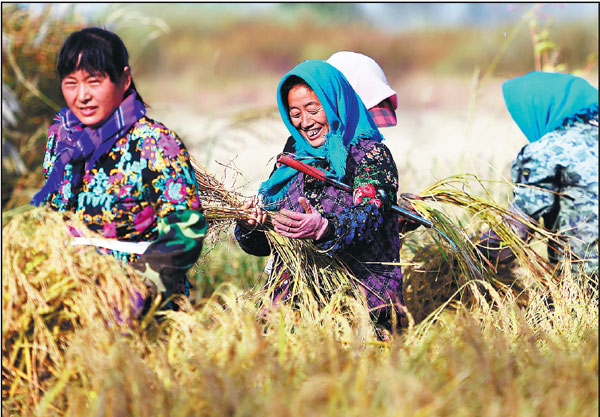
For the past four years, Man Fenglin has grown rice organically, despite the rising cost and falling yields.
The crops grown on his 10 hectares of farmland are sold to companies across China for about 21 yuan ($3) a kilogram, more than six times the price of rice grown on farmland treated with synthetic fertilizers, according to Man, from Wuchang county in the northeastern province of Heilongjiang.
"I can still make more money than ever before, even though organic planting requires much more labor and produces fewer crops," he said.
Every year, his organic farmland produces about 550 kg of rice from every 1,000 square meters, compared with harvests of about 750 kg from conventionally farmed land.
Of the 150 or so households in Zhenxing, Man's home village, about 20 are now growing rice organically, he said.
In addition to Heilongjiang, a major area of rice production, organic farming is booming in many other parts of the country, such as the provinces of Sichuan, Guizhou and Zhejiang, according to the Chinese Certification and Accreditation Administration.
Last year, 1.74 billion packages of organic produce, valued at a combined 36 billion yuan, were sold nationwide, a rise of 16 percent from 2015, according to the administration.
The main products include cereals, beans, vegetables, fruits, poultry, aquatic produce and processed goods, such as edible oils, wine, dairy products and textiles.
"With rising awareness of health, the environment and food safety among Chinese consumers, the nation's organic industry has seen rapid development, both in terms of output and sales," the administration said.
The number of businesses certified to produce organic goods has surpassed 11,000, and 1.52 million hectares of farmland are used for organic production, accounting for about 1 percent of the national total.
Huge potential
"I think the organic industry has huge potential in China," said Zhang Youting, deputy CEO of Organic and Beyond, a Beijing company that supplies organic foods.
"As Chinese people become wealthier, they are also becoming more concerned about food safety. The government's resolve to improve food safety in the next few years will make China's organic industry more credible."
Last year, the company's sales rose to about 100 million yuan, a far cry from the 700,000 yuan recorded in 2007 when it started selling organic food such as fruits, vegetables and wine, including imported goods and those grown on certified domestic organic farms, he said.
China's standards for organic certification are in line with international standards and are among the "strictest in the world", according to the Certification and Accreditation Administration.
As in other countries, organic production in China follows the principle of not using synthetic pesticides, fertilizers or genetic-modification technologies.
Organic products must be sold in packages, and each one must be labeled with an electronic code that allows buyers to track down information about the product, such as its certification status, and learn about the company that produced it.
Businesses whose certification is revoked because they have used banned materials, such as synthetic fertilizers, cannot reapply for five years after the offense, and all farmland must have been "green" for at least two years before it becomes eligible for certification.
Wang Hongfeng has spent the last two years converting part of his 4-hectare farm in Nannie, a village in the Beijing suburbs, for organic use. He expects to complete the process by August, after which he will apply for a certificate to produce organic foods.
As preparation for the certificate, he will only use natural fertilizers and pesticides derived from plant sources while his land, which was previously waste ground, recovers from decades of misuse.
He doesn't even consider using pig manure because it may contain antibiotics ingested by the pigs, and that could pose the risk of the land failing official inspections.
"We have to be very careful because technicians from the institute that awards the certificates inspect the land every year," he said.
Wang will grow vegetables such as eggplants and tomatoes on the converted land, and may make his farm wholly organic in the next few years if his produce proves popular with consumers.
Rising costs
Man, the farmer from Wuchang, said organic farmland usually produces lower yields than conventionally farmed land because the ban on the use of synthetic fertilizers and pesticides means some of the seeds and crops will be eaten by pests.
In addition to the higher cost of organic fertilizers, rising labor costs are another prime contributor to the high price of organic food.
"On nonorganic land, you can spend 100 yuan to buy some weed killer and suddenly a hectare will be clear of weeds," he said.
"But on organic land we have to rely on laborers to pick the weeds before we plant the crop, and we have to repeat the process at least three times prior to planting because the weeds grow back quickly."
Man began organic cultivation in 2012, when he was approached by technicians from Organic and Beyond. "At that time, few villagers had heard of organic food and even fewer knew how to grow it," he said.
Under the technicians' guidance, he learned how to use a mixture of burnt straw ash and pig manure to fertilize his land. He then moved on to organic fertilizers, which were so expensive the company provided him with an annual subsidy. He now sells most of his rice to Organic and Beyond.
"Many farmers will not consider growing organic rice if they can't find a reliable buyer," he said. "They can't take the risk of producing food but not being able to sell it."
Development
Qiao Yuhui, an associate professor of agricultural ecology at the China Agricultural University, said it will take time for the country's organic industry to mature, despite the great progress made in production techniques in recent years.
"The industry still lacks customer recognition. Organic products are too expensive in China," she said, adding that only about one-third of organic produce sold in the country every year is labeled as such.
"Many organic products don't sell because of the high price," she said. "Also, many consumers lack knowledge about organic products and distrust them."
According to Qiao, tightened supervision of the sector and rising public awareness of organic food mean it's easy to see the sector developing, but more government support will be needed to make that happen.
"The organic industry needs technical support, which is largely lacking in China. There is no ministry in charge of providing technical support for the sector, but farmers and producers need to be better equipped in terms of aspects such as improved farming methods and fertilizers," she said.
Moreover, organic producers need education so they will understand the industry better, she added: "Many farmers believe organic just equals no use of chemical fertilizers or pesticides, so they will buy a new kind of fertilizer from hundreds of miles away to raise output. However, they fail to realize that the primary way to develop organic farming lies in local management of their farms, such as using intercropping - the cultivation of at least two types of plant in close proximity - to resist weeds and raise yields."
Contact the writer at wangxiaodong@chinadaily.com.cn
|
Women harvest organic rice in Wuchang, Heilongjiang province. Wang Jianwei / Xinhua |




Copyright 1995 - . All rights reserved. The content (including but not limited to text, photo, multimedia information, etc) published in this site belongs to China Daily Information Co (CDIC). Without written authorization from CDIC, such content shall not be republished or used in any form. Note: Browsers with 1024*768 or higher resolution are suggested for this site.
License for publishing multimedia online 0108263 Registration Number: 130349