Peeping through a door 30 years ago left an indelible mark that still holds many lessons
When I was 5, my mother took me to a painting class at a nearby "cultural palace" - a three-story building made up of a ground-floor movie theater and many rooms open to children during the school holidays. There I received my first art "message", not in my own class but the one next-door.
Before that day came, I had done plenty of doodling on sheets of paper my mother brought home from school.
(In the mid-1980s it was a minor luxury for an average wage-earning Chinese family to provide their child with an unlimited amount of good-quality painting paper.)
|
An exhibition of cartoon books drew large numbers to the National Art Museum of China in Beijing last year. Photos Provided to China Daily |
I can't recall how the idea of attending a painting class came to me, but the moment I realized that there was a possibility to do so, I begged my parents. They agreed, despite their meager income.
So that sunny Sunday morning my mother sat me in a class where a teacher, colorful felt-tip pens in hand, was drawing on a sheet of paper pasted on the blackboard. The children followed him in drawing simple lines and filling demarcated blocks to produce an outlandish potpourri of colors. At the end of that class, everyone handed in a disc-faced owl with feathers like a tropical parrot.
Then came the break, and I ran out and peeked into the classroom next-door. That stolen glance changed my school holidays for the next few years.
In that classroom there was no laughing, no children's frustrated crying out or long-suffering parents' usually useless attempts to pacify them. There was only silence - accentuated by the rustling of pencils on the textured painting paper. The children were older than 10.
The works displayed no color but black and white and the millions of shades in between. I later learned that what they were doing was pencil sketching. At the time, my mind was a blank canvas open to any artistic influence, and, just as easily as the lead of a 6B pencil leaves its mark on paper, the pictures of that room became ingrained in my mind. I told myself and my parents that this was where I belonged.
It was not until last month, when I talked with Wang Wei, founder of Color Edu, a children's art education center in Beijing, that it dawned on me that in being unable to come to terms with the idea of "children's painting", I was perfectly normal.
"We adults tend to give children what we believe they want," he says, referring to the so-called qian bi hua, or simple drawing, a type of cartoonish, stick-figure drawing employing simple lines and a loud, motley collection of colors.
"We think children are going to like it, exactly because we ourselves consider the painting style 'childish', meaning less sophisticated artistically, if you like.
"Today I consider the theory superficial and false," says Wang, who graduated from one of China's best art academies and has been in children's art education for a decade.
"A painting made by a young child may often include vivid colors and random lines, but they come directly from their own wellspring of creativity and imagination, instead of some preformulated rules. I believe we should give them all these elements - colors, lines and even light. But they should come together in a way that we consider beautiful. And remember: A child's untainted mind is more prepared for beauty than any of us is."
So at Wang's invitation, children are introduced to the likes of Joan Miro, Pablo Picasso, Rene Magritte and Antoni Gaudi - artists whose greatness is matched only by their power of imagination, the price most people pay for growing up.
In my case, I never had the opportunity to be exposed to those wonderfully mischievous masterpieces as a child. However, that glimpse through the door opened another world for me. It was my artistic initiation.
For the next seven or eight years I did pencil drawings (I also painted watercolors and oils, but the blacks and grays never lost their charm for me) until heavy schoolwork prevented me from doing so.
Today, more clearly than with any painting I have ever done, I remember the black shine extending from the outer side of my little finger to the side of my palm. It was a shine resulting from hours of drawing, during which I would occasionally rub the paper with the side of my pencil-holding hand, to create the interplay between light and shadow. It was the process that matters above all else, a process that injected joy into my little heart.
So a few years ago I was flabbergasted on reading that a few renowned Chinese artists had condemned the strict pencil sketch training undergone by almost all children - usually between the ages of 12 and 18 - in China who hope to pursue a higher education in art.
Notable among them is Chen Danqing, famous in equal parts for being an artist and an art critic. In 2004, in a protest against what he called "an enrollment system that has kept our most talented students at the doorstep", the Chinese American resigned as a professor at the Academy of Arts and Design at Tsinghua University, one of China's top art education institutions.
On another occasion he commented that "another child has been killed", on being told by the boy's parents that their child "experienced self-doubt due to a lack of progress in his pencil sketch class".
How is it that an art form that so inspires me is under attack by so many art professionals, some of whose works I have long admired?
I took my questions to my interviews of art educators, including Wang and others. And the answer is: It was not pencil sketching that squeezed the genius out of many artistically minded children but the way pencil sketching is viewed by China's art establishment today, as the basis of a formal art education.
Pencil sketch education as we know it today was born in 18th-century France before being exported to Russia and then to China, Chen says. Although there have been many masters throughout history - da Vinci and Rubens are but two of them - who left us wonderfully drawn pencil works, there have been just as many who never tried the art form.
Today, students applying for entry to art college in China must take pencil sketch tests. In the months and often years leading up to the tests, aspiring art students force themselves through gruelling training at one of the numerous coaching centers across the country.
There they draw sometimes for 10 or more hours a day. And usually they draw according to strict guidance by the teachers - rules that enable their works to take on the look of those by "art professionals" in the shortest possible time.
Viewed singularly, almost every one of these works appears refined and sophisticated. Put together, they resemble one another in a startling and stupefying way. It seems that the students are too preoccupied with painting the light as cast on the plaster geometric solids in front of them to allow any light to enter their own minds.
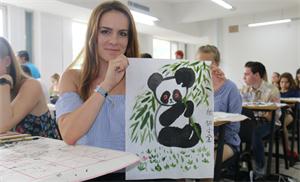
Today many places in Beijing that provide children's art education start with colors. And colors come in a great variety of forms, be it pastel, print or paper cutting. Pencil-sketch classes are open to students when they reach 11 or 12.
"We introduce them to pencil sketching at that point, since grown-up children usually have higher expectation for their works," says Wang Lijuan, founder of Lijuan Experimental Art Education Institution. "And pencil sketching can be an effective tool in studying an object."
Almost needless to say, many of history's master painters used pencil study to record and hone their ideas before they got to work on the walls and ceilings of grand cathedrals. Yet very often the studies themselves are masterpieces in their own right, their emphasis just as important as what is omitted.
The German artist Gerhard Richter once said: "Art is the highest form of hope."
When I was little I used to paint for so long that my limbs went numb and my grandmother had to lift me up from the floor. Today, every time I look back at those concentrated hours, my heart is filled with gratitude.
Then, there were all those school holidays spent drawing in the classrooms at the "cultural palace". Many things can never be erased by the rubber of time, like the deep shadow cast by light on an apple, or the folds of velvet drapes that served as the background. We were translating colors into black and white and everything in between. It's poetic.
These days I take my 4-year-old daughter to an art museum or gallery in Beijing every once in a while. My hope is that art will extend its roots into her heart's fertile soil, just as a giant banyan tree does in the ground around it.
And while we are there, I always linger a little longer in front of an inspiringly executed pencil study or charcoal painting, if there happens to be one.
They remind me of the days when "easel" was a sacred word for me, one that connected me with the blissful Neverland of an artist. Every time I looked up from my own work, from where I stood in the classroom, I saw many easels all around me. Carrying the works of other child students, they formed a forest.
Just one more time I long to be lost in that forest.
zhaoxu@chinadaily.com.cn




Copyright 1995 - . All rights reserved. The content (including but not limited to text, photo, multimedia information, etc) published in this site belongs to China Daily Information Co (CDIC). Without written authorization from CDIC, such content shall not be republished or used in any form. Note: Browsers with 1024*768 or higher resolution are suggested for this site.
License for publishing multimedia online 0108263 Registration Number: 130349