Why would someone with a good, secure job at a top company leave to found a startup?
Like many other people in China, Gao Leqi did just that. After graduating from the Inner Mongolia Normal University with a degree in electrical engineering, he worked for high-tech companies in Beijing for 12 years, eventually becoming the coding and technology manager at one of China's largest educational companies.
But, he saw a need in the market and dreamed of building a company to solve it.
"Many incubators and companies in China share space and other facilities," he says. "A lot of people copy a US company called WeWork that rents out shared office space. But it's very hard in an environment like that to keep track of workers' hours, to control the lights, or to schedule meeting rooms. Doing this on paper is hard and takes a lot of people."
|
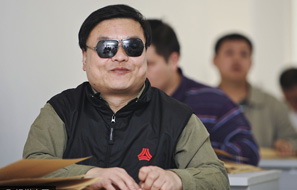
Gao LeQi (right), the founder of Newlohoo, and Xiao Yi, general partner of All-In Capital. David Blair / China Daily |
In 2014, he quit his job and started a company called Newlohoo, in the southern part of Beijing. He manufactures a tablet-like screen that can be placed on the wall outside the door of each room. Any authorized person can enter the room by scanning a QR code from the panel into his or her WeChat account.
Gao and his team have designed the internal electronic components and written software to allow this system to control utilities, keep track of who is in the room, control TVs and other devices, and schedule use of the room or other common facilities. The boss or building manager can use WeChat to control all functions throughout the company or to keep track of employees' work hours.
Unusually for a startup, Newlohoo has reached break-even in only about two years, and it employs 13 people. Already, the product is used at 10 companies. Even so, Gao says, being an entrepreneur is hard. "I am the boss and I am the staff."
He just signed a deal with a large centrally controlled state-owned enterprise. "If we can penetrate this market, we can be all around China five years from now," he says.
Initially, Gao funded the company by doing outsourced work and using his own savings. Now, he has reached the stage where he wants to raise about 1 million yuan ($145,000; 136,000 euros; 116,000) from angel investors.
One early investor is the Australian-funded angel-investor firm, All-In Capital. Xiao Yi, general partner, says: "We invest in a company like this because such intelligent hardware allows every company to work efficiently and have less staff. Newlohoo has good hardware in the telecommunications sector, where it is hard for competitors to overcome good technology.
"I don't want to invest in a business model company. For example, an e-commerce company that sells on Alibaba just tries to differentiate itself by its business model. It just moves a bottle from A to B, without adding any value to society. Competitors can copy it."
Asked why he left a job working for the Australian government's education department, he says: "Australia is like a village market. It is too small to have startups, excitement or innovation. I came back to China to find exciting things."
At first, he built a startup in Wuhan that imports foreign goods - edible snakes, South Korean makeup, Australian health food. It now employs 30 people.
He was able to move into the venture capital business 18 months ago by raising funds from investors in Australia, who are all of Chinese origin.
However, he adds: "Currently in China, startups are very hot, but 90 percent of them are not good. And the really good companies are already invested in by a small number of large venture capital firms."
Acknowledging that almost all new VCs will fail, he believes he can be different by investing as an early-stage angel investor. He says, "I play Texas poker."
He stresses that he uses tough criteria to search for the things that make a startup work. "I see 6 to 10 business plans a day, but have chosen to invest in about 10, so far. The product must have a competitive advantage that can be protected from competitors. It must have clear value-added. Plus, the founders must have a good partnership. They have to have good emotions."
davidblair@chinadaily.com.cn




Copyright 1995 - . All rights reserved. The content (including but not limited to text, photo, multimedia information, etc) published in this site belongs to China Daily Information Co (CDIC). Without written authorization from CDIC, such content shall not be republished or used in any form. Note: Browsers with 1024*768 or higher resolution are suggested for this site.
License for publishing multimedia online 0108263 Registration Number: 130349