|
Yi Xiaoyuan (seated, left) and the host (also on the left) discuss the meaning of a verse created by Jiu Ge, with two Chinese poets at the Shanghai Science Hall on March 24.Zhang Zhihao / China Daily |
Student's artificial intelligence takes on human wordsmiths
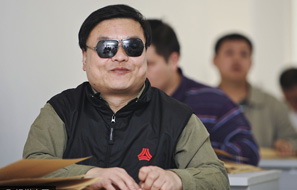
Yi Xiaoyuan had never been so "proud and nervous" in his life. On March 24, the 26-year-old computer science student looked on as the machine he had spent two years working on competed in its first "classical poem relay" at the Shanghai Science Hall.
He had come to think of Jiu Ge, the machine, as his "daughter" and was anxious to see how she would perform in front of a hall packed with reporters, professors and students.
Jiu Ge was competing against two Chinese poets in a contest that saw each side taking turns, using the last character from the previous verse to start their own line. Whoever was judged to have created the most beautiful verse in the shortest time would be crowned the winner.
Using advanced linguistic artificial intelligence created by Yi and his seven-member team, Jiu Ge analyzes and draws inspiration from a database of more than 300,000 Chinese poems. "She can copy their style, symbolism, and rhythm," Yi said.
After six verses, Jiu Ge was dominating. The audience watched in awe as the machine spat out lines filled with rhythm and symbolism within seconds, while the human poets struggled to keep up.
The battle was not over yet, however. On the seventh turn, one of the human competitors recited a seven-character verse that intertwined images of bridges, ancient alleys and the new moon.
The room felt silent - this was the most complex verse of the day, and its difficulty had Yi nervously tapping his finger on the arm of his wheelchair.
About three seconds later, Jiu Ge matched the verse with stanzas that evoked a rising moon, lofty towers and the North Star. The audience burst into applause and cheers, but Yi frowned.
The host, who was also the judge, said the computer's symbolism was weak. The two celestial symbols effectively canceled each other out because in classical Chinese culture, the moon symbolizes purity and modesty, while the North Star is imperial and authoritative.
"So the image painted by the verse is contradictory," he said.
Yi, backstage, said the judge had a point. "Although Jiu Ge can generate classical poems using the same wordplay and style as ancient poets, she still lacks the capacity to understand subtle human emotions and the logic that makes poetry so charming in the first place," he said.
Despite this hiccup, Yi said he was "very satisfied" with Jiu Ge's performance, as it was the machine's first time facing off against a human poet. "I am not someone who gives up easily," he said with a chuckle, while patting his wheelchair. "She should not give up either."
Yi was born into an ethnic Yi family in Yuxi, Yunnan province. Age 6, he developed rheumatoid arthritis and a rare bone disorder that stunted his growth, but he excelled at school.
In 2012, he attained the 16th highest score among the 210,000 students from Yunnan taking the national college entrance exam, landing him a place at Tsinghua University in Beijing. He chose to study computer science - one of the school's most prestigious but challenging majors, and is now a first-year master's student. "Disabled people don't just need money and sympathy, it's more important that we get the chance to create our own future and contribute to society," he said.
Yi wrote his bachelor's dissertation on Jiu Ge's algorithm, and he often spent days debugging the machine's artificial intelligence late into the night. Its name, Jiu Ge, is a reference to one of Yi's favorite classics of Chinese poetry, the anthology Chu Ci, from the Warring States Period (475-221 BC).
"Building an AI does feel like raising a daughter, because every piece of its needs to be created meticulously, or it will crash," he said, adding that he gets his sense of responsibility from his mother, who gave up her job as a nursing teacher to care for him in Beijing.
"My family means everything to me, as I am everything to Jiu Ge," he said.
"I want my baby to maximize her potential through deep learning, be free from her physical limitations, and become a sentient being capable of enjoying beautiful poetry, just like me."
zhangzhihao@chinadaily. com.cn




Copyright 1995 - . All rights reserved. The content (including but not limited to text, photo, multimedia information, etc) published in this site belongs to China Daily Information Co (CDIC). Without written authorization from CDIC, such content shall not be republished or used in any form. Note: Browsers with 1024*768 or higher resolution are suggested for this site.
License for publishing multimedia online 0108263 Registration Number: 130349