China's decision to relocate Beijing's non-capital functions to Xiongan New Area, which is home to Baiyangdian Lake, the largest freshwater body in North China, highlights the acute water shortage Beijing faces. This calls for special attention to the groundwater shortage.
China has 20 percent of the world's population but less than 6 percent of the groundwater. The overstressed North China aquifer serves 11 percent of the country's population, 13 percent of its agricultural production, and 70 percent of its coal production. The measures to solve China's water problems have so far been inadequate. The massive South-North Water Transfer Project has supplied Beijing with 2 billion cubic meters of Yangtze River water a year since 2014, but is not a long-term solution, say some Chinese scientists.
Desalination could be another solution. In coastal areas near Beijing, restrictions on extraction of groundwater for industrial use have been imposed to force desalination into the supply portfolio, but desalinated water has not been incorporated systematically into the municipal water systems. The resultant dependence on and over-extraction of groundwater are having severe impacts on Beijing, including subsidence. Long Di, a researcher at Tsinghua University's Institute of Hydrology and Water Resources, says: "Subsidence is a slow but progressive disaster, and it is irreversible. It can cause cracks in walls, roads, bridges, and underground municipal infrastructure."
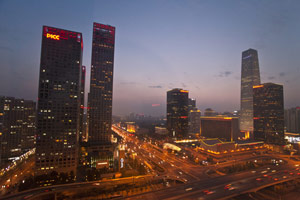
The problem is particularly acute in Chaoyang district, which borders Beijing's eastern suburbs - areas that are rapidly expanding with dense, high-rise buildings. In San Francisco, California, the case of a new luxury 57-floor building leaning several degrees only years after construction, due to poor foundation standards, illustrates the legal, financial and social challenges of building in areas with geo-technical instability. What makes the problem more challenging is that many buildings in Beijing's rapidly subsiding districts are far taller.
Water conservation is dependent as much on individual decisions as on national policymaking. One example is California's 2015 water shortage. California Governor Jerry Brown called for a statewide reduction in water usage of 25 percent in July 2015, and the state exceeded expectations by reducing usage of 31 percent. Much of this reduction came from changes in personal habits; fewer people watered their lawns and washed cars. California also encouraged municipalities to actively manage demand, and many imposed surcharges on individual users who exceeded stipulated limits. Indeed, academic studies have shown pricing to be a powerful water demand management tool.
China's demand profile for water does not closely resemble California's; both markets have high usage for agriculture (64 percent in China and 80 percent in California), but China's manufacturing activity as a share of economic output is larger than California's.
China must adopt a more aggressive volumetric pricing program, however, to manage demand, particularly for industrial users. On a per cubic meter basis, water tariffs on businesses and individuals are less than 12 percent those in Denmark and less than half of those in the developed world. China's implicit subsidization of water serves little purpose, least of all in prompting conservation and innovation.
China has made some efforts to address these challenges. The sponge-cities program, a modified version of low-impact development that focuses on permeable surfaces and water infrastructure, seeks to increase groundwater absorption. The central government has set a target for 80 percent of Chinese cities to meet sponge-city standards by 2030. This is a crucial step in aggressively addressing groundwater depletion in urban areas, including Beijing.
However, there appears to be a tepid appetite for private investment in these projects. More aggressive inducements are needed to prompt public-private partnerships for sponge-city development. Addressing the groundwater depletion problem - and in broader measure the growing crisis of water scarcity amid rapid urbanization - will require a multi-pronged approach that includes unequivocal political will, transparency regarding the impacts and costs of depletion, creative policy initiatives to manage demand, and support for technical innovations to improve usage efficiency. Both China's economic and environmental sustainability are at stake.
Asit K. Biswas is distinguished visiting professor at the Lee Kuan Yew School of Public Policy, National University of Singapore, and Kris Hartley is a lecturer in the Department of City and Regional Planning, Cornell University.




Copyright 1995 - . All rights reserved. The content (including but not limited to text, photo, multimedia information, etc) published in this site belongs to China Daily Information Co (CDIC). Without written authorization from CDIC, such content shall not be republished or used in any form. Note: Browsers with 1024*768 or higher resolution are suggested for this site.
License for publishing multimedia online 0108263 Registration Number: 130349